Part of SKAD HR Group — HR for every stage of business  ·  HRTailor.com  ·  HRTailor.AI

Author: Abhijit Divekar

  • Gratuity After 1 Year: Eligibility, Calculation and Employer Action Steps (2026)

    Gratuity After 1 Year: Eligibility, Calculation and Employer Action Steps (2026)

    Gratuity After 1 Year: Eligibility, Calculation and Employer Action Steps (2025)

    gratuity after 1 year under new labour codes

    Gratuity After 1 Year: What Most Employers Get Wrong in 2025

    Most employers believe gratuity is a “five-year problem.”
    That belief is quietly putting companies at risk in 2025.


    With labour enforcement becoming stricter and employee awareness rising, gratuity is no longer something that can be ignored during the early years of employment. The conversation around gratuity after 1 year under new labour codes is growing for one simple reason—many businesses are realising too late that gratuity exposure starts much earlier than they expected.


    This is not about changing the law overnight. It is about how the law is being interpreted, enforced, and challenged today.

    The Five-Year Rule Is Not the Safety Net Employers Think It Is

    Yes, the law still states that gratuity becomes payable after five years. However, courts and regulators are increasingly focusing on how service is defined, not just how long it lasted.

    Service does not mean uninterrupted physical attendance. It includes paid leave, weekly offs, holidays, sickness, and statutory absences. This definition of continuous service is where most disputes begin.

    When records are unclear, employers lose control of the narrative.

    Why Gratuity Disputes Are Rising Earlier Than Expected

    Gratuity-related issues now surface during:

    • Fixed-term contract closures

    • Early exits due to restructuring

    • Employer-driven terminations

    • Payroll and audit reviews

    In these cases, gratuity eligibility becomes a discussion point even when employment lasted less than five years. Employers who assumed gratuity was irrelevant at this stage often struggle to defend their position due to weak documentation.

    This is where “we never thought about gratuity yet” becomes a costly assumption.

    The Real Risk Is Not the Formula — It’s the Records

    The gratuity calculation itself is straightforward. What causes trouble is missing or inconsistent data.

    Incorrect wage structuring, unclear salary components, and poorly maintained service history create gaps that employees—and auditors—quickly notice. Once a dispute begins, fixing payroll history retroactively becomes nearly impossible.

    This is why gratuity compliance today is about preparation, not payout.

    What Smart Employers Are Doing Differently in 2025

    Forward-thinking companies treat gratuity as part of long-term workforce planning, not a future liability. They track service continuity from the first year and align gratuity readiness with payroll and exit processes.

    A simple internal HR checklist that reviews employment terms, attendance data, and payroll structure helps prevent most disputes before they start. Businesses that integrate gratuity into broader employee benefits India planning experience fewer surprises and stronger trust.

    Termination and Exit Processes Carry Hidden Risk

    Employee exits represent one of the highest compliance risk areas.

    Notice periods, severance calculations, final settlements, and statutory clearances vary widely across countries. What feels like a routine exit in one market may require multiple approvals or filings elsewhere.

    Companies that Expand Internationally sometimes apply home-country exit practices abroad, assuming consistency. This is where disputes, penalties, or reputational damage can occur if processes do not align with local law.

    Turning Gratuity From a Risk Into a Non-Issue

    As labour enforcement becomes more data-driven, managing gratuity casually is no longer safe. Structured statutory compliance support helps businesses stay audit-ready without increasing internal complexity.

    Team Management Services statutory compliance services help organizations maintain accurate records, align payroll data, and stay prepared for gratuity-related reviews at every stage of employment. Instead of reacting to disputes, businesses gain clarity and confidence.

    FAQs

    Yes, gratuity is a statutory requirement for eligible establishments. Employers must comply once the law applies to their organisation.

    Yes. Fixed-term employees may be eligible for gratuity even if they do not complete five years, depending on service conditions.

    Common mistakes include poor attendance tracking, unclear salary structure, missing service records, and delayed exit settlements.

    Because auditors do not check gratuity only at the payout stage. They review whether service continuity, wage structure, and payroll records are being maintained correctly from the start. If early records are weak or inconsistent, gratuity exposure becomes difficult to defend later, even if payment is years away.


  • Fixed-Term Employees Under the New Labour Codes: Gratuity After 1 Year + Equal Benefits Explained

    Fixed-Term Employees Under the New Labour Codes: Gratuity After 1 Year + Equal Benefits Explained

    Fixed-Term Employees Under the New Labour Codes: Gratuity After 1 Year + Equal Benefits Explained

    fixed-term employee gratuity

    Introduction

    Fixed-term employment is no longer a niche hiring model. Instead, in 2025, it has become a core workforce strategy across industries. As organisations increasingly rely on contract-based roles, regulators are paying closer attention to how fixed-term employees are treated—especially under the new labour codes that emphasise fairness, transparency, and equal treatment.


    As a result, one issue now draws consistent attention: fixed-term employee gratuity after 1 year. While many employers still assume gratuity applies only after long service, the rules for fixed-term roles work differently. Therefore, businesses must develop a clearer and more practical understanding of their obligations.

    Why Fixed-Term Employment Is Being Closely Reviewed

    The new labour codes aim to encourage workforce flexibility without compromising employee rights. For this reason, regulators now actively examine whether organisations extend fixed term employment benefits in line with statutory expectations.

    Consequently, companies can no longer treat fixed-term hiring as a workaround. Instead, they must demonstrate that contract-based roles follow the same compliance discipline as permanent employment, particularly when it comes to benefits, documentation, and exits.

    Gratuity for Fixed-Term Employees: The Practical Reality

    Unlike permanent roles, gratuity for fixed-term employees links directly to the contract period itself. Because of this, discussions around fixed-term employee gratuity after 1 year have gained momentum across HR and compliance circles. When a fixed-term contract ends, gratuity becomes payable on a proportional basis, even if the employee has not completed five years.

    Moreover, this approach reflects the intent of the labour codes—to prevent benefit exclusion based solely on employment structure. Employers who overlook this often face challenges during audits or employee exits.

    From a compliance standpoint, fixed-term employee gratuity after 1 year does not imply an early payout assumption. Instead, it highlights that gratuity liability begins with the contract, not with tenure length alone.

    Equal Benefits: What Parity Actually Means

    A central principle of the new labour framework is parity. Accordingly, fixed-term employees performing similar roles must receive benefits comparable to permanent employees. The comparison of equal benefits vs permanent employment is no longer theoretical; regulators now actively review it during inspections.

    In addition, parity extends beyond salary. It also covers working conditions, statutory benefits, and access to internal policies. Therefore, any visible imbalance can raise compliance concerns, especially when organisations renew contract roles repeatedly.

    Leave and Social Security: Where Gaps Commonly Appear

    Leave policies remain one of the most common risk areas. Fixed-term employees are entitled to leave parity, meaning leave accrual and usage should follow the same logic applied to permanent staff.

    At the same time, statutory coverage under social security laws must remain consistent throughout the contract period. When organisations allow gaps in contributions or documentation, employee complaints and regulatory follow-ups often follow.

    What Employers Need to Update Internally

    As enforcement becomes increasingly data-driven, organisations must review how they structure fixed-term roles internally. A timely HR policy update helps ensure appointment terms, payroll alignment, leave tracking, and exit processes remain consistent across employment types.

    When companies proactively align these elements, they reduce disputes and improve audit readiness. More importantly, they gain greater control over compliance outcomes.

    Managing Fixed-Term Compliance With Confidence

    The growing focus on fixed-term employee gratuity after 1 year reflects a broader shift in how employment compliance is viewed in India. Fixed-term roles offer flexibility; however, they also demand the same level of seriousness, accuracy, and preparedness as permanent employment. Managing these requirements informally is no longer safe, especially as audits, documentation checks, and employee awareness continue to rise.

    For this reason, structured statutory support has become essential. Team Management Services helps businesses manage fixed-term employment compliance with clarity and consistency—covering gratuity exposure, benefit parity, payroll alignment, and statutory records in line with current labour law requirements. By following updated labour codes and compliance best practices, TMS enables organisations to reduce risk, stay audit-ready, and operate with confidence. As a result, businesses can trust TMS to handle statutory compliance accurately while they focus on building a resilient and future-ready workforce.

    FAQs

    A fixed-term employee is hired for a specific period mentioned in the employment contract. Once the contract ends, the employment automatically concludes unless renewed, while statutory compliance continues during the contract period.

    Auditors usually review appointment letters, contract terms, payroll records, benefit parity, and exit documentation to ensure compliance with labour codes.

    The biggest risk is assuming fixed-term contracts reduce statutory obligations. In reality, gaps in benefit parity, payroll records, or exit documentation can trigger audits, penalties, or employee disputes.

    Align contracts, payroll, and benefits from day one and avoid informal or manual tracking.

  • Salary by the 7th Rule: Payroll Process Changes for Employers (2026)

    Salary by the 7th Rule: Payroll Process Changes for Employers (2026)

    Salary by the 7th Rule: Payroll Process Changes for Employers (2025)

    salary by 7th rule new labour code

    Why Salary Delays Hurt More Than We Admit

    For many employees, salary day is not just a date on the calendar. It is rent, school fees, groceries, and peace of mind. Even a one-day delay can quietly create stress that lingers far beyond payday. That emotional reality is exactly why the government tightened wage payment rules under the new labour framework. Employers are now expected to follow a stricter timeline. Payroll can no longer be casual or flexible. It must be precise, predictable, and documented. This is where the salary by 7th rule new labour code comes into focus.

    What the “Salary by the 7th” Rule Actually Means

    Under the Code on Wages, salary must be paid within a fixed number of days after the wage period ends. For most establishments, wages must be credited no later than the 7th day of the following month. For larger establishments with more complex operations, the law allows payment up to the 10th day. However, many organisations—especially in IT, ITES, and services—are aligning to the 7th as a standard best practice. This rule exists for one simple reason: timely wage payment is a worker’s right, not a favour.

    The law also makes it clear that:

    • Wages must be credited on time

    • Delays can attract penalties

    • Repeated violations can trigger inspections and disputes

    That changes how payroll teams need to operate.

    Why Employers Can No Longer Treat Payroll as “End-of-Month Work”

    Earlier, many organisations processed payroll after closing books, approving expenses, and reconciling data. Salary often came last. That approach no longer works.

    To meet the salary by 7th rule new labour code, payroll timelines must move forward. This means:

    • Attendance must close earlier

    • Leave data must be finalised on time

    • Payroll inputs cannot remain open till the last moment

    In short, payroll must become a planned process, not a rushed task.

    Payroll Timelines: What Needs to Change Internally

    To meet the deadline consistently, companies need tighter payroll timelines. A typical compliant cycle now looks like this:

    • Attendance and leave close by the last working day

    • Payroll inputs frozen within 1–2 days

    • Salary processing completed by the 4th or 5th

    • Bank file uploaded with buffer time

    • Salary credited well before the 7th

    This structure reduces last-minute errors and removes dependency on heroics from payroll teams. More importantly, it builds trust with employees.

    Payslip Compliance Is No Longer Optional

    Paying salary on time is only one part of compliance. Employers must also issue accurate payslips.

    Payslips must clearly show:

    • Basic pay and allowances

    • Deductions like PF and ESI

    • Net pay credited

    • Wage period details

    With stricter enforcement, missing or incorrect payslips can raise red flags during audits. Many disputes today start not because salary was unpaid, but because the payslip did not match the credit. That’s why payslip compliance must move alongside timely payment.

    IT and ITES: Why This Rule Matters Even More

    In IT and ITES companies, salary delays—however small—spread fast. Internal chats light up. HR inboxes overflow. Morale dips quietly.

    Most IT/ITES salary credit cycles already aim for early-month payments. However, informal flexibility is now replaced by a legal expectation.

    For these sectors, aligning payroll to the salary by 7th rule new labour code is not just compliance. It is reputation management.Employees today expect reliability. When salary arrives on time, month after month, it builds confidence in the organisation.

    Payroll SOPs: The Real Backbone of Compliance

    Rules alone don’t ensure compliance. Systems do.

    This is where a strong payroll SOP becomes essential. A good SOP clearly defines:

    • Cut-off dates for attendance and inputs

    • Approval responsibilities

    • Backup processes for holidays or bank delays

    • Escalation paths if timelines slip

    Without an SOP, payroll depends too much on individuals. With one, payroll becomes predictable and auditable. As enforcement tightens, documented processes matter just as much as actual payment.

    Common Employer Mistakes That Lead to Non-Compliance

    Despite good intentions, many companies still slip up. The most common reasons include:

    • Waiting for final approvals too long

    • Treating payroll as flexible when it is not

    • Not accounting for bank holidays

    • Missing coordination between HR and finance

    • Assuming one-day delays don’t matter

    Under the salary by 7th rule new labour code, even small delays can invite scrutiny. What felt harmless earlier now carries legal weight.

    How Employees Experience This Change

    From an employee’s perspective, this rule brings quiet relief. There is less anxiety. Bills can be planned. Trust improves. Even when salaries are modest, predictability creates emotional stability. That is the hidden impact of timely wage payment. It doesn’t show on balance sheets, but it shows in workplace culture.

    Why This Rule Is About Respect, Not Just Dates

    At its core, this rule is about respect for effort. People give their time and skills every day. Getting paid on time is the minimum acknowledgment of that contribution. The salary by 7th rule new labour code pushes employers to match professionalism with responsibility. It also nudges organisations toward better systems, clearer communication, and stronger payroll discipline.

    Conclusion: Compliance Is Easier When Payroll Is Structured

    Salary payment by the 7th is not a burden if payroll is planned properly. With the right timelines, systems, and SOPs, compliance becomes routine rather than stressful. At Team Management Services, we support organisations with statutory compliance services, payroll structuring, and process alignment under the new labour laws. Our focus is on making compliance practical, sustainable, and employee-friendly. Because when payroll runs smoothly, people focus on work—not on waiting for their salary.

    FAQs

    For most establishments, yes. Larger organisations may have time till the 10th, but many employers follow the 7th as a best practice.

    Even small delays can lead to complaints or inspections, especially if they happen repeatedly.

    Yes. Employers must issue clear and accurate payslips along with salary payment.


    By fixing payroll timelines, documenting payroll SOPs, and avoiding last-minute processing.

  • 48 Hours Weekly Limit: Shift Planning, Overtime and Compliance Tips (2026)

    48 Hours Weekly Limit: Shift Planning, Overtime and Compliance Tips (2026)

    48 Hours Weekly Limit: Shift Planning, Overtime and Compliance Tips (2025)

    48 hours weekly limit

    Introduction

    Managing employee working hours has become an important compliance priority for businesses in 2025. As organisations adopt flexible schedules, extended shifts, and continuous operations, labour authorities are paying closer attention to how working hours are planned and recorded.

    At the centre of this review is the 48 hours weekly limit. While the rule itself is not new, authorities now monitor it differently. Today, compliance depends on accurate records, consistent planning, and proper coordination between HR, payroll, and operations.


    Why Working Hour Compliance Is Under Greater Focus

    Recent labour reforms have strengthened how compliance is evaluated. Under the working hours new labour code, authorities rely on actual data rather than written policies alone. Attendance records, shift schedules, and payroll information are reviewed together to assess compliance.

    As a result, informal approvals or manual adjustments are no longer sufficient. Businesses must ensure that working-hour practices match documented policies across all systems.


    Shift Planning as the First Line of Compliance

    Most working-hour issues arise due to gradual changes in scheduling rather than intentional overuse. Ineffective shift roster planning can cause small daily excesses that add up over the week.

    Well-structured rosters typically include:

    • Clearly defined shift rotations

    • Planned weekly rest days

    • Balanced workload allocation

    When organisations follow these practices, they reduce compliance risk while supporting employee well-being and operational efficiency.

    Attendance and Overtime Must Stay Aligned

    Accurate records form the backbone of compliance.

    Weak attendance compliance creates inconsistencies that audits identify quickly.

    When attendance data does not align with payroll records, resolving concerns becomes difficult.

    Overtime also requires careful control. The overtime rules permit additional hours, but only within defined limits. Employers should approve overtime in advance, document it properly, and review totals regularly. Without these checks, overtime can unintentionally breach compliance requirements.

    Understanding the 4-Day Workweek Concept

    Compressed work schedules continue to generate interest across industries. However, the 4-day week 12 hours clarification makes it clear that fewer working days do not remove weekly hour limits.

    Longer daily shifts require structured planning, employee consent, and accurate tracking. When these elements are missing, flexible schedules can increase compliance exposure instead of reducing it.

    Aligning Systems for Consistent Compliance

    Compliance challenges rarely stem from a single error. Instead, they emerge when teams manage shift planning, attendance tracking, and payroll independently.

    When these systems work together, compliance becomes easier to manage and audit readiness improves.

    Applying the 48 hours weekly limit correctly allows businesses to grow without repeated corrective actions or operational disruption.

    Managing Fixed-Term Compliance With Confidence

    The renewed focus on the 48 hours weekly limit reflects a broader shift toward transparent and data-driven compliance. As regulatory scrutiny increases, informal tracking methods no longer provide adequate protection.

    While flexibility in work arrangements remains possible, organisations need proper planning, accurate records, and consistent internal processes to support it.

    This is where structured statutory support becomes essential. Team Management Services supports businesses by reviewing shift structures, improving record accuracy, and aligning internal processes with current labour law requirements. By following updated labour regulations and compliance best practices, TMS helps organisations reduce risk, remain audit-ready, and focus on operational stability and growth. Organisations that take a proactive approach not only meet compliance expectations but also create healthier and more reliable work environments.

    FAQs

    Yes. Overtime hours are included when calculating the total weekly working hours. Overtime cannot be used to exceed the weekly limit.

    Authorities review attendance records, shift schedules, and payroll data together. Any mismatch between these records can raise compliance concerns.

    Clear shift planning, automated attendance tracking, and alignment between HR and payroll systems offer the most reliable protection.

    Night and rotating shifts must still be planned so total weekly hours stay within limits. Shift timing does not change the weekly cap.

  • Labour Law Changes: What HR Must Update in 30/60/90 Days (Post-Codes 2026)

    Labour Law Changes: What HR Must Update in 30/60/90 Days (Post-Codes 2026)

    Labour Law Changes: What HR Must Update in 30/60/90 Days (Post-Codes 2025)

    labour law changes 2025 HR checklist

    What changed (and why it matters)

    India’s four consolidated labour codes moved into implementation mode with key provisions notified effective 21 November 2025, and enforcement is increasingly data-driven.

    That means HR can’t “catch up later” anymore—policies, payroll outputs, and records must match in real time. Use this labour law changes 2025 HR checklist to plan updates across 30/60/90 days without disrupting operations.

    As a result, one issue now draws consistent attention: fixed-term employee gratuity after 1 year. While many employers still assume gratuity applies only after long service, the rules for fixed-term roles work differently. Therefore, businesses must develop a clearer and more practical understanding of their obligations.

    Why Fixed-Term Employment Is Being Closely Reviewed
    • Old: Compliance often depended on paper files and manual registers. New: Authorities connect attendance, payroll, and statutory filings for faster verification.

    • Old: Wage timelines and disputes moved slowly. New: Online systems and complaint channels speed up escalation and follow-ups.

    • Old: Different teams owned different parts. New: HR must align processes end-to-end because gaps show up quickly in audits and exits.

    Who is impacted
    • Employers: Higher exposure if records conflict across systems.

    • HR teams: Ownership expands from policy to execution proof.

    • Payroll teams: Clean wage structure + accurate deductions + consistent payroll outputs matter more than ever.

    • Employees: Faster grievance routes increase expectations around timelines and fairness.

    What to do now (5-step checklist)
     

    This section is the working core of the labour law changes 2025 HR checklist—use it as your 30/60/90-day plan.

    1. 30 Days: Fix the basics
      Confirm wage structure, attendance capture, and statutory coverage. Assign one compliance owner per location/unit.

    2. 60 Days: Align systems and policies
      Build an HR compliance roadmap and ensure payroll + policy updates match what your payroll engine actually calculates.

    3. Standardise assets
      Create approved templates for appointment letters, policy acknowledgements, overtime approvals, and exit checklists. Keep one controlled version.

    4. Clean your records
      Consolidate employee master data, wage components, and statutory IDs. Ensure your documentation supports every payroll output.

    5. Stress-test compliance
      Run internal checks for audit readiness using sample cases (new joiner, overtime-heavy worker, resignation). Update your HR SOPs if gaps appear.

    Quick example

    A common audit trigger is mismatch: your policy says one thing, attendance shows another, and payroll pays something else. For example, if overtime approvals exist in emails but don’t reflect in payroll remarks or wage registers, the organisation spends time explaining instead of proving. With faster dispute tracking via government portals, small gaps escalate sooner than before.

    At the same time, statutory coverage under social security laws must remain consistent throughout the contract period. When organisations allow gaps in contributions or documentation, employee complaints and regulatory follow-ups often follow.

    Conclusion

    Labour law compliance in 2025 is no longer about reacting to notices or fixing gaps at the last minute. With post-code enforcement becoming more structured, HR teams must work with clear timelines, aligned systems, and documented processes. A phased 30/60/90-day approach helps organisations prioritise actions, reduce risk, and maintain control as expectations continue to rise.

    Team Management Services offers structured statutory compliance support to help organisations navigate these changes with confidence. From payroll alignment and policy updates to documentation review and audit readiness, TMS works closely with HR teams to ensure compliance practices remain accurate, consistent, and aligned with current labour laws. By partnering with experienced compliance specialists, organisations can stay focused on people operations while meeting regulatory requirements with clarity and discipline.

    FAQs

    No. Prioritise wage structure, attendance capture, and statutory coverage first, then move to policies and audit controls.

    Payroll exceptions, overtime patterns, exits, and record completeness—then fix root causes early.

    HR should first ensure that payroll data, attendance records, and statutory timelines align with each other. Most compliance issues in 2025 arise not from missing policies, but from mismatches between what payroll processes, what attendance records show, and what documentation states.

    Compliance works best when HR owns policy and documentation, while payroll owns execution and records. Gaps appear when responsibility is unclear.

  • 2-Day Full & Final Settlement: How to Prevent Delays and Complaints (2026)

    2-Day Full & Final Settlement: How to Prevent Delays and Complaints (2026)

    2-Day Full & Final Settlement: How to Prevent Delays and Complaints (2025)

    2-day full and final settlement rule

    Introduction

    Employee exits have become a sensitive compliance area in 2025. What was once treated as an internal administrative process is now closely monitored by labour authorities. Faster grievance systems, clearer timelines, and rising employee awareness have increased expectations around how organisations handle exits.

    At the centre of this shift is the 2-day full and final settlement rule. While many organisations are familiar with the concept, enforcement has become stricter. HR and payroll teams now need clear processes, system alignment, and defined accountability to avoid delays and complaints.

    What Changed and Why It Matters

    Labour departments have moved toward time-bound enforcement for exit settlements. Delays are no longer viewed as operational challenges; they are increasingly treated as compliance failures.

    Digital complaint portals allow employees to raise settlement-related grievances quickly. As a result, even short delays attract attention and require explanation.


    Old Rule vs New Rule
    • Earlier: Full and final settlements often took several days or weeks

    • Now: Authorities expect settlement completion within a clearly defined timeline

    • Earlier: Manual coordination between HR and payroll was common

    • Now: System-driven processing and documented workflows are expected

    • Earlier: Delays were resolved internally

    • Now: Delays can trigger formal complaints and follow-ups

    What to Do Now: 5-Step Checklist

    To meet the 2-day full and final settlement rule, organisations should treat exits as a structured workflow rather than an exception.

    1. Define a standard exit settlement timeline across all roles

    2. Maintain a clear F&F checklist for HR and payroll teams

    3. Align the resignation process with payroll cut-off dates

    4. Pre-define all settlement components, including recoveries

    5. Use payroll automation to reduce manual dependency and errors

    When these steps are followed consistently, settlement timelines become predictable and manageable.

    Quick Example

    An employee resigns on the 25th of the month with no pending assets or recoveries. HR completes documentation and approvals on Day 1. Payroll processes final dues, including leave encashment, on Day 2.

    The organisation meets compliance expectations, avoids escalation, and closes the exit smoothly.
    In contrast, missing approvals or delayed data sharing can push the settlement beyond timelines and trigger complaints.

    Why Delays Still Happen

    Most settlement delays are not intentional. They usually occur due to:

    • Unclear ownership between HR and payroll

    • Missing exit approvals or recovery details

    • Payroll cut-off conflicts

    • Manual calculations and last-minute corrections

    When organisations standardise exit processes, these issues reduce significantly.

    Why Exit Compliance Needs More Attention in 2025

    Exit-related complaints are among the fastest-growing grievance categories. Employees now understand their rights better and expect timelines to be honoured.

    The 2-day full and final settlement rule reflects a broader shift toward employee-centric compliance. Organisations that prepare in advance reduce disputes, improve trust, and stay audit-ready.

    Managing Exit Compliance With Confidence

    Handling exits efficiently requires more than reminders and follow-ups. Structured statutory support helps organisations align HR actions, payroll execution, and documentation under a single framework.

    Team Management Services supports businesses in managing exit compliance with accuracy and consistency. From payroll alignment and statutory documentation to process reviews and system setup, TMS helps organisations meet settlement timelines confidently while staying aligned with current labour laws.


    FAQs

    Delays can lead to employee complaints, labour department follow-ups, and audit observations, especially when no valid justification exists.

    Yes. The expectation applies to all types of employee exits, including resignations, contract completion, and terminations.

    Yes. All payable dues, including leave encashment, should be processed within the settlement period.

    No. Authorities review execution timelines and payment records, not just written policies.

  • India–Oman Trade Agreement Explained: What the 50% Indian Workforce Provision Means for Employers

    India–Oman Trade Agreement Explained: What the 50% Indian Workforce Provision Means for Employers

    India–Oman Trade Agreement Explained: What the 50% Indian Workforce
    Provision Means for Employers

    India Oman trade agreement workforce

    Introduction: A Workforce Shift Employers Can’t Ignore

    Global hiring strategies are evolving, especially in the Middle East. Companies operating in Oman are facing increasing pressure to balance local workforce policies with the need for skilled professionals who can support business growth. In this context, the recent India–Oman trade agreement has become a key topic of discussion among employers.


    This agreement is not just about trade. It directly influences how companies plan, structure, and execute their hiring strategies in Oman. For organisations already struggling with skill gaps, this development raises an important question: how can businesses respond without creating compliance risks?


    Understanding this shift early can make a major difference in how confidently employers move forward.

    What Is the India–Oman Trade Agreement Really About?

    The India–Oman Comprehensive Economic Partnership Agreement (CEPA) focuses on strengthening cooperation across trade, services, and professional mobility. While many headlines highlight tariff benefits, employers are more interested in what the agreement means for workforce planning.

    One of the most discussed elements is the provision that allows eligible companies to deploy a higher percentage of Indian professionals in Oman under defined conditions. This provision does not remove existing labour rules, but it does create a clearer framework for skilled hiring.

    For employers, this clarity opens new possibilities, but only if the agreement is understood correctly.

    Breaking Down the 50% Indian Workforce Provision

    The 50% provision has attracted attention because it signals increased flexibility in workforce composition. However, it is often misunderstood. The rule does not mean that any company can freely fill half its workforce with foreign employees.


    Instead, it applies to specific professional categories, skill-based roles, and structured employment models. Omanisation requirements continue to apply, and sector-specific rules remain firmly in place.


    The real value of the India Oman trade agreement workforce provision lies in structured access, not unrestricted hiring, which makes interpretation critical.

    Why Indian Talent Continues to Matter in Oman

    Oman’s economy depends heavily on specialised skills across sectors such as infrastructure, energy, IT, healthcare, and manufacturing. While local talent development remains a priority, certain technical and managerial roles still require international expertise.


    Indian professionals bring strong technical knowledge, project experience, and familiarity with regional work environments. Over the years, Indian professionals in Oman have supported complex projects and long-term operations across industries.


    The agreement recognises this reality, but employers must still decide how to use this access responsibly.

    How the Agreement Impacts Employer Hiring Strategy

    For employers, this agreement changes hiring conversations at a strategic level. Workforce planning now involves deeper evaluation of which roles genuinely require international expertise and how those roles align with local regulations.


    This shift also places greater importance on hiring quality rather than hiring speed. Employers are no longer just filling vacancies; they are building compliant, future-ready teams.


    This is where hiring Indian talent for Oman becomes a strategic decision rather than a tactical one.

    Compliance Remains Non-Negotiable

    Despite increased flexibility, compliance expectations have not been reduced. Employers must continue to follow Omanisation guidelines, employment regulations, and documentation standards.


    The agreement supports structured hiring but does not replace employer responsibility. In fact, greater flexibility often comes with closer scrutiny, especially for workforce composition.


    Employers who overlook this balance may face risks that could have been avoided with the right planning.

    Why Recruitment Expertise Matters More Than Ever

    Access to talent does not guarantee successful hiring. Employers still need to identify candidates who match role requirements, experience levels, and operational expectations in Oman.

    This is where cross-border recruitment for Oman plays a critical role. International recruitment is not just about sourcing candidates; it is about evaluating readiness, skill fit, and long-term suitability.

    With competition for skilled talent increasing, recruitment quality can directly impact business outcomes.

    Common Misinterpretations Employers Should Avoid

    Many employers assume that the agreement simplifies everything related to foreign hiring. In reality, the agreement simplifies access, not responsibility. It does not guarantee approvals, remove role restrictions, or eliminate workforce audits. These assumptions can lead to delays, rejections, or compliance challenges. Employers who move forward with clarity rather than assumptions are better positioned to succeed.

    A Practical Hiring Approach After the Agreement

    A structured approach works best in the post-agreement environment. Employers should first identify roles that genuinely require international expertise. Next, they should assess local availability before turning to international recruitment.

    Engaging experienced recruitment partners helps ensure candidate quality, realistic timelines, and alignment with workforce policies. This approach allows businesses to benefit from the agreement without unnecessary risk.

    At this stage, the India Oman trade agreement workforce framework becomes a planning tool rather than a headline statistic.

    Long-Term Workforce Planning Considerations

    Beyond immediate hiring needs, the agreement influences how companies plan for growth, expansion, and talent continuity. Employers who think long term will focus on building sustainable talent pipelines rather than short-term fixes.


    This includes investing in recruitment partnerships that understand both Indian talent markets and Oman’s employment landscape.

    Those who act early are more likely to stay ahead as demand increases.

    Conclusion: Turning Access Into Advantage

    The India–Oman trade agreement offers employers a structured opportunity to strengthen their workforce through skilled international hiring. However, the real advantage lies not in the percentage itself, but in how hiring decisions are made.


    The India Oman trade agreement workforce provision supports access to skills, but successful outcomes depend on informed recruitment strategies and responsible execution.


    This is where experienced recruitment partners add real value. Team Management Services (TMS)  supports foreign employers by providing international recruitment services that connect businesses with qualified Indian professionals suited for Oman-based roles. By focusing on role alignment, candidate quality, and practical hiring needs, TMS helps companies turn opportunity into sustainable workforce growth.

    In the end, informed hiring decisions will define who benefits most from this agreement.

    FAQs

    Yes. It is especially useful for companies planning their first hires in Oman, as it provides clearer workforce guidelines for skilled roles.

    No. Employers should review role requirements and compliance obligations before adjusting their hiring approach.

    It improves clarity in planning, but recruitment timelines still depend on role complexity, candidate availability, and documentation readiness.

    Demand for skilled Indian professionals is expected to increase, making early and well-structured recruitment more important.

    Ideally during workforce planning, so roles, timelines, and candidate profiles are aligned from the start.

  • Global Capability Center Setup Guide: A Practical Playbook for India

    Global Capability Center Setup Guide: A Practical Playbook for India

    Global Capability Centre Setup Guide: A Practical Playbook for India

    Global Capability Center setup guide

    Introduction

    Your leadership team has decided: India needs to be more than just a sales market. You want access to deep talent, sharper costs and true 24×7 capability. Everyone talks about Global Capability Centres in India, but the big question remains: where do we start and what do we do first? 


    Without a clear plan, GCC initiatives can stall in endless internal debates, suffer from rushed decisions on location or structure, or run into compliance surprises. However, when you treat the centre as a long-term strategic asset and follow a structured roadmap, you reduce risk and significantly increase the probability of success. 


    This Global Capability Centre setup guide walks through the journey from initial assessment to ongoing optimisation – focusing on what to do, in what order, and where companies commonly go wrong. Use it as a practical blueprint to frame your internal discussions and align leadership around a realistic, executable plan. 

    Table of Contents

    • What Is a Global Capability Centre? 
    • Why GCC Setup in India Needs a Clear Plan 
    • Key Benefits of Designing Your GCC the Right Way 
    • Global Capability Centre Setup Guide – Step-by-Step 
    • Common Mistakes to Avoid in GCC Setup 
    • Real-World GCC Setup Scenarios 
    • Conclusion & Call to Action 

    What Is a Global Capability Centre?

    A Global Capability Centre is a captive unit owned and controlled by the parent company, typically set up in a location like India to run critical business, technology and support functions. Instead of buying services from a third-party vendor, you build your own team and infrastructure. 


    These centres often handle product development, shared services, analytics, operations, finance, HR, compliance and more. Because the GCC is part of your own organisation, it reflects your culture, ways of working and long-term strategy. 

    In contrast to traditional outsourcing or BPO, a GCC is not just about cost. It is about building enduring capability where you control priorities, talent, knowledge and intellectual property. 

    How GCCs Evolved From Back Offices to Strategic Hubs

    Initially, many overseas companies came to India for “back office” work: data entry, simple support, basic finance processes. Over time, the talent market, infrastructure and operating models matured. Consequently, GCCs progressed from transactional work to high-impact roles in product engineering, digital transformation and analytics-led decision-making. 


    Today, a well-designed Global Capability Centre setup in India can act as an innovation engine, not just a cost centre. 

    Typical Functions Run From a GCC in India

    • Software engineering, product development and DevOps 
    • Data engineering, analytics, AI/ML and business intelligence 
    • Finance operations, controllership and FP&A 
    • Global HR operations, payroll and talent acquisition support 
    • Procurement, vendor management and supply chain planning 
    • Customer support, success and inside sales 

    Why GCC Setup in India Needs a Clear Plan

    Many organisations underestimate the complexity of setting up a GCC. The decision is usually strategic, but the execution is deeply operational. Therefore, treating it like a simple “office opening” often leads to delays, rework and unnecessary cost. 


    A clear plan helps you align stakeholders, make better trade-offs and avoid getting stuck between ambition and reality. 

    Compliance and Regulatory Confidence


    Firstly, you are creating a legal and operational footprint in a new jurisdiction. That means dealing with company incorporation, labour laws, tax registrations, data protection and local regulations. 


    If you improvise here, you risk non-compliance, delayed approvals or structures that are hard to unwind. A structured GCC setup playbook ensures that legal, tax and HR compliance decisions are made consciously and documented from day one. 


    Cost and Operational Efficiency 


    Your early choices – city, office model, hiring strategy, vendor ecosystem – have long-term cost implications. For example, focusing only on cheap rents while ignoring talent depth can slow hiring and push salaries up later. 


    In addition, decisions on org structure, process design and technology stack influence how lean or heavy your GCC will be over the next 3–5 years. Planning upfront helps you avoid expensive corrections. 

    Speed, Flexibility, and Scaling 


    You want to move fast, but you also want to scale sensibly. A structured approach balances both. 


    By sequencing decisions – first objectives, then design, then hiring and operations – you create a roadmap that allows for controlled speed. As a result, you can expand functions, add shifts or open satellite locations without repeatedly reworking the basics. 

    Key Benefits of Designing Your GCC the Right Way

    When you invest in good design, the payoff shows up for years. 


    • Stronger strategic alignment 
      A clear blueprint ties the GCC’s mandate to your global strategy, markets and product roadmap. Therefore, teams in India know exactly how they contribute to enterprise outcomes. 
    • Faster time-to-value 
      Because decisions on scope, talent and processes are made early, you avoid months of re-alignment later. As a result, your first waves of hiring start delivering impact quickly. 
    • Lower long-term operating cost 
      Thoughtful choices around location, org design and vendor mix help you avoid bloated structures and misaligned compensation. 
    • Better talent branding and retention 
      A well-structured GCC with clear career paths, leadership visibility and strong employee value proposition attracts and retains talent in a competitive market. 
    • Resilience and business continuity 
      Standardised processes, cross-training and distributed teams make your organisation more resilient to disruptions in any one geography. 

    If you want to see what “good” can look like, you can explore our Global Capability Centre services in India to understand how strategy, design and long-term HR operations come together. 

    Global Capability Centre Setup Guide – Step-by-Step

    The rest of this article focuses on execution: what to do, in what order, and what questions to ask at each stage. Think of it as a practical GCC setup playbook that you can map against your own context. 

    Step 1 – Discovery & Assessment

    Firstly, align on why you are setting up a GCC at all. This may sound obvious, but different leaders often hold different pictures in their heads. 


    Start by clarifying: 


    • Which functions and processes you want to bring into the GCC in the first 12–24 months. 
    • The expected headcount trajectory over 3–5 years. 
    • Budget, risk appetite and how success will be measured. 

    Next, link these choices to your global business strategy. Are you trying to accelerate product development? Improve customer support? Build a new analytics capability? A sharp answer here drives every subsequent decision. 


    Meanwhile, assess internal readiness. Do you already have leaders who understand India or similar markets? Are your global processes mature enough to be replicated or adapted? Honest assessment at this stage prevents misaligned expectations later. 

    Step 2 – Planning & Design

    Once you know why and what, you can design how. 


    Decide on structural questions such as: 


    • Entity structure vs a phased approach using a partner-led bridge model. 
    • Primary city (for example, Bengaluru, Hyderabad, Pune, Gurugram, Chennai) and potential satellite locations. 
    • Hybrid vs office-centric work model, and how that aligns with your functions and culture. 

    In addition, define your operating model and governance: 


    • Reporting lines between GCC leaders and global stakeholders. 
    • Decision rights for local leadership vs HQ. 
    • KPI frameworks and review rhythms. 

    An initial org design should cover leadership roles, critical early hires and how teams will interface with existing global units. If you’re not ready for a full-fledged entity, you can also start lean with our Employer of Record services in India and later transition into a GCC model once the case is proven. 

    Step 3 – Implementation & Setup

    This is where plans move into action. 


    Firstly, address the legal and infrastructure layer: 


    • Company incorporation (if chosen), statutory registrations and initial bank accounts. 
    • Office strategy – managed office, co-working or leased space – based on scale and flexibility needs. 
    • Technology stack: connectivity, security controls, collaboration tools and access to global systems. 

    Next, focus on people: 


    • Hire key leaders who understand both your global culture and the local talent market. 
    • Launch the first hiring wave for priority functions, balancing speed and quality. 
    • Define HR policies, compensation structures, benefits and performance frameworks that are competitive in India but aligned with your global principles. 

    Meanwhile, start consciously building culture. Simple practices like regular leadership visits, joint town halls, cross-location project teams and clear communication go a long way in making the GCC feel like part of “one company”, not a distant satellite. 

    Step 4 – Ongoing Management & Optimisation

    Once the centre is live, the real work of scaling and refining begins. 


    Firstly, track performance against the KPIs and SLAs defined earlier. Look at not just cost metrics, but also quality, speed, innovation and employee engagement.


    In addition, standardise and improve processes. Identify repetitive tasks that can be automated, knowledge that should be documented and skills that can be cross-trained across teams. Over time, this helps your GCC evolve from a cost-saving unit to a strategic value centre. 


    Finally, keep your India Global Capability Centre strategy dynamic. You may add new functions, open additional locations or elevate the centre’s role in transformation initiatives. Periodic reviews with global leadership ensure that the GCC continues to align with changing business priorities. 

    Common Mistakes to Avoid in GCC Setup

    Many GCCs run into trouble not because the model is wrong, but because the setup was rushed or incomplete. A few common pitfalls include: 


    • Choosing a location based only on salary cost 
      Ignoring talent depth, competition, infrastructure and ecosystem can make hiring and retention significantly harder. 
    • Underestimating compliance and regulatory complexity 
      Treating legal and tax decisions as an afterthought can lead to penalties, rework or structures that don’t scale. 
    • Copy-pasting HQ structures into India 
      Not adapting roles, org design and ways of working to the local context often results in confusion and inefficiency. 
    • Hiring leadership too late 
      Trying to run GCC setup from overseas without strong local leaders can slow decision-making and weaken culture. 
    • Neglecting culture and employer branding 
      In a competitive Indian talent market, a weak brand and unclear employee value proposition will hurt hiring and retention. 
    • Not planning for scale from day one 
      Designing everything for “today’s 30 people” without considering future growth leads to repeated re-organisation later. 

    Real-World GCC Setup Scenarios

    To make this more concrete, here are a few simplified scenarios that reflect what we see in practice. 

    1. US-based SaaS company building a 30–50 person GCC in Bengaluru

    A high-growth SaaS company wants to accelerate product development and customer support. Initially, they considered only outsourcing. However, they realised they needed tighter integration, shared product context and long-term ownership of IP. 


    By following a structured setup approach – with clear scope, phased hiring and strong local leadership – they went live with their first engineering squads and a small support pod within months. Over time, the GCC expanded into DevOps and customer success, becoming a key driver of product velocity. A partner like TMS supported them with early hiring, HR operations and ongoing payroll and compliance. 

    2. European manufacturing firm building a finance and analytics GCC in Pune

    This organisation already had scattered vendors handling finance and reporting. Data quality issues and inconsistent processes made group-level decision-making slow. They chose to consolidate finance operations and analytics into a single Global Capability Centre design and rollout. 


    Through structured assessment, they defined which processes to lift and shift, which to re-engineer and how to sequence migrations. As a result, the new centre delivered cleaner data, faster closes and better analytics insights, while also creating a pipeline of finance leaders familiar with group operations. 

    3. Global healthcare company setting up a compliance and R&D support GCC in Hyderabad

    Operating in a heavily regulated industry, this company wanted a centre that could combine compliance, documentation and R&D support. They were rightly cautious about data security, regulatory expectations and reputation risk. 


    By front-loading compliance design, implementing robust security controls and hiring experienced local leadership, they built a centre that met global standards and passed audits with confidence. Over time, the GCC extended into clinical data analysis and digital health initiatives, with Team Management Services helping across HR, payroll and on-ground staffing needs. 

    Conclusion

    Setting up a centre in India is no longer a question of “if” for many global organisations – it is a question of “how” and “when”. A clear Global Capability Centre setup guide and disciplined approach can dramatically reduce missteps, align stakeholders and accelerate value creation from your GCC. 


    Choosing between outsourcing, EOR and GCC is a strategic decision. However, once you decide that a GCC is the right path, execution quality becomes everything: the right scope, design, leadership, location and HR operations make the difference between a struggling unit and a high-performing global hub. 


    If you’re planning a GCC and want a structured, low-risk rollout, book a consultation with TMS and get a tailored roadmap for your India strategy – from early assessment and design through to hiring, HR, payroll and long-term optimisation. 

    FAQs

    India offers a deep talent pool, competitive costs and strong capabilities in technology, analytics, finance and operations. In addition, time-zone advantages and mature ecosystems in cities like Bengaluru, Hyderabad and Pune make India ideal for building scalable, high-impact capability centres.

    The first step is to clarify why you need a GCC and what you want it to own in the first 12–24 months. Once you align leadership on scope, headcount, budget and success metrics, it becomes much easier to choose location, structure and the right execution partners.

    Timelines vary, but a typical GCC can move from initial assessment to first teams going live in a few months. However, the overall duration depends on factors like legal setup, hiring complexity, technology integration and how quickly decisions are made across global stakeholders.

    Most organisations start with a focused set of functions—such as engineering pods, finance operations, analytics or shared services—where processes are reasonably defined. Once the first wave stabilises and trust is built, you can gradually expand into more complex or strategic work.

    Typical pitfalls include choosing a city only on cost, underestimating compliance requirements, delaying local leadership hiring, and copy-pasting HQ structures without adapting to India. As a result, hiring, retention and productivity can all suffer if design and governance are not planned upfront.

    TMS helps across the lifecycle—clarifying strategy, advising on location and structure, supporting early setup, and providing on-ground HR, staffing, payroll and compliance support as you scale. Therefore, your team can focus on building high-value capabilities while TMS helps keep the India operations stable and compliant.

  • Overtime Laws in India (2026): Overtime Pay Rules Under the New Labour Codes

    Overtime Laws in India (2026): Overtime Pay Rules Under the New Labour Codes

    Overtime Laws in India (2025): Overtime Pay Rules Under the New Labour Codes

    overtime pay rules in India 2025

    Introduction

    In 2025, overtime is no longer treated as an occasional adjustment made during peak workloads. Labour authorities now view overtime as a measurable indicator of how well an organisation manages working hours, payroll accuracy, and employee welfare.

    This shift has placed the overtime pay rules in India 2025 under closer scrutiny.

    For HR and payroll teams, the focus has moved from “whether overtime is paid” to “how overtime is approved, calculated, and recorded.”

    What Has Changed — and Why HR Teams Are Paying Attention

    Recent enforcement trends show that overtime is being reviewed alongside attendance, shift schedules, and payroll outputs. Authorities now look for consistency across these records rather than isolated explanations.

    Because systems are increasingly digital, discrepancies appear faster. As a result, overtime-related complaints and audit questions now surface earlier in the employment lifecycle.

    Digital complaint portals allow employees to raise settlement-related grievances quickly. As a result, even short delays attract attention and require explanation.


    Then vs Now: How Expectations Have Shifted

    Instead of long explanations, here’s how enforcement thinking has changed:

    • Earlier approach:
      Overtime approvals were informal, often based on operational need.

    • Current approach:
      Authorities expect documented approval and traceable records.

    • Earlier approach:
      Payroll teams corrected overtime errors later.

    • Current approach:
      Incorrect or delayed payments raise compliance concerns.

    • Earlier approach:
      Overtime stood alone as a payroll item.

    • Current approach:
      It is evaluated together with attendance and working-hour data.

    Who Feels the Impact First

    Overtime compliance touches multiple roles at once:

    • Employers carry financial and regulatory exposure.

    • HR teams manage approvals and policy clarity.

    • Payroll teams ensure accurate calculations and payouts.

    • Employees expect transparency and fairness.

    When accountability is unclear, overtime becomes one of the fastest sources of disputes.

    How Organisations Should Respond in 2025

    Instead of reacting to issues, organisations should redesign how they handle overtime under the overtime pay rules in India 2025.

    A practical response includes:

    • Defining which roles qualify for overtime clearly

    • Taking prior overtime consent before assigning extra hours

    • Applying a consistent OT calculation method across payroll cycles

    • Monitoring weekly hours to remain within the 48 hours cap

    • Reviewing trends, especially for shift workers overtime

    This approach helps prevent repeat errors rather than fixing them later.

    The organisation meets compliance expectations, avoids escalation, and closes the exit smoothly.
    In contrast, missing approvals or delayed data sharing can push the settlement beyond timelines and trigger complaints.

    A Simple Workplace Scenario

    Consider a logistics team working extended hours during seasonal demand. HR approves overtime in advance, attendance systems capture actual hours, and payroll processes payments at overtime double wages within the same cycle.

    Because approvals, records, and payouts align, the organisation avoids disputes and remains compliant.

    Why Overtime Still Causes Confusion

    Most overtime issues do not arise from intent to violate rules. They usually stem from:

    • Fragmented ownership between HR and payroll

    • Manual approvals without documentation

    • Inconsistent payroll logic

    When teams treat overtime as an exception rather than a process, the same issues resurface.

    Why Payroll Accuracy Matters More Than Ever

    Authorities now view overtime as part of payroll compliance, not just an HR activity. Any mismatch between hours worked, approvals granted, and payments made raises questions during inspections.

    For this reason, the overtime pay rules in India 2025 require organisations to manage overtime with the same discipline applied to wages and statutory deductions.

    Managing Overtime With Confidence

    The growing attention on overtime reflects a wider shift toward transparent, employee-focused compliance. Organisations that plan overtime carefully reduce disputes, protect productivity, and maintain trust.

    Team Management Services helps organisations manage overtime more effectively by aligning attendance tracking, approval processes, and payroll execution into a single, compliant workflow.

    With structured statutory compliance support, organisations can meet overtime requirements confidently while staying aligned with evolving labour laws.

    For this reason, the overtime pay rules in India 2025 require organisations to manage overtime with the same discipline applied to wages and statutory deductions.

    FAQs

    Eligibility depends on role definitions, wage structure, and applicable labour laws.

    Yes. Overtime pay is calculated on the employee’s ordinary rate of wages, not on the gross salary. This usually includes basic pay and certain allowances, as defined under applicable labour laws.

    Using inconsistent calculation methods or delaying overtime payments to future cycles often creates compliance and employee grievance risks.


    No. Overtime applies only when extra hours are assigned or approved by the employer. Voluntarily staying back without approval does not automatically qualify as overtime.

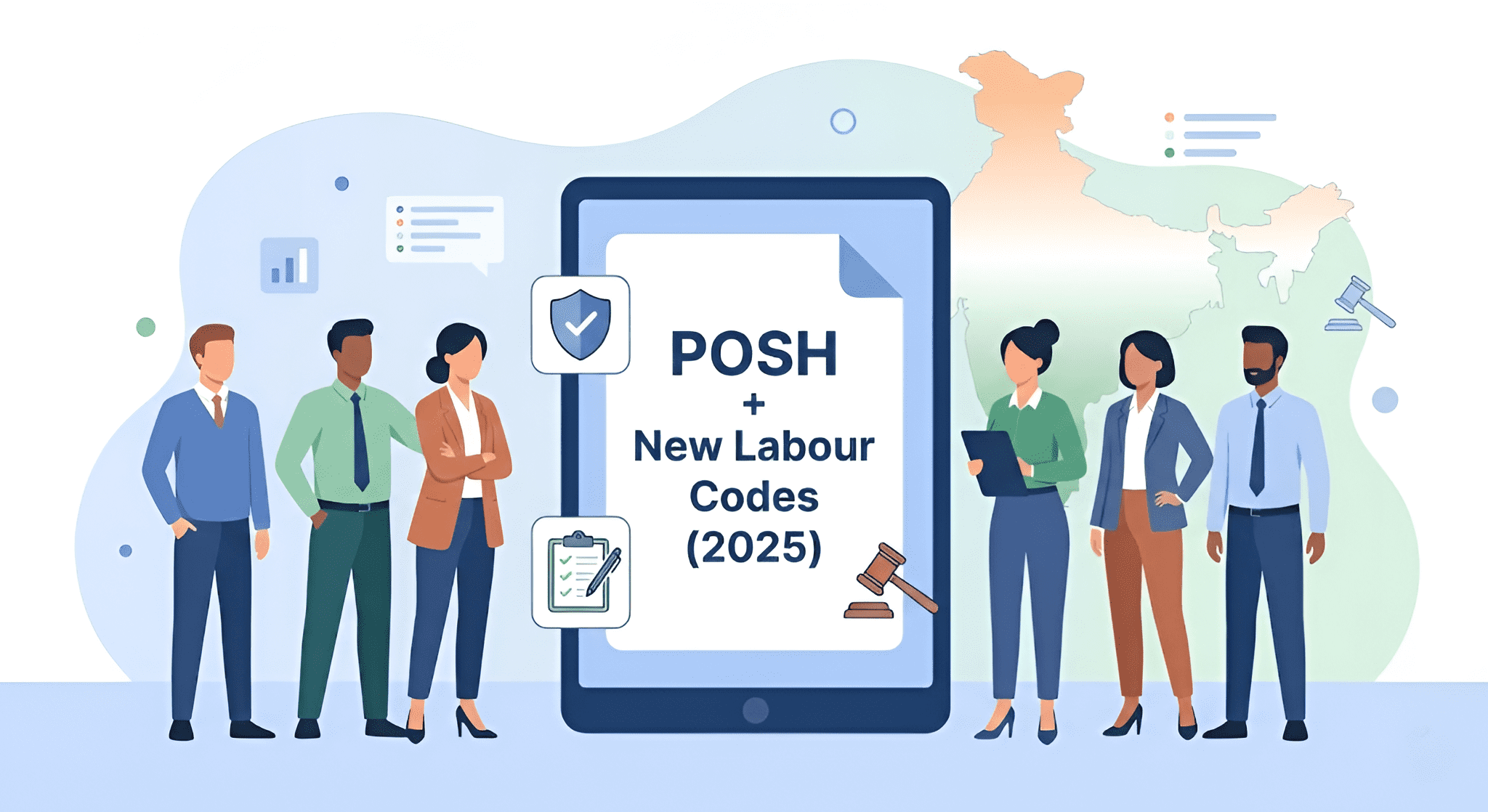
  • POSH + New Labour Codes (2026): A Single Compliance Framework for Safer Workplaces

    POSH + New Labour Codes (2026): A Single Compliance Framework for Safer Workplaces

    POSH + New Labour Codes (2025): A Single Compliance Framework for Safer Workplaces

    POSH and new labour codes compliance

    Introduction

    HR teams in 2025 face a different kind of compliance challenge. The focus has moved away from maintaining individual policies and toward ensuring that safety, conduct, and working conditions operate seamlessly across the organisation.

    As a result, POSH and new labour codes compliance is no longer managed in isolation. Authorities now expect these requirements to function as a unified framework that supports safer and more respectful workplaces.

    Why Integration Matters More Than Ever

    The new labour codes emphasise safe working environments, equal treatment, and employee welfare. These objectives directly support the intent of POSH legislation. In practice, regulators now look beyond policy documents to examine how safety and respect are implemented on the ground.

    One clear example is women night shift safety, where compliance depends on operational planning rather than written intent. Shift allocation, supervision, and employee confidence all contribute to how safety standards are evaluated.

    As enforcement becomes more practical and outcome-focused, POSH and new labour codes compliance is reviewed as a single framework rather than two separate obligations.

    Moving Beyond Policy Ownership

    Earlier, organisations focused on having policies in place. In 2025, authorities focus on awareness, behaviour, and response quality.

    A well-defined workplace conduct policy sets expectations clearly, but its real value lies in how consistently it is communicated and followed. Regulators increasingly assess whether employees understand reporting channels and whether managers actively support respectful conduct.

    This shift places accountability not just on HR, but also on leadership and line managers.

    Committees, Consent, and Operational Responsibility

    Strong POSH governance depends on effective internal mechanisms. Inspectors now review whether committees function independently, members receive training, and decisions are documented properly.

    Effective IC/ICC compliance requires more than formal constitution. It demands regular engagement, confidentiality, and timely action. Alongside this, labour codes require employers to manage operational safety risks, including consent + transport arrangements for employees working late hours.

    When these elements work together, organisations reduce exposure and build employee trust.

    Training and Complaint Handling as Proof of Intent

    Training has shifted from an annual checkbox to an ongoing responsibility. A defined training calendar helps organisations demonstrate continuous awareness across levels, including new joiners and managers.

    Equally important is a clear complaints process. Employees expect timely acknowledgment, confidentiality, and transparency. Delays or inconsistent handling often attract more scrutiny than the complaint itself.

    These factors explain why POSH and new labour codes compliance is now evaluated through execution rather than documentation alone.

    What This Means for Organisations in 2025

    Organisations that continue to manage POSH and labour codes separately risk gaps in execution. Those that integrate them benefit from clearer accountability, smoother audits, and stronger employee confidence.

    Viewed together, POSH and new labour codes compliance becomes a framework for safer workplaces, predictable processes, and credible governance.

    Managing Integrated Compliance With Confidence

    As compliance expectations continue to rise, informal practices no longer provide sufficient protection. Organisations now need structured systems that connect policies, training, internal committees, and day-to-day operational decisions into one coherent framework.

    Team Management Services supports organisations in building integrated compliance frameworks that address both labour code requirements and POSH compliance obligations. From POSH policy alignment and Internal Committee support to training programs, documentation review, and compliance readiness, TMS helps businesses implement statutory requirements with clarity and consistency.

    Conclusion

    When compliance is approached as an ongoing practice rather than a checklist, workplaces become safer and more resilient. Integrating POSH principles with labour code requirements helps organisations move from reactive issue-handling to preventive governance. In the long run, this alignment strengthens trust, supports employee well-being, and creates a workplace culture that can adapt confidently to evolving regulatory expectations.

    FAQs

    Yes. Organisations must maintain full POSH compliance at all times, including policies, committees, and training, even if no complaints have been reported.

    Training should be conducted regularly, especially for new joiners, managers, and committee members. One-time or outdated training is no longer considered adequate.

    Authorities increasingly review POSH compliance as part of overall workplace safety, dignity, and labour code enforcement rather than as a separate exercise.


    Organisations most often fall short due to gaps in execution, such as inactive Internal Committees, inconsistent training coverage, or incomplete documentation. Regulators now evaluate how effectively POSH processes operate in practice, not just whether policies exist.