Part of SKAD HR Group — HR for every stage of business  ·  HRTailor.com  ·  HRTailor.AI

Author: Abhijit Divekar

  • Setup India operations with TMS EOR in less than 30 days

    Setup India operations with TMS EOR in less than 30 days

    Setup India operations with TMS EOR in less than 30 days

    By Abhijit Divekar  •  Published: January 31, 2026  •  Updated: May 13, 2026

    Key Takeaway

    Foreign companies can begin hiring employees in India within 30 days through an Employer of Record (EOR) — without incorporating a local entity. An EOR handles payroll, statutory compliance (PF, ESIC, PT, gratuity), employment contracts, and tax filings while the client company retains day-to-day management of its team. This approach saves 4–6 months compared to entity setup and reduces upfront costs by 60–80%.

    Why Foreign Companies Are Choosing EOR to Enter India

    India is among the most attractive markets for global expansion. With over 1.4 billion people, a massive skilled talent pool, and competitive labour costs, European, American, and APAC companies are actively seeking ways to hire employees in India without setting up a local entity. However, the traditional route — incorporating a subsidiary through the Registrar of Companies (RoC), obtaining PAN/TAN registration, and setting up statutory accounts — takes 4 to 6 months and costs between INR 10–25 lakh in legal and compliance setup fees.

    An Employer of Record in India eliminates this entire process. The EOR acts as the legal employer on paper while the client company directs the employee’s daily work, projects, and performance. This model has gained significant traction since 2020, particularly among technology companies, consulting firms, and manufacturing businesses testing the Indian market before committing to a full entity.

    What Exactly Is an Employer of Record?

    An Employer of Record (EOR) is a third-party organisation that legally employs workers on behalf of another company. The EOR services in India model works as follows:

    • Legal employment: The EOR signs employment contracts with your India-based employees, making them legally compliant from day one
    • Payroll processing: Salary calculations, tax deductions (TDS), and bank transfers are managed monthly by the EOR
    • Statutory compliance: PF (Provident Fund), ESIC (Employee State Insurance), Professional Tax, Labour Welfare Fund, and gratuity provisions are all handled by the EOR
    • HR administration: Leave management, employee onboarding documentation, and exit formalities follow Indian labour law requirements
    • Day-to-day control: The client company assigns work, manages performance, and makes all operational decisions about the employee

    This arrangement differs from a staffing agency or PEO. In a dedicated EOR arrangement, the service provider takes on full legal employer liability, whereas a PEO co-employs workers alongside the client and typically requires an existing local entity.

    The 30-Day EOR Setup Timeline

    One of the most common questions from companies evaluating EOR India services is how quickly they can get started. Below is a realistic week-by-week timeline for setting up India operations through an EOR partner:

    Week Activity Responsibility Deliverable
    Week 1 Service agreement, scope definition, compliance review EOR + Client Signed EOR agreement
    Week 2 Employment contracts drafted, offer letters issued, PF/ESIC registration for employees EOR India-compliant employment contracts
    Week 3 Employee onboarding, KYC verification, bank account setup, IT asset coordination EOR + Employee Employee onboarded and active
    Week 4 First payroll cycle setup, statutory deposit schedule confirmed, reporting dashboard access EOR Payroll ready, compliance active

    Compare this with entity setup, which involves 8–12 weeks for RoC registration alone, followed by another 4–6 weeks for PAN, TAN, GST, bank account opening, and Shops & Establishments registration. The EOR approach compresses months of bureaucracy into a streamlined 30-day process.

    Entity Setup vs EOR: A Detailed Comparison

    For companies evaluating whether to establish a subsidiary in India or use an Employer of Record service, the decision involves cost, speed, risk, and long-term strategy. Here is a side-by-side comparison:

    Factor Entity Setup (Subsidiary) EOR Model
    Time to hire 4–6 months 2–4 weeks
    Setup cost INR 10–25 lakh (legal, accounting, compliance) Zero setup cost; monthly per-employee fee
    Compliance burden Client manages PF, ESIC, PT, TDS, annual returns EOR handles all statutory compliance
    Legal liability Client bears full employer liability EOR assumes legal employer responsibility
    Scalability Slow — each new state may need additional registrations Immediate — hire in any Indian state through EOR
    Exit strategy Company closure takes 6–12 months Simply end the EOR agreement (notice period applies)
    Permanent Establishment risk Subsidiary creates PE by design Properly structured EOR minimises PE risk
    Best suited for 50+ employees, long-term India commitment 1–50 employees, market testing, rapid scaling

    Statutory Compliance Handled by the EOR

    India’s labour compliance framework is one of the most complex in Asia. Every employer — including foreign companies — must comply with central and state-level labour laws. When you use EOR services in India for foreign companies, the EOR handles all of the following:

    • Provident Fund (PF): 12% employer contribution + 12% employee contribution under the Employees’ Provident Fund and Miscellaneous Provisions Act, 1952. Applicable when the establishment has 20+ employees.
    • Employee State Insurance (ESIC): 3.25% employer + 0.75% employee for workers earning up to INR 21,000/month. Provides medical, disability, and maternity benefits.
    • Professional Tax (PT): State-level tax varying from INR 150–300/month depending on the state. Maharashtra, Karnataka, Tamil Nadu, and Telangana all have different slabs.
    • Tax Deducted at Source (TDS): Monthly income tax withholding as per applicable slab rates under the Income Tax Act, 1961.
    • Gratuity: Payment of Gratuity Act, 1972 requires employers to pay 15 days’ wages for each year of service upon completion of 5 years.
    • Labour Welfare Fund (LWF): Semi-annual or annual contributions varying by state — INR 6–50 per employee in most states.
    • Shops & Establishments Act: State-specific registration covering work hours, overtime, leave entitlements, and holiday provisions.

    Without an EOR, a foreign company would need to independently register for each of these, file monthly and annual returns, and stay updated on regulatory changes across 28 states and 8 union territories. Learn more about statutory compliance requirements in India.

    Why EU Companies Are Accelerating India Expansion

    The EU-India strategic partnership has gained significant momentum. With ongoing Free Trade Agreement negotiations and mutual interest in diversifying supply chains away from single-source dependencies, European companies are actively expanding their India presence. Key drivers include:

    • Talent access: India produces over 1.5 million engineering graduates annually, with strong capabilities in IT, data science, finance, and life sciences
    • Cost advantage: A qualified software engineer in India costs 60–70% less than an equivalent hire in Germany, France, or the Netherlands
    • Time zone overlap: India Standard Time (IST) overlaps with 3–4 hours of European business hours, enabling same-day collaboration
    • Market potential: India’s GDP growth of 6.5–7% annually makes it both a talent source and a consumer market worth entering
    • Digital infrastructure: UPI, Aadhaar, and DigiLocker have created a digitally advanced compliance and payments ecosystem

    For companies that want to begin with 2–10 employees to test the market, the EOR model provides a risk-free entry point. Once the team grows beyond 50 employees, many companies transition to a fully owned subsidiary while the EOR continues handling compliance during the transition period.

    How to Choose the Right EOR Partner in India

    Not all employer of record services in India are equal. When selecting an EOR partner, evaluate these five factors:

    1. Local Compliance Expertise

    The EOR should have direct experience with Indian labour laws — not just a network of subcontractors. Ask whether they file PF/ESIC returns in-house or outsource this to another firm. An EOR that handles compliance internally reduces risk and ensures faster resolution of queries.

    2. Multi-State Capability

    India’s labour laws vary significantly by state. Professional Tax slabs differ, Shops & Establishments Act requirements change, and LWF contribution rates are state-specific. Your EOR should have registrations and operational capability across all major states — not just the metro cities.

    3. Transparent Pricing

    EOR pricing in India typically ranges from USD 150–400 per employee per month, depending on the scope of services. Clarify what is included: payroll processing, compliance filings, employee benefits administration, onboarding/offboarding, and HR support. Watch for hidden fees around statutory registrations or employee terminations.

    4. Data Security and IP Protection

    Ensure the EOR has robust data handling practices. Employment data, salary information, and employee personal details must comply with India’s Digital Personal Data Protection Act (DPDPA) 2023. Additionally, confirm that intellectual property clauses in the employment contract clearly assign IP rights to the client company.

    5. Transition Support

    The best EOR partners help clients plan the eventual transition from EOR to entity when the time is right. This includes employee transfer processes, gratuity and PF account continuity, and ensuring zero disruption to employees during the changeover. TMS provides end-to-end EOR services with built-in transition support for companies planning long-term India operations.

    Common Concerns About EOR — Addressed

    Does EOR create Permanent Establishment risk?

    When structured correctly, EOR does not create a Permanent Establishment (PE) for the foreign company. The EOR is the legal employer, and the foreign company does not have a fixed place of business in India. However, this depends on the specific activities performed and the applicable Double Taxation Avoidance Agreement (DTAA) between India and the home country. Always consult a tax advisor for your specific situation.

    Can employees be promoted or given stock options through EOR?

    Yes. The EOR can implement salary changes, designation updates, and bonus structures as directed by the client company. ESOPs issued by the foreign parent company can be granted to EOR-employed staff, though the tax treatment of ESOP exercises in India must be handled correctly.

    What happens if the employee relationship does not work out?

    The EOR manages the entire separation process in compliance with Indian labour law. This includes serving appropriate notice periods, calculating full and final settlement (including gratuity if applicable), and ensuring all statutory filings are completed. The client company makes the termination decision; the EOR executes it legally.

    Frequently Asked Questions

    How can a foreign company hire employees in India without setting up an entity?

    A foreign company can hire employees in India through an Employer of Record (EOR). The EOR becomes the legal employer and handles all payroll, statutory compliance (PF, ESIC, Professional Tax), employment contracts, and tax filings. The foreign company manages the employee’s daily work and performance without needing to incorporate a subsidiary, register for GST, or obtain a local PAN. This allows companies to start hiring within 2–4 weeks.

    How much does EOR cost in India per employee per month?

    EOR services in India typically cost between USD 150 and USD 400 per employee per month, depending on the service scope. Basic packages include payroll processing and statutory compliance, while comprehensive packages add benefits administration, onboarding support, and dedicated HR coordination. There are usually no upfront setup costs, and pricing is based on headcount rather than employee salary levels.

    What statutory benefits does an EOR handle in India?

    An EOR in India handles all employer statutory obligations including Provident Fund (12% employer contribution), Employee State Insurance (3.25% employer contribution for eligible employees), Professional Tax (varies by state), TDS on salary, gratuity provisions, Labour Welfare Fund contributions, and compliance with the Shops & Establishments Act. The EOR also files monthly and annual returns with EPFO, ESIC, and the Income Tax Department.

    How quickly can I hire through an EOR in India?

    Most EOR providers can onboard employees within 2 to 4 weeks from signing the service agreement. The first week involves contract finalisation, the second week covers employment documentation and statutory registrations, and by the third week, the employee can begin work. The first payroll cycle typically runs in week four. This compares favourably to the 4–6 months required for entity incorporation.

    Is EOR better than setting up a subsidiary in India?

    EOR is better for companies hiring 1–50 employees, testing the Indian market, or needing to start quickly. It offers zero setup costs, full compliance coverage, and easy exit. A subsidiary becomes more cost-effective when headcount exceeds 50, the company needs a permanent legal presence, or specific business activities require entity-level licenses. Many companies start with EOR and transition to a subsidiary as their India team grows.

    Conclusion

    Setting up India operations no longer requires months of legal paperwork and significant upfront investment. With an experienced Employer of Record in India, foreign companies can hire compliant employees within 30 days, access India’s vast talent pool, and maintain full operational control — all while the EOR handles the complexities of Indian labour law.

    Whether you are a European company responding to EU-India trade opportunities, a US firm building a global capability centre, or an APAC business scaling your India team, the EOR model provides a proven, low-risk path to expansion.

    Contact TMS today to discuss your India expansion timeline and receive a customised EOR proposal within 48 hours.

    Last Updated: March 2026

    Hire in India Without an Entity?

    TMS EOR lets foreign companies hire Indian employees compliantly — no entity setup required. Payroll, EPF, ESIC, contracts & HR ops managed end-to-end. Start hiring in 2–4 weeks.

    View EOR ServicesBook Free Consultation EOR Pricing GuideEOR vs Entity SetupGCC Setup India

    About the Author

    Abhijit Divekar

    Abhijit Divekar is the Managing Partner of Team Management Services (TMS), with 19+ years of experience in HR outsourcing, contract staffing, and statutory compliance across India. He has helped 450+ companies build compliant, scalable workforces.

  • Why selling Goods & Services to the Largest Democracy should be your Next Move after EU-INDIA FTA?

    Why selling Goods & Services to the Largest Democracy should be your Next Move after EU-INDIA FTA?

    Why selling Goods & Services to the Largest Democracy should be your
    Next Move after EU-INDIA FTA?

    EU-INDIA FTA

    Introduction

    Some markets announce themselves loudly. Others wait patiently until the world is ready to listen. India has always been present in global conversations. It was discussed as a future opportunity, a complex economy, a market that required time and patience. Yet today, the tone has changed. India is no longer a market of tomorrow. It is a market of now.


    With the signing of the trade agreement between India and the European Union, companies across the world are rethinking their growth strategies. The agreement is not just about exports and imports. It is about access, trust, and long term collaboration. If you are a business leader wondering where your next phase of growth will come from, this moment deserves attention. Especially if your business sells goods or services that thrive in large, diverse, and fast moving economies.

    Understanding What This Moment Really Means

    Before deciding where to move next, it helps to understand why this agreement matters. The EU-INDIA FTA represents years of negotiation aimed at improving trade, investment, and economic cooperation. It focuses on reducing trade barriers, improving regulatory alignment, and encouraging deeper engagement across sectors.


    What makes this agreement special is its scope. It does not only cover physical goods. It also opens doors for services, digital offerings, professional expertise, and long term partnerships. For businesses, this creates a rare combination. A large market with improved access, supported by policy clarity and growing global confidence.

    India Is Not Just Big. It Is Proven.

    Size alone does not make a market attractive. Trust does. India has proven itself repeatedly over the past decade. Global companies have entered cautiously, tested the waters, and then expanded significantly. Technology platforms built millions of users. Enterprise software companies scaled teams across cities. Consumer brands created loyal customer bases.


    India did not just consume these products and services. It adapted them, integrated them, and made them part of daily life. This matters because India rewards commitment. Companies that invest in understanding the market often see long term returns. Growth may not always be instant, but it is resilient. Selling into India today means engaging with a market that understands global products, values innovation, and responds strongly to quality and reliability.

    Why the Largest Democracy Matters for Business

    India is the world’s largest democracy, and that matters more than many realize. Democratic systems create accountability. They build institutions. They encourage long term policy stability. Over time, they create an environment where businesses can plan with greater confidence. India’s regulatory framework continues to evolve, but its direction is clear. Transparency is improving. Digital systems are expanding. Compliance processes are becoming more structured. For companies selling goods and services, this creates an environment where scale and structure can coexist. It allows businesses to build not just revenue, but reputation.

    From Trade Access to Market Belonging

    Trade agreements open doors. Presence keeps them open. Many companies begin by exporting into India. This is often the first step. However, companies that succeed tend to go further. They establish local support, build teams, listen to customers closely. Selling services especially requires proximity. It requires understanding local needs, responding quickly, and adapting offerings over time. Goods may cross borders easily, but trust does not. Trust is built through people. This is where many companies pause. They see the opportunity but hesitate at execution.

    The Real Barriers Businesses Face

    India is welcoming, but it is also structured. Employment laws are detailed. Payroll and statutory requirements are precise. Compliance is taken seriously. These realities can feel overwhelming for companies unfamiliar with the environment. Setting up a legal entity takes time. Managing local hiring requires knowledge. Mistakes can be costly, both financially and reputationally. Yet avoiding the market entirely carries a different cost. Missed opportunity. This tension between ambition and caution is where many growth decisions stall.

    Why Timing Matters More Than Ever

    Economic windows do not stay open forever. The EU-INDIA FTA has created momentum. It signals trust between economies and encourages companies to act. Early movers often benefit from less competition and stronger positioning. India moves quickly. Talent markets evolve. Customer expectations rise. Businesses that enter earlier tend to shape conversations rather than react to them. Waiting does not always mean safer. Sometimes it means slower.

    Selling Services to India Is a Growth Multiplier

    While goods often lead the conversation, services deserve equal attention. India’s services sector is expanding rapidly. Demand exists across technology, consulting, engineering, financial services, education, and digital platforms. Businesses offering expertise, platforms, or specialized solutions often find strong traction. Services require presence. They require relationships and they require ongoing engagement. Companies that understand this build teams locally. They empower people who understand the culture and customer expectations. Over time, this creates differentiation that is hard to replicate.

    A Smarter Way to Enter the Market

    Many companies are now choosing flexibility over permanence at the start. Instead of establishing a legal entity immediately, they hire local talent through an Employer of Record. This allows them to operate legally while testing the market. Under this model, employment contracts, payroll, statutory benefits, and compliance are managed locally. The business retains full operational control. This approach reduces risk. It preserves speed. It allows companies to learn before committing fully. For businesses entering India after the EU-INDIA FTA, this model aligns well with both opportunity and caution.

    Why India Rewards Commitment

    India notices who shows up. Companies that invest in people, processes, and presence often see loyalty in return. Customers value reliability. Partners value consistency. Employees value growth. This creates a virtuous cycle. Presence builds trust. Trust builds scale. Scale builds sustainability. Selling into India becomes easier when the market sees you as part of its ecosystem rather than an external supplier.

    Looking Beyond Short Term Gains

    India is not a market for quick wins alone. It is a market for long term thinkers. Businesses that succeed often do so because they approach India with respect and patience. They adapt offerings, listen closely, invest steadily. The EU-INDIA FTA makes this journey more accessible, but mindset remains crucial. Those who see India as a partner rather than a transaction tend to build something lasting.

    Conclusion

    Selling goods and services to the world’s largest democracy is no longer a distant ambition. It is a realistic next step for businesses ready to grow thoughtfully. India offers scale, resilience, and opportunity. The policy environment is improving, market is proven,  demand is real. The question is not whether India is ready. It is whether your business is.

    At Team Management Services, we support companies entering India by providing Employer of Record Services that simplify local hiring, payroll, and compliance. We help businesses build teams confidently, without unnecessary complexity, so they can focus on serving the market and growing sustainably. Growth feels different when it is grounded in understanding. With the right structure, India becomes not just a market you sell to, but a place where your business truly belongs.

    FAQs

    Yes. India has strong demand for both goods and services, especially in technology, consulting, and digital solutions.

    No. Many companies begin by hiring locally through an Employer of Record.

    Hiring can typically be completed within a few weeks when using an EOR model.

    Yes. The employment contract clearly states the EOR as the legal employer, which is standard and widely accepted.

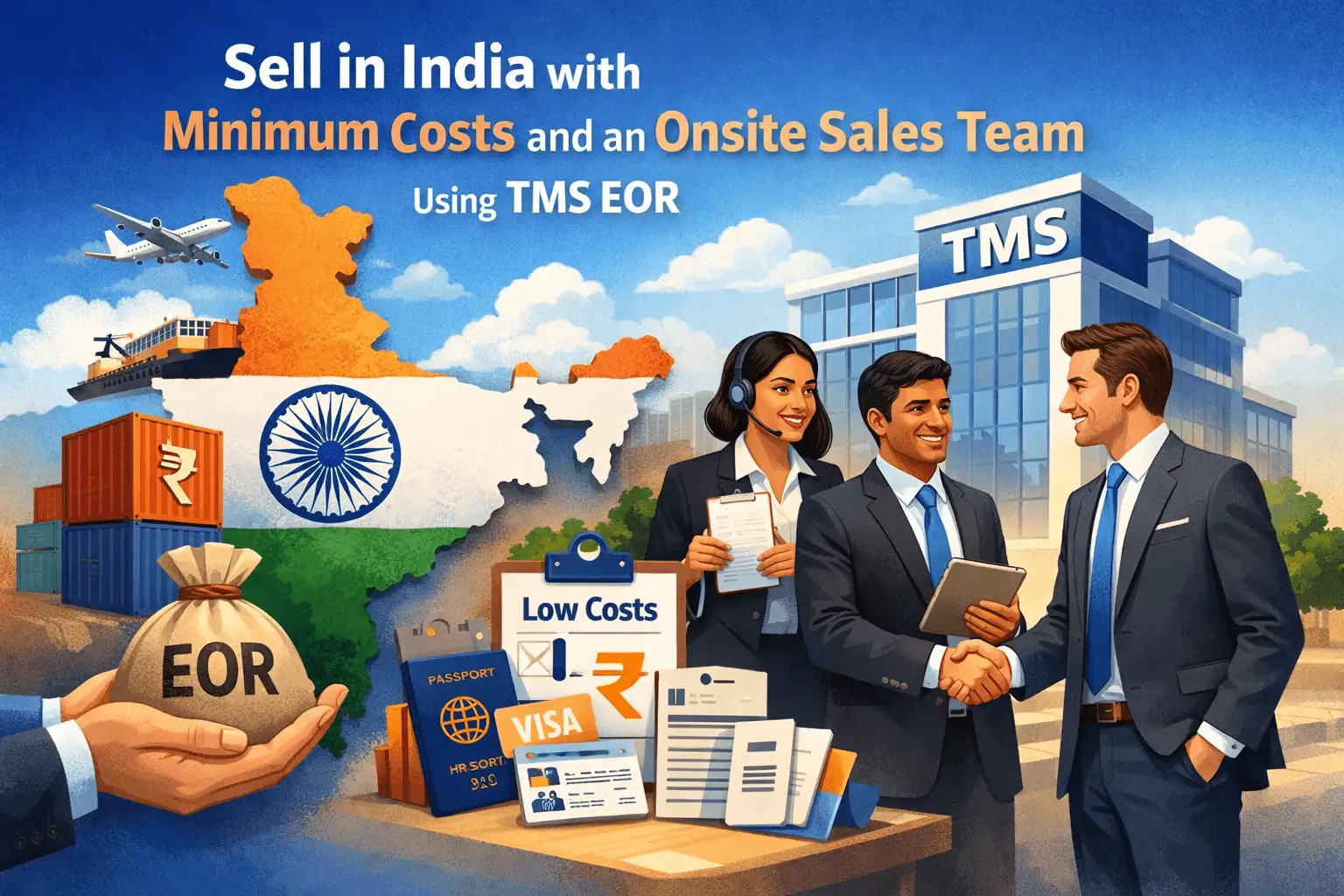
  • Sell in India with Minimum Costs and an Onsite Sales Team Using TMS EOR

    Sell in India with Minimum Costs and an Onsite Sales Team Using TMS EOR

    Sell in India with Minimum Costs and an Onsite Sales Team Using TMS EOR

    sell in India without entity

    Introduction

    For many international companies, India is no longer a market of curiosity. It is a market of intent. Demand is visible, customers are receptive, and growth potential is clear. Yet despite this, companies often hesitate to take the first step, not because of lack of opportunity, but because the cost and complexity of entry feel disproportionate to the risk they are willing to take.


    This hesitation usually stems from one assumption: that selling in India requires setting up a full local company before a single conversation with customers can begin. In reality, this assumption delays revenue, inflates costs, and limits flexibility at the very stage where agility matters most.

    Today, more companies are choosing a different path, one that allows them to test demand, build local sales presence, and generate revenue before making structural commitments.

    Why Selling Comes Before Setting Up

    In early-stage market entry, revenue is more valuable than infrastructure. Before investing in offices, registrations, and long-term overheads, companies need answers to simpler but more critical questions. Is there demand for our product or service? How long is the sales cycle? What pricing works locally? Who are the real decision-makers?


    These answers do not come from spreadsheets. They come from conversations on the ground.


    That is why many global businesses now choose to sell in India without entity formation as their first step. This approach allows companies to validate the market while keeping costs tightly controlled.

    The Cost Problem That Stops Companies from Entering India

    Traditional entry models front-load costs. Legal fees, compliance setup, accounting structures, and administrative staffing are required long before revenue materializes. For sales-led expansion, this creates a mismatch between investment and return.


    For leadership teams, the concern is not whether India will work in the long run, but whether it will work soon enough to justify early spend. When entry costs are high, even promising markets feel risky.


    Lowering the cost of entry changes the equation entirely. It allows companies to focus spending where it matters most: customer acquisition.

    Why an Onsite Sales Team Makes the Difference

    India is a relationship-driven market. Buyers expect local presence, contextual understanding, and responsiveness that remote sales models struggle to deliver. While digital outreach plays a role, closing deals often requires people on the ground who understand local buying behavior and decision cycles.


    An onsite sales team provides credibility, speed, and market intelligence that cannot be replicated from outside the country. The challenge has always been how to build such a team without committing to a full entity too early.


    This is where modern employment models enable a more flexible approach.

    How Companies Sell in India Without an Entity

    It is entirely possible to hire and deploy a local sales team in India without establishing a legal entity, provided employment and compliance are handled correctly. Through an Employer of Record model, companies can legally employ sales professionals who operate locally while remaining fully aligned with the global organization.

    This makes it possible to sell in India without entity registration, while still maintaining a strong, credible presence in the market. Sales teams can meet clients, attend industry events, and actively build pipelines, all without the company bearing the upfront burden of incorporation.

    The Role of TMS EOR in Sales-Led Market Entry

    Team Management Services EOR enables companies to hire onsite sales professionals in India quickly and compliantly by operating through an established EOR in India framework. Employment contracts are structured under Indian labor laws, payroll and statutory obligations are managed locally, and employees work exclusively for the client company.

    From a business perspective, this allows leadership teams to focus on sales strategy, customer engagement, and revenue generation, rather than administrative complexity. The sales team feels local to the market while remaining fully integrated into the company’s global operations. This structure supports rapid entry while preserving strategic optionality.

    Selling First, Deciding Later

    One of the biggest advantages of a sales-first entry model is flexibility. Companies are not locked into long-term commitments before understanding the market. Instead, they gain time and insight.


    As sales activity progresses, patterns emerge. Deal sizes become clearer. Customer expectations reveal themselves. Leadership can then decide, based on evidence, whether deeper investment makes sense. For many companies, this staged approach proves more effective than traditional all-or-nothing entry strategies. It enables them to sell in India without entity setup initially, and move toward incorporation only when scale justifies it.

    Compliance Without Complexity

    A common concern among international companies is whether such a model introduces compliance risk. In practice, the opposite is true.

    Employment compliance in India is detailed, but well-defined. When managed through a local EOR partner, employment contracts, payroll processing, statutory contributions, and reporting obligations are handled accurately from the start. This removes uncertainty and allows companies to operate with confidence. For sales teams, this means stability and clarity. For leadership, it means governance is preserved even in early-stage expansion.

    From Sales Experimentation to Scalable Market Presence

    Sales-led expansion in a new market is inherently iterative, as messaging evolves, target segments are refined, and approaches are adjusted based on real customer response. Locking sales teams into rigid structures too early can restrict this learning process and increase financial risk before traction is proven. An EOR-led model allows companies to give onsite sales teams the freedom to iterate while keeping costs variable rather than fixed, which aligns well with the uncertainty that accompanies early-stage market entry.


    As momentum builds and deals begin to close, the transition toward a deeper presence becomes far more straightforward because teams are already operational, customers are active, and internal processes have been tested. At that point, setting up a local entity becomes a deliberate scaling decision rather than a speculative investment, while the ability to sell in India without entity formation in the initial phase enables companies to move forward confidently without overcommitting.

    A Smarter Way to Enter India

    Sales-led expansion in a new market is inherently iterative, as messaging evolves, target segments are refined, and approaches are adjusted based on real customer response. Locking sales teams into rigid structures too early can restrict this learning process and increase financial risk before traction is proven. An EOR-led model allows companies to give onsite sales teams the freedom to iterate while keeping costs variable rather than fixed, which aligns well with the uncertainty that accompanies early-stage market entry.


    As momentum builds and deals begin to close, the transition toward a deeper presence becomes far more straightforward because teams are already operational, customers are active, and internal processes have been tested. At that point, setting up a local entity becomes a deliberate scaling decision rather than a speculative investment, while the ability to sell in India without entity formation in the initial phase enables companies to move forward confidently without overcommitting.

    FAQs

    Yes, in many cases contracts can be structured through the parent company, depending on deal type and customer requirements. Legal structuring can be aligned accordingly.

    It is particularly effective for B2B companies, but B2C businesses also use this model to test distribution partnerships and channel sales before deeper investment.

    In most cases, hiring and onboarding can begin within weeks, allowing companies to start market engagement much faster than traditional entry routes.

  • How Indian companies are taking advantage of EOR services to expand to European Union (EU) markets post the EU-India FTA deal.

    How Indian companies are taking advantage of EOR services to expand to European Union (EU) markets post the EU-India FTA deal.

    How Indian Companies Are Taking Advantage of EOR Services to Expand into European Union Markets Post the EU–India FTA

    EOR services for EU expansion

    Introduction

    The relationship between India and the European Union is entering a more pragmatic phase. While discussions around the EU–India Free Trade Agreement continue, Indian companies are no longer waiting on policy outcomes to shape their growth strategies. Instead, they are preparing operationally for Europe by adopting market entry models that allow speed, flexibility, and compliance to coexist.


    What stands out in this shift is the growing reliance on Employer of Record solutions. Rather than viewing EOR as a temporary workaround, Indian companies are using it as a structured pathway to build an early presence across EU markets without taking on the complexity of immediate entity formation.


    This approach reflects a broader evolution in how global expansion is being executed in a post-FTA environment.

    Why the European Union Is a Strategic Priority for Indian Companies

    For Indian businesses with global ambitions, the European Union offers a combination of scale, stability, and sophistication that few regions can match. It provides access to high-value customers, mature economies, and demand for technology-driven services, engineering capabilities, and specialized manufacturing support.


    At the same time, Europe is not a single market. Each country operates under its own labor regulations, tax frameworks, and employment standards. Historically, this fragmentation has made expansion slow and expensive, especially for companies entering multiple EU countries simultaneously.


    The renewed momentum around the EU–India Free Trade Agreement has changed how Indian companies view this challenge. Instead of delaying entry due to regulatory complexity, they are prioritizing operational readiness so that they can move quickly as commercial opportunities arise.

    The Execution Gap Indian Companies Face in EU Expansion

    While intent to expand is strong, execution often becomes the bottleneck. Establishing a legal entity in an EU country requires time, local advisors, and ongoing compliance infrastructure. When expansion spans several countries, these requirements multiply and can significantly delay market entry.


    For Indian companies, especially those entering Europe for the first time, this creates a sequencing problem. Leadership teams want to explore demand, hire locally, and engage customers, but without committing to high fixed costs before traction is proven.


    This is where EOR services for EU expansion have become a practical solution rather than an operational compromise.

    What EOR Services Enable in the EU Context

    An Employer of Record allows a company to hire employees in a foreign country without setting up a local legal entity. The EOR partner becomes the legal employer for compliance and statutory purposes, while the Indian company retains full control over the employee’s work, responsibilities, and performance.


    In the European Union, where employment laws are detailed and employee protections are strictly enforced, this model offers a compliant way to hire talent quickly. Employment contracts, payroll, social security contributions, and labor law obligations are managed locally, ensuring adherence to country-specific regulations.


    For Indian companies unfamiliar with EU employment frameworks, this removes a major source of operational risk.

    How Indian Companies Are Using EOR Services Strategically

    Indian companies are increasingly adopting EOR services as a deliberate entry strategy rather than a short-term workaround. In the early stages of expansion, they typically hire sales, account management, technical, or customer success roles in one or more EU markets.


    This allows them to establish local presence, build relationships, and understand customer expectations without committing to entity setup upfront. Because EOR models support country-specific compliance, companies can test multiple EU markets in parallel without building separate legal infrastructures for each one.


    As traction builds, teams can scale incrementally, and leadership gains the insight needed to decide where deeper investment makes sense.

    The Influence of the EU–India FTA on Expansion Planning

    Although the EU–India FTA is still evolving, its broader implications are already influencing corporate strategy. Indian companies expect closer trade cooperation, greater regulatory alignment, and improved market access over time. This expectation has increased the urgency to establish an early foothold in Europe.


    By using EOR services for EU expansion, companies are able to act on this opportunity without waiting for policy finality. They can begin hiring, engaging customers, and building operational familiarity, positioning themselves advantageously for future trade facilitation measures.


    This proactive stance allows businesses to convert policy momentum into practical readiness.

    Compliance Expectations Across EU Markets

    Employment compliance in the European Union is rigorous and varies significantly by country. Requirements related to working hours, statutory benefits, termination protections, and employee representation are closely regulated and actively enforced.


    For Indian companies, managing these obligations internally can be challenging and resource-intensive. An experienced EOR partner ensures that local employment standards are met from the outset, reducing exposure to compliance risks that could disrupt operations or damage reputation.


    In Europe, where governance and regulatory adherence are critical to business credibility, this compliance assurance is particularly valuable.

    Why the EOR Model Aligns Well with Indian Companies

    Indian companies are accustomed to operating in complex regulatory environments, but they also value efficiency and speed. The EOR model aligns well with this mindset by enabling expansion without unnecessary structural overhead.

    It lowers upfront costs, shortens time to market, and preserves flexibility. Importantly, it also keeps strategic options open. Companies are not locked into irreversible decisions before understanding market dynamics.

    For leadership teams, this balance between control, compliance, and adaptability makes EOR a compelling component of their EU expansion strategy.

    From Initial Presence to Long-Term Market Commitment

    EOR services are not typically the final destination for expanding companies. Instead, they serve as a structured starting point. As operations mature, Indian companies can evaluate whether to establish local entities, consolidate regional hubs, or continue operating under an EOR model based on business performance and long-term objectives.


    The key advantage is that these decisions are informed by real operational data rather than assumptions. Hiring needs, sales cycles, and customer engagement patterns provide clarity that no pre-entry analysis can fully replicate.

    In this way, EOR services for EU expansion help companies move from exploration to execution with confidence.

    A Smarter Way to Enter India

    As economic ties between India and the European Union continue to strengthen, Indian companies that build early operational familiarity with EU markets will be better positioned to capture long-term value. The ability to hire locally, remain compliant, and operate flexibly without overcommitting resources is shaping a more pragmatic expansion playbook, especially in a post-FTA environment where execution readiness matters as much as strategy.


    Employer of Record services have become central to this approach, allowing companies to turn regulatory complexity into a manageable variable rather than a barrier. By working with experienced partners such as Team Management Services (TMS), Indian organizations are combining ambition with practical entry models that enable confident, controlled expansion, transforming Europe from a challenging destination into a structured and achievable growth market.

    FAQs

    Yes. EOR services allow Indian companies to hire in multiple EU countries simultaneously without setting up separate legal entities.

    EOR partners manage employee data and payroll in line with GDPR requirements, reducing compliance risk for Indian companies.

    No. EOR models can support sales, technical, consulting, and operational roles, depending on local regulations.

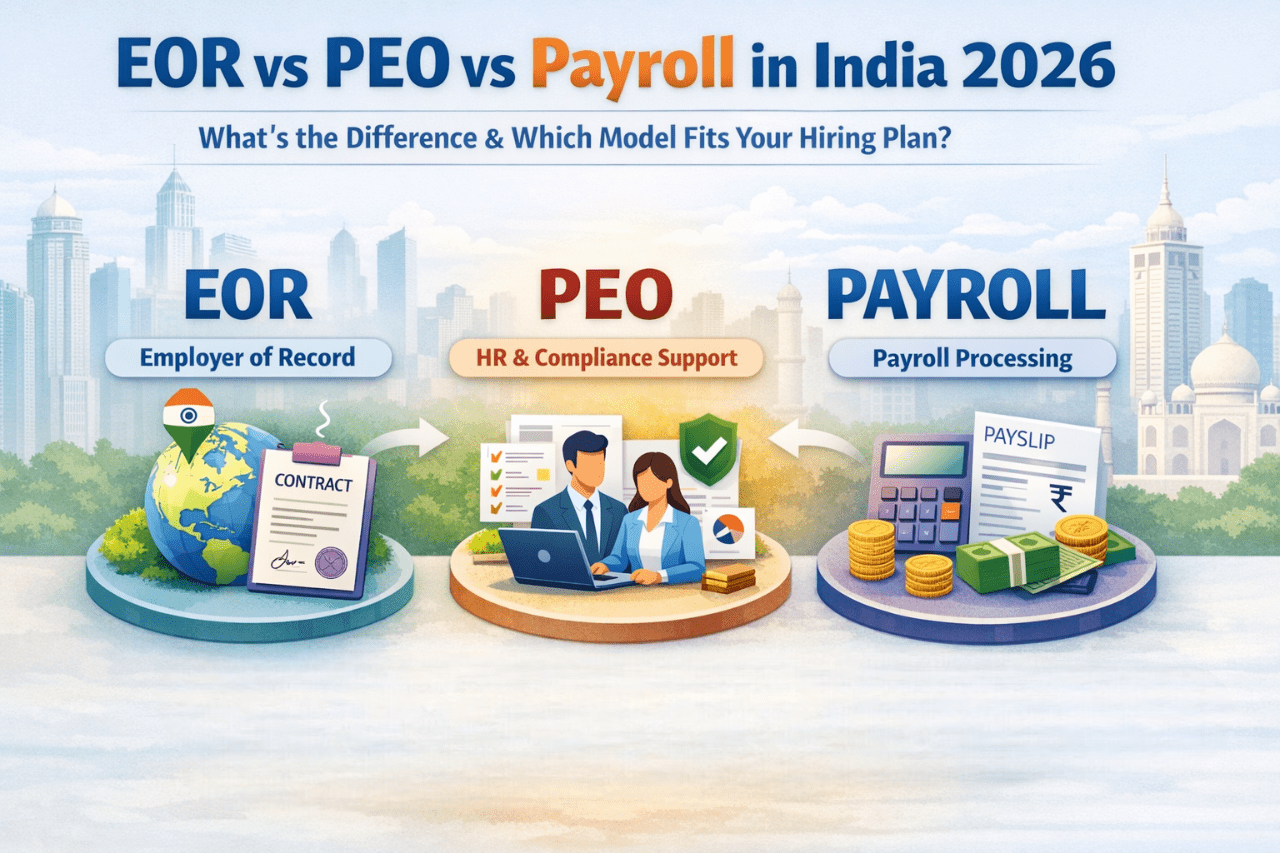
  • EOR vs PEO vs Payroll in India (2026): What’s the Difference and Which Model Fits Your Hiring Plan?

    EOR vs PEO vs Payroll in India (2026): What’s the Difference and Which Model Fits Your Hiring Plan?

    EOR vs PEO vs Payroll in India (2026): What’s the Difference and Which Model Fits Your Hiring Plan?

    EOR vs PEO vs Payroll

    Introduction:

    Hiring in India is exciting, but the operating model you choose determines how smoothly payroll and compliance run. Many companies get stuck because EOR, PEO, and payroll outsourcing sound similar, yet they suit different hiring stages. In 2026, with distributed teams and tighter governance expectations, choosing the right model early can save time, cost, and risk later.

    This blog explains the difference between EOR, PEO, and payroll in India, how responsibilities shift, and which model best fits your India hiring plan.

    Why this decision matters in India

    Payroll in India isn’t only about salary credits and payslips — it ties directly to statutory rules like EPF, ESI, Professional Tax, and TDS, and those rules can change depending on salary and employee location. For example, EPFO publishes EPF contribution references, and a wage ceiling determines ESI coverage. Getting these calculations wrong can trigger corrections, delays, or avoidable penalties.

    Because payroll and compliance are tightly connected, the model you choose affects more than just cost. The same hiring plan can feel light under one model and heavy under another.

    What is an Employer of Record (EOR) in India?

    An Employer of Record (EOR) lets you hire in India without setting up your own entity. The EOR becomes the legal employer on paper, while you retain control over the employee’s daily work and performance. That combination makes EOR a common choice for market entry or rapid scaling.

    The provider’s local entity typically handles employment contracts, payroll processing, statutory deductions, and required filings. This approach speeds hiring and keeps things cleaner, especially when you are just entering India.

    What is a PEO in India?

    A PEO model usually fits when you already have an India entity or expect to maintain one. In most practical setups, your company remains the employer and the PEO supports HR operations, payroll execution, and compliance coordination.

    This setup suits teams that need to scale without moving every HR and payroll process inside the company. It preserves direct employment while outsourcing much of the operational workload.

    What is payroll outsourcing in India?

    Payroll outsourcing targets payroll processing and statutory calculations specifically. Your India entity stays the legal employer, and you hand off the execution layer to reduce errors and improve compliance consistency.

    If you want to keep HR decision-making in-house but want payroll to run more smoothly — with better reporting and fewer operational gaps — this option often works best.

    The simplest way to compare EOR vs PEO vs payroll

    The clearest difference is the legal employer. With EOR, the provider stands as the legal employer. Under PEO and payroll outsourcing, your company usually remains the employer through your India entity. That legal distinction changes how contracts are issued, how exits are handled, and who carries statutory compliance risk.

    When speed without an entity matters, EOR generally fits. If you prefer direct employment but want outsourced HR support, consider a PEO. For companies that wish to keep employment internal and only want execution-level support, payroll outsourcing often proves the simplest route.

    Compliance impact: what payroll must cover in India

    Most companies hiring in India face the same compliance layers. EPFO issues contribution references, ESI applies according to eligibility rules and wage limits, and Professional Tax varies by state but has annual caps. Employers must also withhold TDS on salary based on estimated annual income and employee declarations.

    Because of these layers, companies don’t choose a model based only on price — they consider how much risk and execution they want to carry internally.

    Which model fits your India hiring plan in 2026?

    When you’re hiring in India for the first time and lack an entity, EOR often provides the quickest compliant route. If you already run an entity and want to outsource broader HR and payroll operations, PEO support may be the right move. For organizations that already have an entity and only want to improve payroll accuracy and governance without changing employment structure, payroll outsourcing is frequently the simplest solution.

    Many companies follow a staged approach: they start with EOR to hire fast, then transition to their own entity later using a PEO or payroll partner once India operations stabilize.

    Conclusion:

    Choosing between EOR, PEO, and payroll outsourcing in India depends on where your company stands today and how you plan to scale in 2026. If you need to hire without an India entity, EOR usually offers the cleanest entry path. Companies with an entity that want operational HR and payroll support will likely find PEO beneficial. If your priority is payroll execution and compliance discipline while keeping HR control internal, payroll outsourcing often fits best.

    At Team Management Service, we provide end-to-end support for companies hiring and scaling in India—whether you need an EOR model, PEO-style HR operations support, or payroll outsourcing. We help you stay compliant across payroll processes and statutory requirements, so your team can grow smoothly without operational friction.

    FAQs

    EOR becomes the legal employer and hires on your behalf, often without requiring you to have an India entity. PEO usually supports companies that already have an India entity while the company remains the employer.

    Yes, payroll outsourcing typically assumes your company has an India entity because you remain the legal employer while outsourcing payroll execution.

    Payroll outsourcing is usually lower-cost because it’s narrower in scope. EOR includes the employing structure and broader compliance handling, so it’s typically priced higher

    Companies often choose EOR when they want to hire quickly in India without setting up a local entity or when they are testing the market before committing long-term.

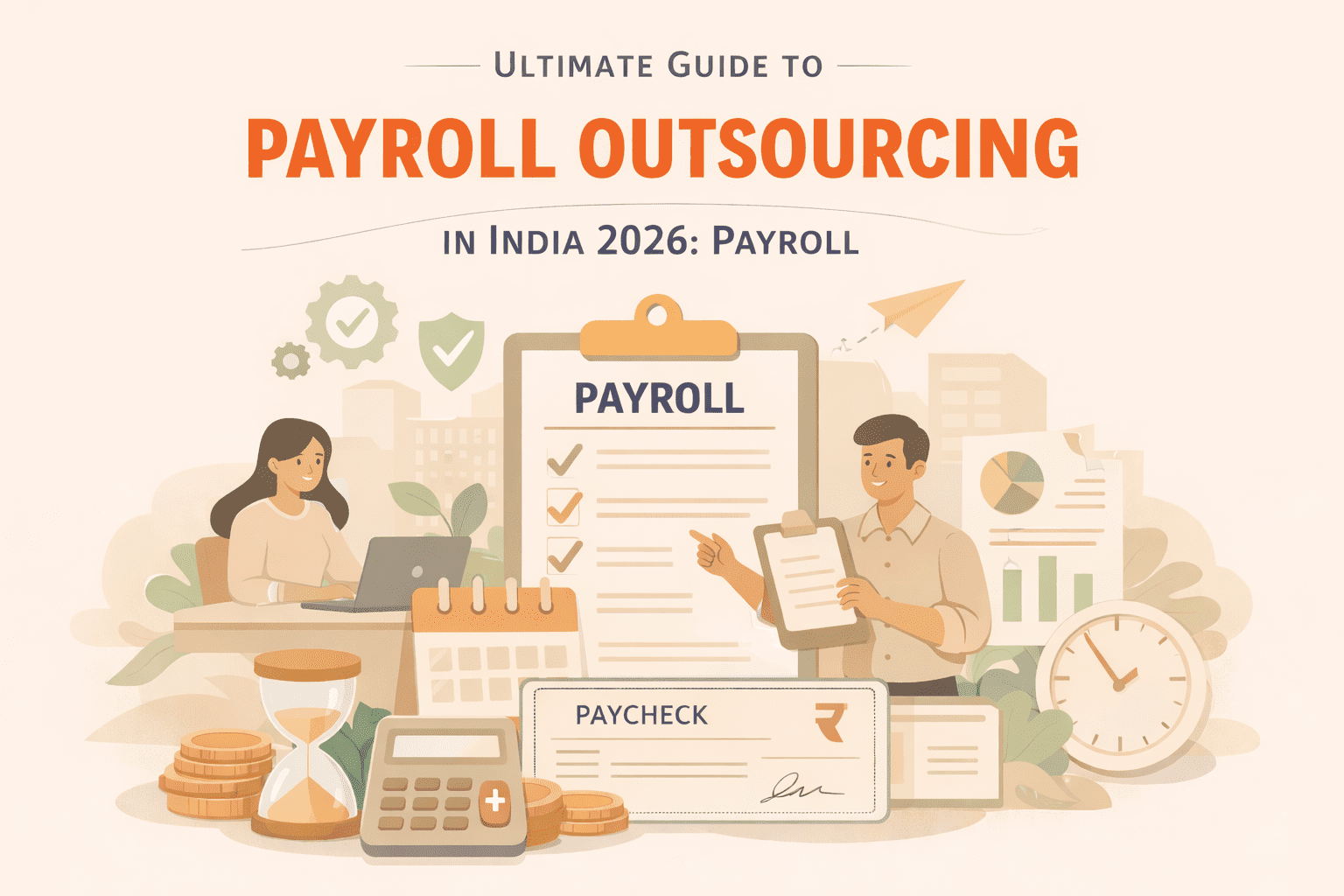
  • Ultimate Guide to Payroll Outsourcing in India 2026: Payroll

    Ultimate Guide to Payroll Outsourcing in India 2026: Payroll

    Ultimate Guide to Payroll Outsourcing in India 2026: Payroll

    payroll outsourcing in india 2026

    Introduction:

    Payroll outsourcing in India 2026 helps companies run payroll with fewer errors, clearer monthly controls, and stronger compliance discipline. It’s a practical move when payroll starts eating into HR and finance bandwidth, when corrections repeat every month, or when leadership wants more predictable reporting.

    This guide stays focused on payroll outsourcing only. It explains what the service includes, how the monthly process works, which compliance touchpoints matter, what drives cost, and how to pick the right payroll outsourcing partner in India in 2026.

    What payroll outsourcing means in India

    Payroll outsourcing means you hand the payroll engine to a specialist provider while your company keeps decision-making control. You still define salary structures, approve increments, and sign off on monthly payroll. The provider runs the execution: gross-to-net calculations, payslips, payroll registers, and payroll reporting.

    In India, payroll outsourcing also depends heavily on process discipline. Providers typically standardize how you submit monthly inputs like attendance, leave, incentives, reimbursements, new joiners, exits, and revisions. When those inputs arrive clean and on time, payroll stops feeling like a monthly emergency.

    What payroll outsourcing typically includes

    Payroll outsourcing in India 2026 usually covers gross-to-net processing, payslip generation, payroll registers, and standard payroll reports. Better vendors also add validation checks and reconciliation outputs. Those controls reduce repeat errors and make payroll easier to review.

    Payroll outsourcing also supports statutory-linked computations and summaries. EPF contribution references come from EPFO guidance. ESIC publishes contribution rates and rules that payroll teams apply when eligibility conditions apply. Professional Tax varies by state, although many references cite an overall cap framework. TDS on salary follows Section 192 guidance on estimation-based withholding.

    How the payroll outsourcing process runs each month

    A good payroll cycle starts with a fixed input cutoff. Your HR team shares finalized attendance, leave, variable pay, reimbursements, and employee changes. Clear cutoffs prevent late changes that delay payroll closure.

    Next, the provider validates data and flags exceptions early. Your team confirms corrections, and the provider locks the final dataset. After that, the provider runs payroll, prepares the payroll register, and shares it for review and approval.

    Once you approve, the provider generates payslips and final payroll reports. Many vendors also support salary disbursement files depending on scope. The month ends with reconciliations and statutory-ready summaries so the next cycle stays clean.

    Payroll compliance touchpoints to expect in 2026

    Payroll compliance in India connects directly to statutory deductions and reporting. EPF needs correct contribution calculations aligned to EPFO references. ESI needs correct rate application based on ESIC guidance.

    Professional Tax requires state-wise logic because slabs differ by location. TDS on salary requires estimation-based withholding and deduction at the time of payment as described under Section 192 guidance.

    A strong provider explains how they validate rules, track exceptions, and maintain an audit trail from payroll computation to compliance summaries.

    Cost of payroll outsourcing in India

    Payroll outsourcing cost depends on headcount, payroll complexity, and service scope. A simple payroll with stable structures costs less. Multi-state payroll, frequent revisions, variable pay, and reimbursements increase pricing because the process needs more checks.

    Scope also changes pricing. Costs usually rise when the vendor includes helpdesk support, payroll software access, integrations, or deeper reporting. Compare vendors on outcomes, not only on per-employee fees.

    How to choose a payroll outsourcing partner in India 2026

    A reliable vendor runs payroll like a system. You should see clear timelines, documented cutoffs, validation steps, and approval cycles. Ask for sample outputs such as payroll registers, statutory summaries, and reconciliation reports to judge quality.

    Security matters because payroll includes sensitive personal and banking data. Integration support also helps in 2026 because clean data flow between HRMS, attendance tools, and payroll reduces manual errors. Finally, test support quality for exits and year-end tasks, since those moments show how strong the vendor really is.

    Common mistakes to avoid

    Payroll outsourcing fails when inputs remain messy. Late attendance, untracked incentives, and unclear ownership create delays and corrections. Fix the input process first by standardizing formats and cutoffs.

    Skipping monthly reconciliation is another problem. Reconciliation prevents recurring errors and makes year-end work easier. Also, don’t assume outsourcing transfers all compliance responsibility. In most setups, your entity remains accountable while the vendor supports execution and reporting.

    Conclusion

    Payroll outsourcing in India 2026 works best when you treat payroll like a controlled monthly close. A structured provider improves accuracy, strengthens reporting, and keeps compliance outputs consistent. With clean inputs and strong validations, payroll becomes predictable and scalable.

    At Team Management Service, we provide payroll outsourcing in India with structured monthly workflows, compliance-aligned processing, and scalable support—so your payroll stays accurate, predictable, and audit-ready as you grow.

    FAQs

    Payroll outsourcing in India means a third-party provider manages payroll calculations, prepares payroll registers, generates payslips, and supports payroll reporting.

    Payroll commonly connects to EPF, ESI, Professional Tax, and TDS on salary, along with documentation and reconciliation.

    No. States set different slabs and rules, although many references cite an overall cap framework.

    Check monthly timelines, validation controls, sample outputs, data security, integration capability, and support responsiveness.

  • Complete Guide to HR Outsourcing Services in India for Startups and SMEs

    Complete Guide to HR Outsourcing Services in India for Startups and SMEs

    Complete Guide to HR Outsourcing Services in India for Startups and SMEs

    By Shruti S.  •  Published: March 5, 2026  •  Updated: March 7, 2026 Key Takeaway: HR outsourcing enables startups and SMEs to access enterprise-grade payroll processing, statutory compliance management, recruitment support, and employee lifecycle administration without building an in-house HR department. Indian startups using HR outsourcing report 35-50% savings on HR operational costs and a 90%+ reduction in compliance penalties. Services typically cost ₹200-500 per employee per month for comprehensive HR management — a fraction of a full-time HR hire.

    Introduction: Why HR Outsourcing Is Essential for Indian Startups and SMEs

    Running a startup or SME in India means wearing multiple hats. Founders manage product development, sales, finance, and operations — often simultaneously. HR management, despite being critical, rarely receives the focused attention it requires until a compliance notice arrives or a key employee leaves due to payroll errors.

    India’s labour law landscape — with 44 central laws, state-specific regulations, and mandatory social security contributions — makes HR management disproportionately complex for smaller organisations. An SME with 25 employees across 2 states faces the same PF, ESI, PT, TDS, and LWF compliance obligations as a company with 25,000 employees, but without the dedicated HR infrastructure to manage them.

    This is where HR outsourcing services in India transform the equation. By partnering with an HR outsourcing company, startups and SMEs get access to payroll processing, compliance management, recruitment support, and employee administration — managed by specialists — at a cost that is 50-70% less than building equivalent in-house capabilities.

    What HR Functions Can Be Outsourced?

    HR outsourcing is not an all-or-nothing decision. Indian startups and SMEs can outsource specific functions based on their needs and internal capabilities:

    HR Function What’s Included Best Outsourced When…
    Payroll Processing Salary computation, payslips, bank transfers, Form 16 10+ employees or multi-state operations
    Statutory Compliance PF, ESI, PT, TDS, LWF filings and payments Any company without a compliance specialist
    Recruitment Job posting, screening, interviews, offer management Hiring 5+ positions or specialised roles
    Employee Onboarding Documentation, PF/ESI registration, induction Frequent new joins (5+ per month)
    Leave & Attendance Tracking, policy enforcement, integration with payroll No HRMS software in place
    Contract Staffing Third-party employment for flexi workers Variable workforce or project-based hiring
    Employee Offboarding Full & final settlement, PF transfer, experience letters Any company — offboarding errors create legal risk

    Most startups begin by outsourcing payroll and compliance — the two functions with the highest penalty risk — and gradually expand to include recruitment, onboarding, and contract staffing as the organisation grows.

    Why Startups and SMEs Choose HR Outsourcing

    1. Cost Efficiency Without Compromising Quality

    Hiring a full-time HR manager costs ₹4-8 lakh per year. Add a payroll specialist (₹3-5 lakh), compliance software (₹50,000-2 lakh), and occasional legal advisory (₹50,000-1.5 lakh), and the total in-house HR cost for a 50-employee company reaches ₹8-16 lakh annually.

    Outsourced HR services for the same 50 employees cost approximately ₹1.2-3 lakh per year (at ₹200-500 per employee per month) — delivering the same payroll accuracy, compliance coverage, and employee administration at 65-85% lower cost.

    2. Compliance Expertise From Day One

    India’s statutory compliance requirements apply to every employer regardless of size. A startup with 10 employees must file PF ECR monthly, deposit ESI contributions, deduct and deposit TDS, calculate Professional Tax per state slabs, and maintain Shops & Establishments registration — the same obligations as a 10,000-employee enterprise. An HR outsourcing partner brings immediate compliance expertise, ensuring your company avoids the costly learning-curve mistakes that plague early-stage businesses.

    3. Scalability That Matches Business Growth

    Startups and SMEs experience rapid headcount changes — from 15 to 50 employees in 6 months, or from single-city operations to 5-state presence within a year. Internal HR infrastructure cannot scale this quickly. An HR outsourcing partner’s infrastructure is already built for multi-state, multi-volume operations, so your HR capabilities scale in lockstep with your hiring — zero setup delays, zero additional registrations on your end.

    4. Access to Technology Without Capital Investment

    Enterprise HRMS platforms (SAP SuccessFactors, Darwinbox, Keka) cost ₹2-10 lakh annually for SMEs. HR outsourcing providers include technology platforms — employee self-service portals, payroll dashboards, compliance calendars, and leave management systems — as part of the service fee. Startups get enterprise-grade HR technology at zero additional cost.

    5. Focus on Core Business

    Every hour a founder or COO spends troubleshooting PF portal errors, reconciling ESI contributions, or managing a payroll discrepancy is an hour not spent on product development, customer acquisition, or strategic planning. HR outsourcing returns this time to the leadership team — which, for a startup, can be the difference between hitting or missing growth milestones.

    How to Choose an HR Outsourcing Company in India

    The Indian HR outsourcing market includes everything from freelance payroll consultants to large-scale HR services firms. Here are the critical evaluation criteria for startups and SMEs:

    • Service scope: Does the provider cover payroll + compliance + recruitment, or only payroll? Startups benefit most from integrated providers that handle the full HR spectrum.
    • Multi-state capability: If you plan to hire across states (even 2-3 states), ensure the provider has active registrations and compliance knowledge in all target states.
    • Startup-friendly pricing: Avoid providers that require minimum headcount commitments or long-term contracts. The best startup-focused HR companies offer month-to-month engagement with per-employee pricing.
    • Technology included: Verify that the provider offers a dashboard or portal for real-time payroll status, compliance tracking, and employee data management.
    • Compliance guarantee: Ask about on-time filing rates and whether the provider offers a compliance guarantee (assumption of penalty liability for filing errors).
    • Transition speed: A good provider should onboard a startup within 1-2 weeks, with full payroll processing starting from the next pay cycle.

    Team Management Services (TMS) provides integrated HR outsourcing services including payroll processing, statutory compliance, contract staffing, and talent acquisition for startups, SMEs, and enterprises across 100+ Indian cities — with flexible pricing and zero minimum headcount requirements.

    Common HR Outsourcing Models

    Depending on your needs, you can engage an HR outsourcing partner through different models:

    • Payroll-only outsourcing: The provider handles salary processing and statutory filings. You manage recruitment, onboarding, and employee relations internally. Best for companies with strong internal HR but limited payroll/compliance capability.
    • Comprehensive HR outsourcing: The provider manages payroll, compliance, recruitment, onboarding, leave management, and offboarding. Best for startups and SMEs without an internal HR team.
    • Contract staffing (third-party employment): The provider becomes the legal employer of your workforce, handling all employment obligations. Best for project-based teams, variable workforce, and multi-state deployments.
    • HR consulting + outsourcing hybrid: The provider offers strategic HR advisory (policy design, compensation benchmarking, org structure) alongside operational outsourcing. Best for growing companies establishing their HR foundation.

    Frequently Asked Questions

    What is HR outsourcing and how does it work in India?

    HR outsourcing involves engaging a third-party provider to manage some or all of your HR functions — payroll processing, statutory compliance (PF, ESI, PT, TDS), recruitment, onboarding, and employee administration. The provider uses its own team, technology, and compliance infrastructure to deliver these services, while you retain all business decisions regarding hiring, performance management, and workforce strategy. Services are typically delivered remotely with a dedicated account manager.

    How much does HR outsourcing cost for startups in India?

    HR outsourcing for Indian startups typically costs ₹200-500 per employee per month for comprehensive services (payroll + compliance + basic HR administration). Recruitment services are usually charged separately — either as a percentage of annual CTC (8-15% for permanent placement) or as a fixed fee for contract staffing. For a 30-employee startup, total HR outsourcing costs range from ₹6,000-15,000 per month — significantly less than a single full-time HR hire.

    Is HR outsourcing suitable for early-stage startups with fewer than 20 employees?

    Yes, early-stage startups benefit the most from HR outsourcing because they lack the internal HR infrastructure to handle compliance obligations. Even a 5-employee startup must comply with TDS, Professional Tax, and potentially PF and ESI requirements. Outsourcing these from the start prevents compliance gaps from accumulating and ensures the company is built on a solid HR foundation from day one.

    What is the difference between HR outsourcing and a PEO?

    In HR outsourcing, the client company remains the legal employer and the provider manages HR functions on the client’s behalf. In a Professional Employer Organisation (PEO) model, the PEO becomes a co-employer, sharing legal employer responsibilities. In India, the PEO model is less common — most arrangements follow the HR outsourcing model (client is employer, provider manages processes) or the contract staffing model (provider is the full legal employer under the Contract Labour Act).

    Can HR outsourcing companies handle multi-state compliance in India?

    Yes, this is one of the primary reasons companies outsource HR. Each Indian state has different Professional Tax slabs, LWF contribution schedules, and Shops & Establishments Act requirements. HR outsourcing companies like TMS maintain active registrations and compliance infrastructure across all Indian states, enabling clients to hire in any state without obtaining separate registrations or building state-specific compliance knowledge.

    Conclusion: Start With What You Need, Scale as You Grow

    HR outsourcing is not about replacing your HR function — it is about building one that works from day one. For startups focused on product-market fit and SMEs focused on scaling operations, outsourcing the compliance-heavy, process-intensive elements of HR to a specialist partner is the most efficient path to compliant, professional workforce management.

    Start with payroll and compliance. Add recruitment when you are scaling. Include contract staffing when you need workforce flexibility. The right HR outsourcing partner grows with your business — providing exactly the support you need at each stage.

    Talk to TMS about HR outsourcing for your business — integrated HR services from payroll to recruitment across 100+ Indian cities.

    Last Updated: March 2026

    About the Author

    Shruti S.

    Shruti S. is a Content Writer at Team Management Services (TMS) with 5+ years of experience in business and HR content. She holds an MBA in Marketing and writes about contract staffing, payroll outsourcing, statutory compliance, HR rules, talent acquisition, apprenticeship schemes (NATS, NAPS), and labour law for Indian businesses.

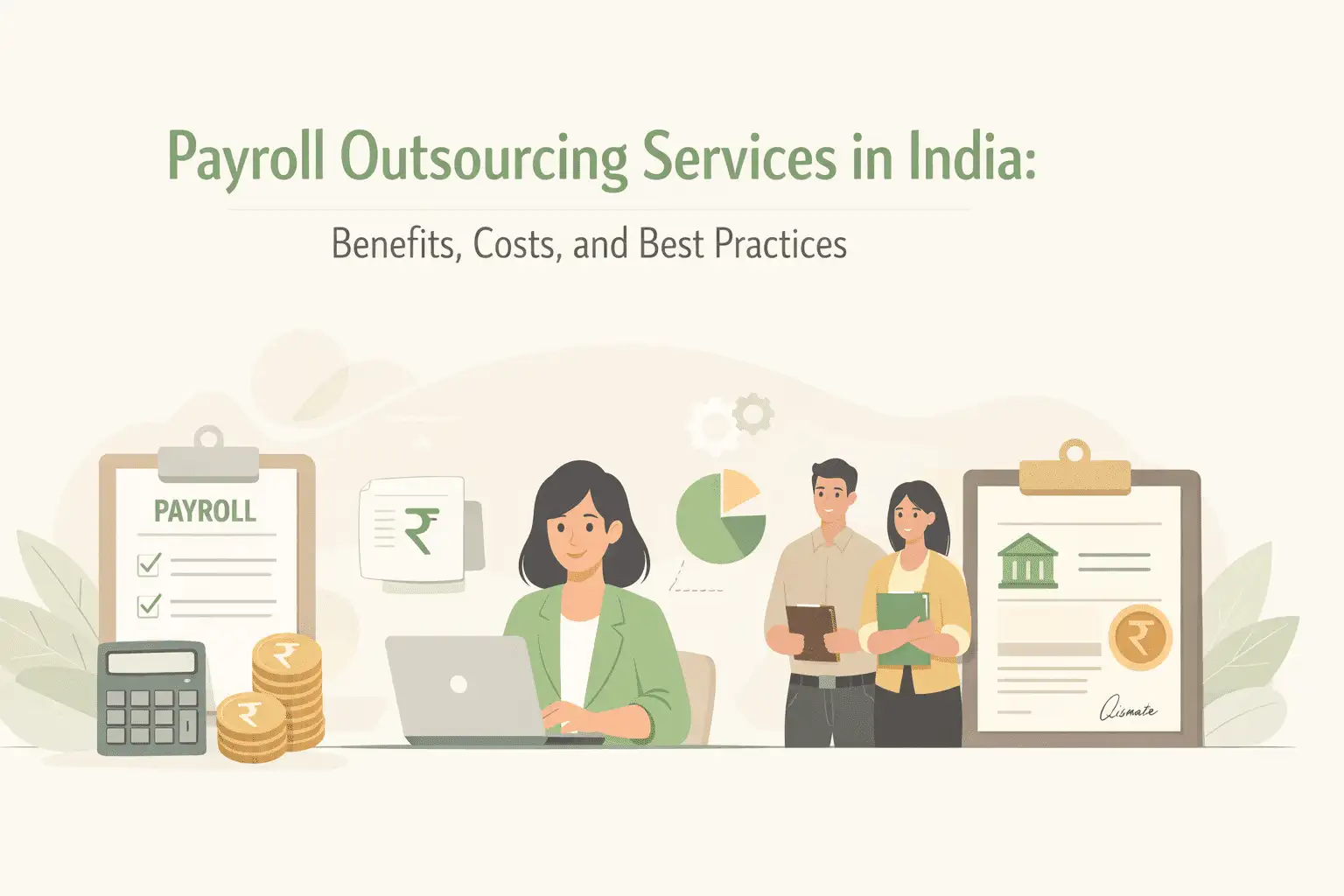
  • Payroll Outsourcing Services in India: Benefits, Costs and Best Practices

    Payroll Outsourcing Services in India: Benefits, Costs and Best Practices

    Payroll Outsourcing Services in India: Benefits, Costs, and Best Practices

    Introduction:

    Payroll management plays a crucial role in every organization because it directly impacts employee satisfaction and regulatory compliance. However, managing payroll internally can quickly become complicated. Tax regulations change frequently, compliance requirements evolve regularly, and payroll errors can easily occur if systems are not properly managed. Therefore, many organizations are gradually shifting toward Payroll Outsourcing Services in India to streamline payroll processes and improve operational efficiency.

    Moreover, businesses today are constantly searching for ways to optimize their resources. Payroll outsourcing offers a practical solution because it reduces administrative workload while ensuring compliance with statutory regulations. As a result, companies are able to focus more on strategic business functions rather than spending valuable time on payroll management.

    Understanding Payroll Outsourcing in the Indian Business Environment

    Payroll outsourcing refers to the process of delegating payroll-related tasks to a third-party service provider. These service providers manage a variety of payroll functions including salary calculations, statutory deductions, tax filings, compliance management, and employee payslip generation.

    Furthermore, payroll providers often offer automated systems that help businesses track employee data and generate reports easily. Because of these technological capabilities, payroll processing becomes more transparent and reliable.

    In India, payroll management requires compliance with multiple statutory regulations such as provident fund, employee state insurance, income tax, and professional tax. Consequently, managing payroll internally can become challenging, particularly for growing organizations. Therefore, many businesses prefer Payroll Outsourcing Services in India to ensure compliance while maintaining operational efficiency.

    Why Payroll Outsourcing is Becoming Popular in India

    Over the past decade, India has experienced rapid economic growth and increasing workforce expansion. As companies grow, payroll complexity also increases. Multiple employee benefits, tax structures, and compliance requirements must be managed carefully.

    Because of these complexities, organizations often face challenges while managing payroll internally. HR teams may spend significant time handling salary calculations, tax deductions, and regulatory updates.

    However, outsourcing payroll allows companies to delegate these responsibilities to specialists who understand the regulatory landscape. As a result, payroll operations become smoother and more accurate.

    Key Benefits of Payroll Outsourcing

    Payroll errors can create serious problems for both employees and employers. Incorrect salary calculations may lead to employee dissatisfaction, while compliance mistakes may result in financial penalties.

    However, payroll outsourcing providers rely on automated systems and experienced professionals to handle payroll calculations. Because payroll processes are carefully monitored, the chances of errors are significantly reduced.

    In addition, payroll reports are generated regularly to maintain transparency. Therefore, organizations can easily review payroll records and ensure that everything is processed correctly.

    Stronger Compliance Management

    Compliance is one of the most challenging aspects of payroll management in India. Businesses must regularly comply with statutory laws such as PF, ESI, income tax, and labor regulations.

    Moreover, government policies are frequently updated, which makes compliance even more complex. Because of this, companies may struggle to keep track of regulatory changes.

    Payroll outsourcing providers specialize in compliance management. Consequently, statutory deductions and filings are handled accurately and on time. As a result, organizations are able to avoid penalties and maintain proper regulatory compliance.

    Improved Cost Efficiency

    Maintaining an in-house payroll department often requires dedicated staff, payroll software, and compliance expertise. These requirements may increase operational costs significantly.

    However, payroll outsourcing reduces the need for additional resources. Instead of investing in payroll infrastructure, businesses can rely on external service providers who already have the necessary systems and expertise.

    Because operational expenses are minimized, companies can allocate their resources more effectively. Therefore, payroll outsourcing often becomes a cost-effective solution for businesses of all sizes.

    Better Focus on Core Business Activities

    HR teams play an important role in employee engagement, recruitment, and organizational development. However, payroll management often consumes a significant portion of their time.

    When payroll responsibilities are outsourced, HR professionals can focus on strategic initiatives rather than administrative tasks. Consequently, businesses experience improved productivity and stronger workforce management.

    In addition, organizations gain access to professional payroll expertise without increasing internal workload. This is one of the key reasons why Payroll Outsourcing Services in India continue to grow in popularity.

    Cost Structure of Payroll Outsourcing in India

    The cost of payroll outsourcing depends on several factors including workforce size, service complexity, and additional compliance requirements.

    Most payroll providers charge based on a per-employee-per-month model. Under this model, businesses pay a fixed amount for each employee whose payroll is processed.

    However, additional services such as tax filing, statutory compliance management, HR integrations, and reporting tools may affect the overall pricing.

    Despite these variations, outsourcing payroll often proves more economical than maintaining a full internal payroll department. Therefore, many organizations view payroll outsourcing as both a financial and operational investment.

    Conclusion

    Managing payroll can become complex as businesses grow and compliance requirements increase. Therefore, outsourcing payroll is an effective way to simplify processes, reduce errors, and improve operational efficiency.

    By partnering with an experienced provider like Team Management Services, businesses can ensure accurate payroll management while staying compliant with regulations. As a result, organizations can focus more on growth, employee engagement, and long-term business success.

    FAQs

    Payroll outsourcing means hiring a third-party provider to manage salary processing, tax deductions, and compliance. It helps businesses simplify payroll operations.

    Services typically include salary processing, tax deductions, compliance management, and payslip generation. Some providers also offer payroll reports and HR integration.

    Yes, it reduces the cost of maintaining payroll staff and software. Most providers charge a simple per-employee monthly fee.

    Businesses should check the provider’s experience, compliance knowledge, and technology. Reliable customer support is also important.

  • Employer of Record India Explained: Everything Businesses Need to Know.

    Employer of Record India Explained: Everything Businesses Need to Know.

    Employer of Record India Explained: Everything Businesses Need to Know

    Introduction:

    Expanding a business into new markets is exciting. However, it often comes with legal complexities, compliance challenges, and administrative responsibilities. Many companies want to hire talent in India but hesitate because establishing a local entity can be time-consuming and expensive.

    This is exactly where an Employer of Record India service becomes valuable.

    An Employer of Record (EOR) allows businesses to hire employees in India legally without setting up a local company. The service provider manages employment responsibilities such as payroll, tax compliance, employment contracts, and statutory benefits. As a result, companies can focus on growth while administrative burdens are handled efficiently.

    In recent years, global hiring has increased significantly. Therefore, businesses are actively searching for reliable solutions to build international teams quickly. An Employer of Record makes this possible while ensuring that employment regulations are followed properly.

    Understanding the Concept of an Employer of Record

    To begin with, an Employer of Record is a third-party organization that legally employs workers on behalf of another company.

    Although the EOR becomes the official employer for compliance purposes, the employees continue to work for the client company. The client controls daily tasks, project management, and performance expectations. Meanwhile, the EOR manages administrative and legal responsibilities.

    In India, employment regulations can vary depending on state laws, tax rules, and labor policies. Consequently, many companies prefer to work with an Employer of Record India provider to avoid compliance risks.

    Through this model, companies can hire local talent quickly while remaining fully compliant with Indian labor regulations.

    Why Businesses Expand Their Workforce in India

    India has become one of the most attractive destinations for global hiring. Several factors contribute to this growing trend.

    First, the country offers a highly skilled and diverse talent pool. Professionals in fields such as technology, finance, marketing, and customer support are widely available. Moreover, English proficiency and strong technical expertise make Indian professionals highly compatible with international teams.

    Additionally, India offers competitive operational costs compared to many Western countries. Because of this, businesses can build high-performing teams while maintaining cost efficiency.

    However, hiring employees directly requires a registered local entity. For many organizations, establishing a subsidiary is not the ideal first step. Therefore, companies often turn to an Employer of Record India solution to enter the market faster and more securely.

    How an Employer of Record Works in India

    The process of working with an Employer of Record is structured yet straightforward.

    First, the client company identifies the candidate it wants to hire in India. Afterward, the EOR provider becomes the legal employer and drafts an employment contract that complies with Indian labor laws.

    Next, the employee is onboarded through the EOR’s local entity. Payroll processing, tax deductions, and statutory contributions are then managed by the provider. Meanwhile, the employee performs daily work for the client company exactly as expected.

    Because all employment obligations are handled professionally, businesses can operate confidently without worrying about regulatory complications.

    Key Responsibilities Managed by an Employer of Record

    An Employer of Record handles several crucial employment responsibilities.

    For example, payroll management is handled accurately and on time. Taxes, provident fund contributions, and other statutory deductions are processed according to Indian regulations. In addition, employment contracts are created in compliance with local labor laws.

    Furthermore, employee benefits, leave policies, and insurance coverage are often managed through the EOR. As a result, employees receive a structured employment experience while companies remain compliant.

    Through these services, an Employer of Record India provider ensures that both employers and employees benefit from a transparent and legally compliant framework.

    Benefits of Using an Employer of Record in India

    Companies expanding internationally face multiple operational challenges. Fortunately, an Employer of Record simplifies the process significantly.First, businesses can enter the Indian market without establishing a legal entity. This eliminates the lengthy process of company registration and regulatory approvals.

    Second, hiring becomes significantly faster. Instead of waiting months to set up operations, companies can onboard employees within days or weeks.Additionally, compliance risks are reduced because local employment regulations are managed by experienced professionals.

    Another major advantage is flexibility. Companies can scale teams up or down depending on project requirements. Consequently, international expansion becomes more strategic and less risky.

    Compliance and Legal Protection

    Employment compliance in India can be complex due to multiple labor laws, tax regulations, and regional variations. Therefore, companies that attempt to manage these requirements alone may face legal risks.

    An Employer of Record India provider ensures that employment contracts, payroll processing, and statutory filings follow Indian regulations. Because these processes are handled by experts, businesses are protected from potential penalties or compliance violations.

    Moreover, employees benefit from legally compliant employment agreements, which strengthens trust and workplace transparency.

    The Future of Global Hiring

    Remote work and distributed teams are transforming how companies operate worldwide. Organizations are no longer restricted by geographic boundaries when building teams.

    As a result, global hiring solutions are becoming increasingly important. Employer of Record services provide the flexibility and compliance required for international workforce management.Businesses that adopt these models are able to expand faster, hire better talent, and operate more efficiently in competitive global markets.

    Conclusion

    Expanding into India offers significant opportunities, but employment regulations and compliance requirements can make the process challenging. An Employer of Record helps businesses hire talent quickly while staying fully compliant with local laws.

    With the right partner, companies can scale their teams without establishing a local entity. Team Managemnet Services  helps organizations manage hiring, payroll, and compliance efficiently, enabling businesses to grow and build strong teams in India with confidence.

    FAQs

    An Employer of Record (EOR) is a third-party organization that legally hires employees on behalf of a company. It manages payroll, taxes, and compliance while the employee works for the client company.

    Companies use an EOR to hire employees in India without establishing a local entity.
    It simplifies compliance, payroll management, and administrative responsibilities.

    Yes, hiring through an Employer of Record in India is completely legal.
    The EOR ensures that employment contracts, taxes, and statutory obligations follow Indian labor laws

    Companies can hire employees within a few days or weeks using an EOR.
    This process is much faster compared to setting up a local company or subsidiary.

  • Top 10 Contract Staffing Services Provider in India

    Top 10 Contract Staffing Services Provider in India

    Top 10 Contract Staffing Services Provider in India

    Introduction:

    Businesses today operate in an environment where speed, adaptability, and efficiency determine success. Companies are constantly expanding, launching new projects, and entering competitive markets. However, hiring permanent employees for every short-term requirement can slow down growth and increase operational costs.

    Because of this shift in hiring strategy, contract staffing has become one of the most preferred workforce solutions in India. It allows organizations to bring in skilled professionals for specific projects or time-bound roles without committing to long-term employment. As industries grow and technology evolves, companies increasingly depend on flexible workforce models to remain competitive.

    Mumbai, being one of India’s largest business hubs, has seen a rapid rise in demand for Contract Staffing Services Mumbai. Organizations across sectors such as finance, IT, logistics, media, and manufacturing rely on contract staffing to quickly fill skill gaps and maintain productivity. Instead of spending months in recruitment processes, companies can access experienced professionals through trusted staffing providers.

    The Growing Importance of Contract Staffing in India

    The modern workforce landscape has changed dramatically over the past decade. Companies no longer rely solely on traditional hiring models. Instead, they are focusing on agile workforce strategies that help them scale operations efficiently.Contract staffing supports this transformation by offering flexibility and speed. When companies take on new projects or expand into new markets, the demand for skilled professionals increases immediately. Through contract staffing, these requirements can be fulfilled quickly without disrupting ongoing operations.


    Another important factor driving this model is cost efficiency. Permanent hiring involves multiple expenses including benefits, long-term salaries, and administrative costs. Contract staffing reduces these financial commitments while still ensuring access to experienced professionals.Additionally, businesses operating in metropolitan cities like Mumbai often face intense competition for talent. In such situations, reliable Contract Staffing Services Mumbai play a crucial role in connecting companies with pre-screened professionals who can start contributing immediately.

    Top Contract Staffing Services Provider in India

    India has several well-established staffing companies that support businesses across industries. These providers have built strong talent networks, developed efficient hiring processes, and gained extensive experience in workforce management.Team management  Services has emerged as one of the most recognized workforce solutions providers in India. The company has built a strong reputation for delivering reliable contract staffing services across sectors such as telecom, retail, IT, and banking. Their large talent pool and structured hiring process allow organizations to quickly access skilled professionals whenever required.


    Another major name in the staffing industry is Quess Corp. Known for its comprehensive workforce solutions, Quess supports businesses with contract staffing, payroll services, and workforce management. The company has helped thousands of organizations build flexible teams that support growth and productivity.Randstad India also plays a significant role in the contract staffing landscape. As a globally recognized HR services provider, Randstad focuses on delivering quality talent across industries including technology, finance, and engineering. Their strong candidate evaluation process ensures that businesses receive professionals who can contribute effectively from day one.

    Why Businesses Prefer Contract Staffing

    Organizations today must respond quickly to changing market conditions. Project deadlines are tighter, competition is stronger, and innovation cycles are shorter. In this environment, workforce flexibility becomes essential.

    Contract staffing allows businesses to focus on productivity rather than administrative complexities. Skilled professionals can be onboarded quickly, enabling companies to complete projects on time without long recruitment delays.Furthermore, businesses gain access to specialized expertise that may not be available internally. This is especially valuable in industries where technology and innovation evolve rapidly.


    In cities with intense business activity, the role of Contract Staffing Services Mumbai becomes even more significant. These services help organizations maintain operational stability while ensuring that the right talent is always available when needed.

    Key Benefits of Contract Staffing for Businesses

    One of the most important benefits is faster hiring. Traditional recruitment processes can take several weeks or even months. Contract staffing providers maintain ready databases of skilled professionals, allowing companies to fill critical roles quickly and maintain operational continuity.

    Another major advantage is scalability. Businesses often experience fluctuations in workforce demand due to seasonal projects, product launches, or expansion plans. Contract staffing allows organizations to increase or reduce team size depending on project requirements without long-term commitments.

    Contract staffing also reduces administrative burden. Staffing providers typically manage payroll processing, statutory compliance, employee documentation, and onboarding procedures. This allows companies to focus on core business operations rather than HR management.

    Industries That Heavily Depend on Contract Staffing

    Contract staffing has become widely adopted across multiple industries in India. Each sector benefits from the flexibility and efficiency this workforce model provides.

    The Information Technology sector is one of the largest users of contract staffing. Companies frequently hire developers, software testers, cybersecurity specialists, and data analysts for project-based work.

    The Banking and Financial Services sector also relies on contract professionals for roles such as relationship managers, analysts, and operations support staff.

    Challenges in Contract Staffing and How Providers Solve Them

    Although contract staffing offers numerous advantages, companies may face certain challenges when managing a flexible workforce.

    One common concern is compliance with labor laws and statutory regulations. Professional staffing providers address this by ensuring that employment contracts, payroll systems, and legal requirements are handled accurately.

    Another challenge is maintaining workforce stability. Reliable staffing companies carefully screen candidates and ensure that professionals are well-suited to their assigned roles.

    How to Choose the Right Contract Staffing Partner

    Selecting the right staffing provider is essential for achieving successful workforce outcomes.

    Businesses should first evaluate the industry experience of the staffing company. Providers with sector-specific expertise are more likely to understand skill requirements and recruitment challenges.

    Another important factor is the size and quality of the talent pool. A strong network of candidates allows staffing firms to respond quickly to urgent hiring needs.

    Companies should also review the provider’s compliance management and payroll capabilities, as these are critical components of contract staffing services.

    Conclusion

    Contract staffing has transformed the way businesses approach hiring. It enables organizations to remain flexible, access skilled professionals quickly, and respond effectively to changing market demands.

    For companies seeking reliable workforce solutions, choosing the right staffing partner can make a significant difference. A trusted staffing expert with deep industry understanding and a strong talent network can help businesses grow faster and operate more efficiently.

    Among emerging workforce partners, Team Management Services continues to attract attention as a dynamic staffing solutions provider helping organizations connect with the right talent and build stronger teams for the future.

    FAQs

    Contract staffing services help companies hire skilled professionals for temporary or project-based roles without long-term employment commitments.

    Companies use contract staffing to hire talent quickly, reduce recruitment costs, and manage short-term projects efficiently.

    Contract staffing allows businesses to scale teams quickly, access specialized skills, and reduce hiring risks. It also helps organizations focus on core operations while staffing firms handle HR administration.

    Yes, contract staffing reduces long-term salary commitments, employee benefits, and administrative costs.