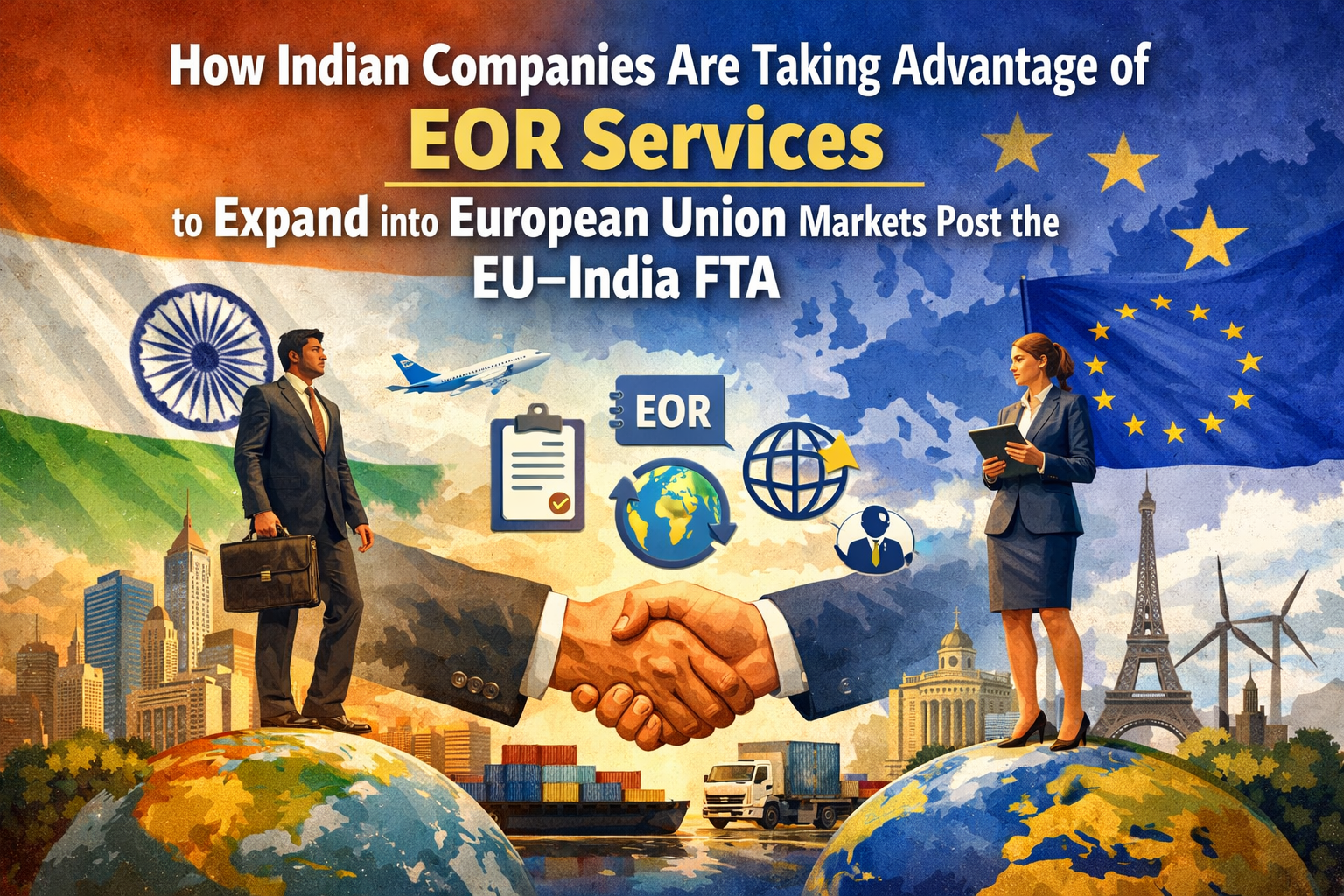
How Indian companies are taking advantage of EOR services to expand to European Union (EU) markets post the EU-India FTA deal.
How Indian Companies Are Taking Advantage of EOR Services to Expand into European Union Markets Post the EU–India FTA
Introduction
The relationship between India and the European Union is entering a more pragmatic phase. While discussions around the EU–India Free Trade Agreement continue, Indian companies are no longer waiting on policy outcomes to shape their growth strategies. Instead, they are preparing operationally for Europe by adopting market entry models that allow speed, flexibility, and compliance to coexist.
What stands out in this shift is the growing reliance on Employer of Record solutions. Rather than viewing EOR as a temporary workaround, Indian companies are using it as a structured pathway to build an early presence across EU markets without taking on the complexity of immediate entity formation.
This approach reflects a broader evolution in how global expansion is being executed in a post-FTA environment.
Why the European Union Is a Strategic Priority for Indian Companies
For Indian businesses with global ambitions, the European Union offers a combination of scale, stability, and sophistication that few regions can match. It provides access to high-value customers, mature economies, and demand for technology-driven services, engineering capabilities, and specialized manufacturing support.
At the same time, Europe is not a single market. Each country operates under its own labor regulations, tax frameworks, and employment standards. Historically, this fragmentation has made expansion slow and expensive, especially for companies entering multiple EU countries simultaneously.
The renewed momentum around the EU–India Free Trade Agreement has changed how Indian companies view this challenge. Instead of delaying entry due to regulatory complexity, they are prioritizing operational readiness so that they can move quickly as commercial opportunities arise.
The Execution Gap Indian Companies Face in EU Expansion
While intent to expand is strong, execution often becomes the bottleneck. Establishing a legal entity in an EU country requires time, local advisors, and ongoing compliance infrastructure. When expansion spans several countries, these requirements multiply and can significantly delay market entry.
For Indian companies, especially those entering Europe for the first time, this creates a sequencing problem. Leadership teams want to explore demand, hire locally, and engage customers, but without committing to high fixed costs before traction is proven.
This is where EOR services for EU expansion have become a practical solution rather than an operational compromise.
What EOR Services Enable in the EU Context
An Employer of Record allows a company to hire employees in a foreign country without setting up a local legal entity. The EOR partner becomes the legal employer for compliance and statutory purposes, while the Indian company retains full control over the employee’s work, responsibilities, and performance.
In the European Union, where employment laws are detailed and employee protections are strictly enforced, this model offers a compliant way to hire talent quickly. Employment contracts, payroll, social security contributions, and labor law obligations are managed locally, ensuring adherence to country-specific regulations.
For Indian companies unfamiliar with EU employment frameworks, this removes a major source of operational risk.
How Indian Companies Are Using EOR Services Strategically
Indian companies are increasingly adopting EOR services as a deliberate entry strategy rather than a short-term workaround. In the early stages of expansion, they typically hire sales, account management, technical, or customer success roles in one or more EU markets.
This allows them to establish local presence, build relationships, and understand customer expectations without committing to entity setup upfront. Because EOR models support country-specific compliance, companies can test multiple EU markets in parallel without building separate legal infrastructures for each one.
As traction builds, teams can scale incrementally, and leadership gains the insight needed to decide where deeper investment makes sense.
The Influence of the EU–India FTA on Expansion Planning
Although the EU–India FTA is still evolving, its broader implications are already influencing corporate strategy. Indian companies expect closer trade cooperation, greater regulatory alignment, and improved market access over time. This expectation has increased the urgency to establish an early foothold in Europe.
By using EOR services for EU expansion, companies are able to act on this opportunity without waiting for policy finality. They can begin hiring, engaging customers, and building operational familiarity, positioning themselves advantageously for future trade facilitation measures.
This proactive stance allows businesses to convert policy momentum into practical readiness.
Compliance Expectations Across EU Markets
Employment compliance in the European Union is rigorous and varies significantly by country. Requirements related to working hours, statutory benefits, termination protections, and employee representation are closely regulated and actively enforced.
For Indian companies, managing these obligations internally can be challenging and resource-intensive. An experienced EOR partner ensures that local employment standards are met from the outset, reducing exposure to compliance risks that could disrupt operations or damage reputation.
In Europe, where governance and regulatory adherence are critical to business credibility, this compliance assurance is particularly valuable.
Why the EOR Model Aligns Well with Indian Companies
Indian companies are accustomed to operating in complex regulatory environments, but they also value efficiency and speed. The EOR model aligns well with this mindset by enabling expansion without unnecessary structural overhead.
It lowers upfront costs, shortens time to market, and preserves flexibility. Importantly, it also keeps strategic options open. Companies are not locked into irreversible decisions before understanding market dynamics.
For leadership teams, this balance between control, compliance, and adaptability makes EOR a compelling component of their EU expansion strategy.
From Initial Presence to Long-Term Market Commitment
EOR services are not typically the final destination for expanding companies. Instead, they serve as a structured starting point. As operations mature, Indian companies can evaluate whether to establish local entities, consolidate regional hubs, or continue operating under an EOR model based on business performance and long-term objectives.
The key advantage is that these decisions are informed by real operational data rather than assumptions. Hiring needs, sales cycles, and customer engagement patterns provide clarity that no pre-entry analysis can fully replicate.
In this way, EOR services for EU expansion help companies move from exploration to execution with confidence.
A Smarter Way to Enter India
As economic ties between India and the European Union continue to strengthen, Indian companies that build early operational familiarity with EU markets will be better positioned to capture long-term value. The ability to hire locally, remain compliant, and operate flexibly without overcommitting resources is shaping a more pragmatic expansion playbook, especially in a post-FTA environment where execution readiness matters as much as strategy.
Employer of Record services have become central to this approach, allowing companies to turn regulatory complexity into a manageable variable rather than a barrier. By working with experienced partners such as Team Management Services (TMS), Indian organizations are combining ambition with practical entry models that enable confident, controlled expansion, transforming Europe from a challenging destination into a structured and achievable growth market.
FAQs
Yes. EOR services allow Indian companies to hire in multiple EU countries simultaneously without setting up separate legal entities.
EOR partners manage employee data and payroll in line with GDPR requirements, reducing compliance risk for Indian companies.
No. EOR models can support sales, technical, consulting, and operational roles, depending on local regulations.