This guide explains Delhi labour compliance for employers with 100 or more staff, including where the Delhi labour code rules stand today. Delhi hosts the headquarters and regional offices of many large employers. It has no Professional Tax, but its Shops Act, Labour Welfare Fund and contract labour rules all apply, and its Labour Code rules are still in draft.
The four central Labour Codes have been in force since 21 November 2025. Delhi has published draft OSH and Industrial Relations rules (3 December 2025) and draft Social Security rules (July 2025). As of 7 November 2026, none is final. This guide sets out what an employer with 100 or more staff in Delhi needs to manage today.
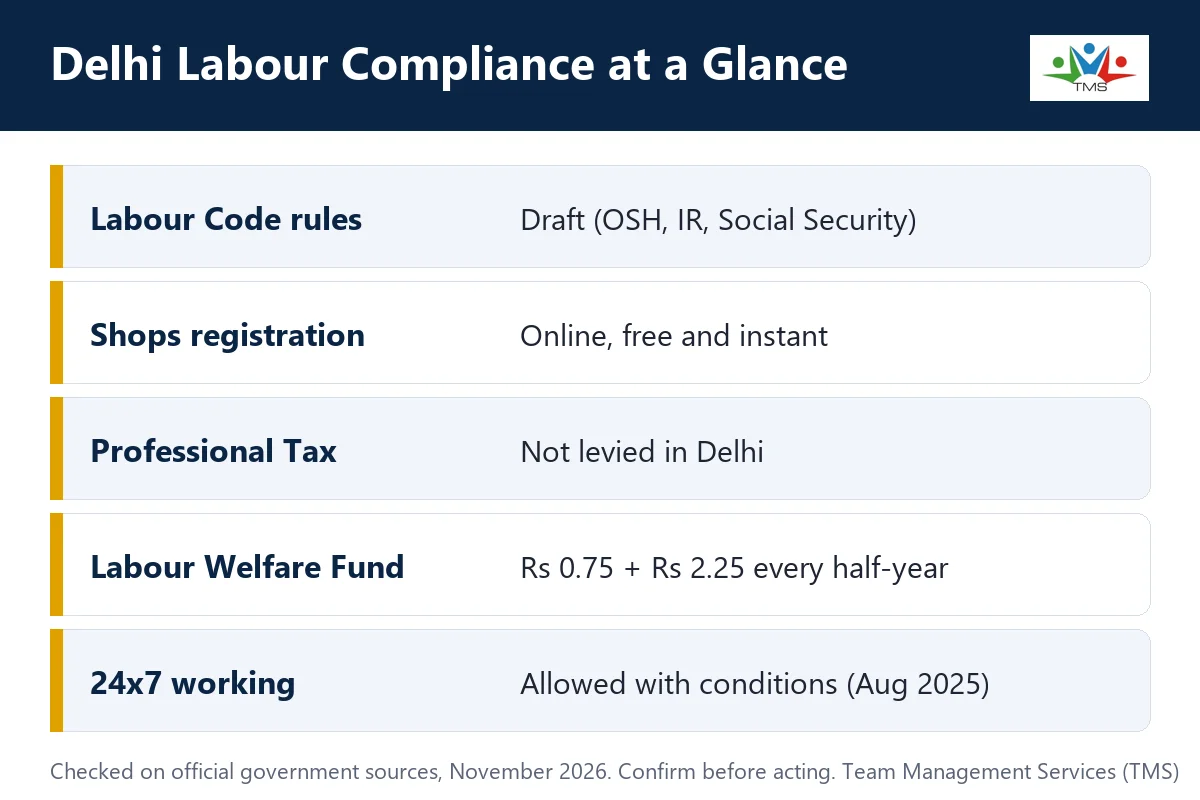
Delhi Labour Compliance at a Glance
| Area | Position (checked 7 November 2026) |
|---|---|
| Labour Code state rules | Draft only |
| Professional Tax | Not levied |
| Labour Welfare Fund | Rs 0.75 employee, Rs 2.25 employer, half-yearly |
| Shops and Establishments | Delhi Shops and Establishments Act 1954; online registration, free |
| Contractor licence | 50+ contract labour (OSH Code) |
Contract Labour Compliance in Delhi: Principal Employer Duties under the OSH Code
Since 21 November 2025, contract labour across India is governed by the Occupational Safety, Health and Working Conditions Code, 2020 (the OSH Code), which replaced the Contract Labour (Regulation and Abolition) Act, 1970. For an employer with 100 or more staff, the Code changes four things.
| Requirement | What the OSH Code says |
|---|---|
| Establishment registration | Every establishment with 10 or more workers registers electronically within 60 days (s.3). An unregistered establishment cannot employ workers. |
| Contractor licence | Required where a contractor engages 50 or more contract labour (s.45, s.47). One licence is valid for 5 years (s.48). |
| Welfare and wages | The principal employer provides welfare facilities to contract labour (s.53) and pays any wages the contractor fails to pay, recovering them from the contractor (s.55). |
| Core activities | Contract labour is not permitted in core activities, except in three cases set out in s.57. |
Engaging contract labour through a contractor who needed a licence and did not hold one is treated as a contravention by the principal employer (s.54). Contractor licence checks should therefore be part of every vendor onboarding.
Contract labour in Delhi today
The Delhi Labour Department relies on the OSH Code for principal employer liability, while its online portal still processes contractor licences and principal employer registrations under the old Contract Labour Act. Until the final Delhi rules are notified, employers should keep existing registrations and licences valid and follow the Code’s principal employer duties.
Professional Tax in Delhi
Delhi does not levy Professional Tax. For employees based in Delhi, no PT deduction applies; employees in other states are taxed by their work location.
Labour Welfare Fund in Delhi
Delhi applies the Bombay Labour Welfare Fund Act, 1953, as extended to Delhi. The contribution is Rs 0.75 per employee and Rs 2.25 by the employer for each half-year, for employees on the register on 30 June and 31 December. The employer pays both shares before 15 July and 15 January.
Shops and Establishments in Delhi
The Delhi Shops and Establishments Act, 1954 remains in force. Registration is online, free and issued instantly.
| Rule | Position |
|---|---|
| Working hours | 9 hours a day, 48 a week; half-hour break after 5 hours |
| Leave | 15 days privilege leave (carries up to 45) and 12 days sickness or casual leave |
| 24×7 operation | Permitted for all establishments except liquor shops (notification of 7 August 2025) |
| Women at night | Written consent, transport and security, CCTV, a POSH Internal Committee, and an undertaking filed with the Labour Department |
Delhi’s current minimum wage order is effective from 1 April 2025, with unskilled workers at Rs 18,456 a month.
Delhi Labour Compliance Checklist for Multi-State Employers
Most employers with 100 or more staff operate in more than one state. The central Codes are common, but registrations, Professional Tax, LWF and shop rules are state by state. A practical control list:
- Map every site and headcount by state, including contract labour on any day of the last 12 months.
- Confirm OSH Code establishment registration for each site with 10 or more workers.
- Keep a register of contractors with licence numbers, validity, states covered and permitted headcount.
- Set Professional Tax and LWF deductions in payroll by work location, not by head office.
- Track each state’s due dates in one calendar: PT is monthly in some states and half-yearly in others.
- Check Shops and Establishments registration or intimation for every office, store and branch.
- Review night-shift approvals and conditions for women employees state by state.
- Recheck each state’s Labour Code rules every quarter: several states are still at the draft stage.
How TMS Supports Large Employers in Delhi
Team Management Services manages statutory compliance, payroll and contract labour governance for employers across India, including OSH Code registrations, contractor licence audits, Professional Tax and LWF filings, and Shops and Establishments registrations. See our HR services in Delhi and contract labour compliance services, or speak to our compliance team.
Frequently Asked Questions
Is there Professional Tax in Delhi?
No. Delhi does not levy Professional Tax.
Can Delhi establishments operate 24×7?
Yes. A notification of 7 August 2025 permits all establishments except liquor shops, subject to conditions including consent and safety measures for women working at night.
What is the Delhi LWF contribution?
Rs 0.75 per employee and Rs 2.25 by the employer for each half-year, paid by the employer before 15 July and 15 January.
Related Reading
- Statutory compliance services in Delhi NCR
- Professional Tax rates 2026, state by state
- Labour Code state rules 2026: what each state decides
Sources
- Delhi Labour Department: Shops Act, minimum wages and draft rules
- Delhi Labour Welfare Board
- Ministry of Labour and Employment: Labour Codes
Last checked: 7 November 2026. Where state rules are still in draft, positions may change when final rules are notified. This guide is general information, not legal advice.