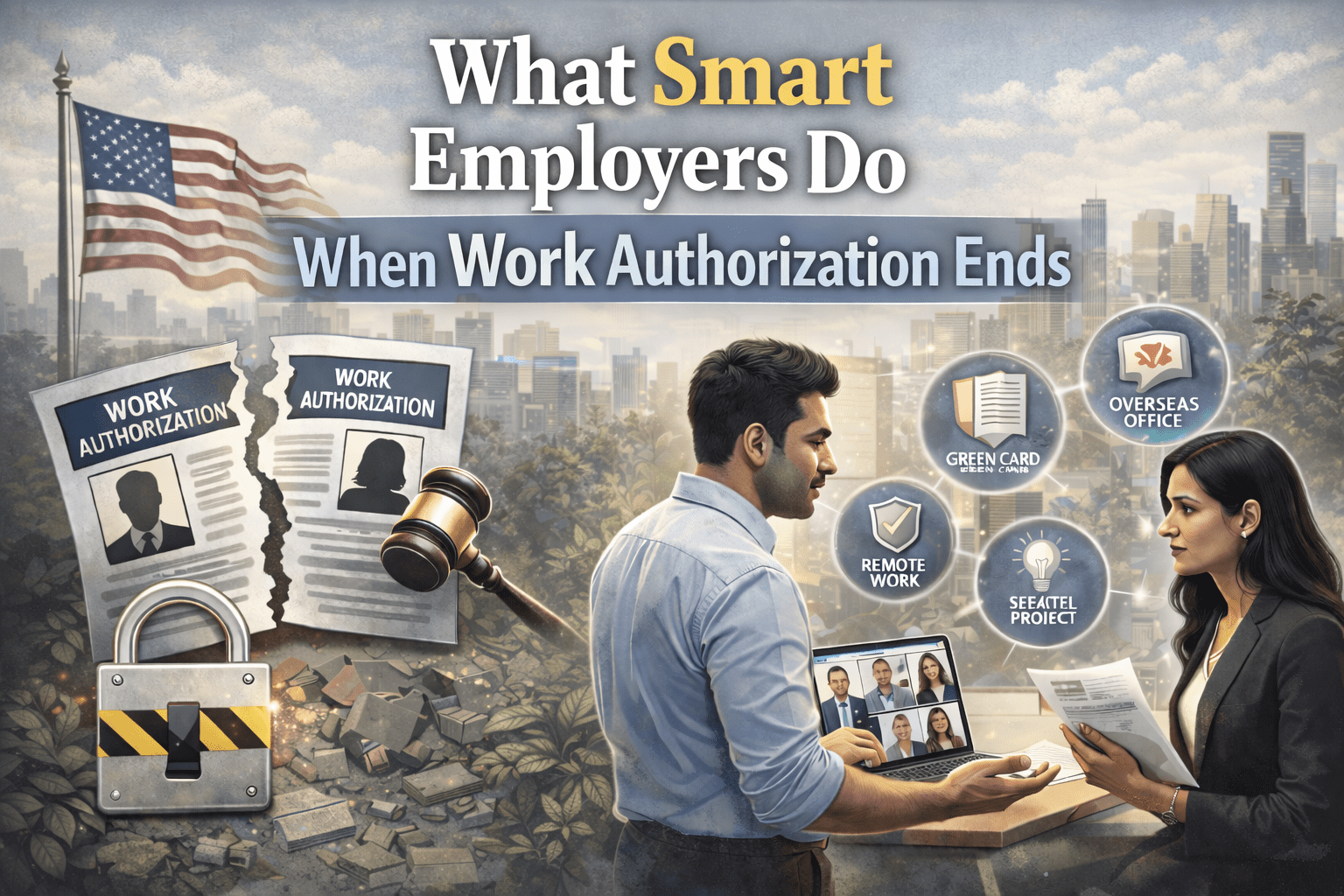
What Smart Employers Do When Work Authorization Ends
Introduction:
However, when work authorization stalls, smart employers keep talent productive by shifting roles to India through an EOR — no visa. No downtime, full compliance. Moreover, work authorization issues rarely come with advance notice. One day, teams are running smoothly. The next, an employer is informed that an employee can no longer legally continue working due to visa or authorization expiry.
When an employee work authorization expired, the impact goes far beyond compliance. Projects stall, costs rise, and difficult decisions must be made quickly.
Smart employers understand that this moment is not just a legal issue—it is a leadership test.
Why This Situation Is Becoming More Common
For example, global hiring has increased significantly over the last decade. At the same time, visa processing timelines have become less predictable.
More companies are facing situations where:
- Employees must stop work immediately
- Travel restrictions force sudden relocations
- Approvals remain uncertain for extended periods
When an employee visa expired, employers are often left navigating unclear options under pressure.
The Immediate Risks Employers Face
Once work authorization ends, employers must act fast. Continuing work without authorization exposes the company to serious legal and financial risks.
However, stopping work entirely creates another set of challenges:
- Missed deadlines
- Client dissatisfaction
- Internal disruption
- Rising bench costs
A work authorization expired employee situation forces leadership to balance compliance with business continuity.
Why Waiting or Replacing Talent Is No Longer a Practical Solution
Earlier, companies often placed employees on temporary leave while waiting for approvals. Today, that approach is costly and unsustainable. Paid leave without productivity strains budgets, while prolonged uncertainty damages morale and increases attrition risk. For employers, waiting without a structured plan frequently leads to rushed decisions later—usually at a much higher cost.
When authorization ends, replacing the employee may appear to be the safest route. However, this option carries significant hidden expenses. Recruitment costs, onboarding time, and the loss of institutional knowledge can easily outweigh short-term compliance relief. In highly skilled roles, replacements may take months to reach full productivity. Specifically, this is why many employers now explore alternatives before letting go of trained talent.
How Smart Employers Reframe the Problem
Instead of viewing authorization expiry as an endpoint, experienced employers see it as a transition point.
They separate:
- Employment structure from
- Work contribution
This mindset allows companies to retain talent while staying compliant—even when physical presence or visa status changes.
Employer of Record: A Practical Compliance Solution
One increasingly adopted solution is transitioning affected employees to an Employer of Record (EOR) model in India.
Under this structure:
- The EOR becomes the legal employer in India
- Payroll, taxes, and labor compliance are managed locally
- The employee continues working operationally for the U.S. company
This approach allows employers to retain output without violating local or international regulations.
Managing Costs When Authorization Ends
Cost control becomes critical the moment authorization expires.
Keeping employees on U.S. payroll without work authorization is not viable. At the same time, terminating skilled employees can increase long-term costs.
India payroll under an EOR model often provides:
- Predictable employment costs
- Continued productivity
- Reduced bench expenses
When an H1B work authorization expired, this balance between compliance and cost becomes especially important.
Protecting Client Commitments and Delivery Timelines
Client expectations do not pause for immigration issues. Sudden employee exits can put contracts, timelines, and service quality at risk.
By planning structured employment transitions, employers can:
- Maintain delivery continuity
- Avoid reassigning projects midstream
- Preserve client trust
This continuity is often the key driver behind employer decisions.
Why Employee-Centric, Flexible Workforce Models Are Becoming the Standard
From the employee’s perspective, authorization expiry often feels like career instability. Employers who communicate clearly and offer structured alternatives reduce anxiety, strengthen loyalty, and demonstrate long-term commitment—not just short-term compliance. Providing legal, compliant employment options, such as the TMS Employer of Record (EOR) solution. Reinforces this trust and highlights the importance of the human element, which many companies initially underestimate.
At the same time, global workforce planning has evolved. Employers no longer rely on a single country or visa category to build resilient teams Authorization uncertainty has accelerated the shift toward flexible. Compliant employment models that adapt to changing conditions. Rather than reacting case by case, forward-thinking employers now design policies in advance—often leveraging solutions like TMS EOR—to stay prepared, compliant, and competitive.
When Should Employers Act?
Employers typically explore structured alternatives when:
- Authorization expiry is confirmed or imminent
- Approvals lack clear timelines
- Projects cannot afford disruption
- No local entity exists in the employee’s country
Acting early reduces risk and avoids last-minute decisions.
A Smarter Way Forward
Visa and authorization systems may remain unpredictable, but workforce continuity does not have to suffer because of it. When an employee’s work authorization expires, employers who act decisively—while remaining fully compliant—can protect productivity, control costs, and retain valuable institutional knowledge. Clear planning and timely action prevent disruption, reduce uncertainty for employees, and avoid the expensive consequences of rushed decisions.
The choices made at this stage often shape long-term workforce resilience. Organizations that plan ahead, adopt flexible employment models. Prioritize both compliance and people are far better positioned to navigate ongoing regulatory uncertainty with confidence.
FAQs
Yes. Employers can reassess payroll and location once authorization is restored, depending on business needs.
No. EOR can support both short-term transitions and long-term workforce strategies.
Immediate action is recommended to avoid compliance risks and operational disruption.
No. It also applies when approvals are delayed or when authorization validity is uncertain.
Frequently Asked Questions
What can employers do when work authorization stalls?
They can shift roles to India through an EOR. The work continues without a visa.
Is moving a role to India fast?
Yes. Projects avoid long downtime.
Does the employee stay with the company?
Effectively, yes — you direct the work while the EOR employs them. Continuity is preserved.
Is it compliant?
Yes. In fact, the EOR ensures full Indian labour-law compliance.
Build Your India Team with TMS
Hiring and paying staff in India is simplest with one accountable partner. Therefore, TMS covers the full lifecycle:
- Employer of Record (EOR) — hire and pay staff in India with no entity setup.
- Payroll outsourcing — salaries, PF, ESIC, and TDS handled accurately.
- Statutory compliance — labour-law compliance under the Codes now in force.
- Contract staffing — flex your India headcount as needed.