We use cookies to improve your experience, analyse traffic, and for marketing. You can accept all, reject non-essential, or choose your preferences. See our Cookie Policy.
Cookie preferences
Choose which cookies to allow. Essential cookies are always on. Read our Cookie Policy.
Essential
Required for the site to function. Always active.
Analytics
Helps us understand how visitors use the site (Google Analytics, Microsoft Clarity).
Marketing
Used to measure ad performance and show relevant ads (Google Ads).
5 Warning Signs Your HR Compliance Might Be Outdated
5 Warning Signs Your HR Compliance Might Be Outdated
Introduction
When it comes to running a business, HR compliance often doesn’t make the headlines—until something goes wrong. It’s not just about following rules; it’s about building a safe, transparent, and lawful workplace. Outdated HR policies or processes can quietly create serious risks for both employees and employers.
From overlooked legal changes to inconsistent onboarding, the warning signs are often subtle—until they become expensive. Let’s break down five clear indicators that your HR compliance might need more than just a quick review.
1. Your Employee Handbook Feels Like It Was Written in Another Era
The employee handbook is more than a welcome packet—it’s your company’s HR blueprint. If it still talks about fax machines or ignores work-from-home protocols, you’re probably overdue for an update. Outdated policies can create gaps in protection. Laws around equal opportunity, anti-harassment, leave entitlements, and remote work have changed drastically in recent years. A non-compliant handbook can’t defend your business in a legal dispute—and worse, it could be used against you.
Regularly reviewing and updating your employee manual is a simple way to maintain HR compliance while reinforcing workplace clarity and consistency.
Pro tip: Have your handbook legally reviewed once a year or after any major legislative updates.
2. Different Teams Follow Different Hiring and Onboarding Methods
Inconsistent onboarding isn’t just confusing—it’s a compliance risk. If one department uses printed contracts while another relies on email confirmations, your hiring process lacks legal uniformity. Recruitment and onboarding need to follow a defined structure that aligns with local employment laws. From documentation to background verification, every step matters. A scattered approach could violate labor laws, trigger discrimination claims, or result in missed mandatory disclosures.
Consistency ensures that every new hire starts on the right legal footing, protecting both the employee and the organization.
Reminder: Uniform hiring processes are a key part of HR compliance. Documentation should always be accurate, traceable, and audit-ready.
3. There’s Uncertainty Around Leave Policies and Work Hours
If employees often ask, “How many days of sick leave do I get?”—you may have a compliance issue. Labor laws related to working hours, weekly offs, leave structures, and overtime differ across states. Not staying current means unintentional violations.
For example, some states mandate specific leave types like earned leave, while others have defined rules for compensatory offs. If your HR policies ignore these details, even unknowingly, it can lead to compliance penalties and employee dissatisfaction.
Clearly communicating leave rules and working hours builds trust—and avoids trouble.
Tip: Align your leave policy with state-specific labor laws to keep your HR compliance practices watertight.
4. Statutory Registers Are Missing or Not Maintained Properly
From Form 7 registers to wage slips and muster rolls—statutory registers are non-negotiable under Indian labour laws. If these documents are missing, incomplete, or still managed in dusty files, you’re inviting risk. Labour inspectors don’t give much notice before a visit. A single missing register can lead to penalties or even legal action. Digital tools make it easier to maintain these records, but you still need someone to ensure they’re compliant.
Maintaining updated statutory registers is one of the most basic pillars of HR compliance—but also one of the most overlooked.
Check: Are your registers updated monthly? Are they stored safely, digitally or physically?
5. Payroll Is Still Handled Manually
Manual payroll calculations might have worked when your team had ten employees. But as your business grows, spreadsheets often fall short. Errors in salary, PF, ESI, gratuity, or tax deductions don’t just cause frustration—they can invite serious legal trouble. India’s payroll compliance landscape is layered and fast-changing. Keeping up with TDS rules, PT slabs, and labour welfare fund updates isn’t easy. One small error can lead to fines, loss of credibility, or both.
Automated payroll systems or professional payroll partners can keep you compliant and efficient without guesswork.
Fact: One of the most common areas where HR compliance fails is payroll. Don’t let outdated systems be the cause.
Time to Rethink Your HR Compliance Strategy?
HR compliance isn’t just a checkbox on your HR to-do list—it’s the foundation for protecting your people and your business. If even one of the warning signs above feels familiar, it may be time to review your compliance processes before they become liabilities.
This is where Team Management Services (TMS) can help. Our team works closely with businesses to keep their HR functions aligned with current laws and documentation standards. Whether you need support with statutory registers, policy updates, or payroll accuracy, we’ve got you covered.
Explore how we can support your compliance journey by visiting our Statutory Compliance Solutionspage through our official website.
What Compliance Reports Should HR Generate Every Month?
What Compliance Reports Should HR Generate Every Month?
Introduction
Let’s face it—HR compliance isn’t something you can leave on autopilot. With laws changing often and inspections getting stricter, generating monthly HR compliance reports isn’t just a formality anymore. It helps protect your company from penalties, builds employee confidence, and keeps you ready for audits at any time.
Each month comes with its own set of deadlines and paperwork. If you’re still managing everything with last-minute notes or just trying to remember what’s due, it might be time for a change. These reports don’t just organise your tasks—they show that your HR team takes compliance seriously and stays on top of responsibilities.
So, what exactly should your HR team report every month? Below are the key reports that should always be on your checklist.
1. PF and ESI Contribution Reports
The Provident Fund (PF) and Employee State Insurance (ESI) contributions aren’t just routine—they’re legally mandated. Each month, both employee and employer contributions must be calculated and deposited into the respective accounts. But the job doesn’t end there.
A monthly PF/ESI report helps HR verify that the contributions are accurate, deductions are consistent, and UANs are correctly mapped. These reports also act as backup when reconciling payroll data or responding to government inspections. Miss the PF deadline (usually the 15th of the following month), and you could face interest or damages. So, consider this a high-priority task on your compliance checklist.
2. Professional Tax and Labour Welfare Fund Reports
In states where Professional Tax (PT) and Labour Welfare Fund (LWF) are applicable, monthly monitoring is a must. While PT returns are generally submitted monthly, LWF may be filed half-yearly or annually—but it still needs regular internal tracking.
Why? Because skipping even one monthly PT deduction could throw off your filings or raise red flags during audits. Generating monthly summaries helps HR verify that all regional mandates are met, especially for companies operating in multiple states. A little diligence here can go a long way in avoiding compliance gaps.
3. Salary and Wage Register
Sure, salary slips are shared with employees. But internally, HR must maintain a complete monthly wage register that includes gross salary, deductions, and net pay for every employee. This isn’t just best practice—it’s a legal requirement under labour laws like the Payment of Wages Act and Minimum Wages Act.
Digital tools can help, but don’t assume automation is foolproof. A thorough monthly review ensures that anomalies (such as miscalculations or unapproved deductions) don’t get carried forward. Also, during labour inspections, wage registers are among the first documents requested. So, keeping them accurate and up-to-date isn’t optional—it’s strategic.
4. Leave and Attendance Reports
Every company has leave policies, but without proper records, enforcing them is nearly impossible. That’s where monthly HR compliance reports on leave and attendance come into play. These reports log employee hours, absenteeism, late marks, and paid leaves—creating a transparent system that protects both employer and employee rights.
Additionally, when employees apply for maternity leave, earned leave encashment, or face disciplinary action, this data becomes essential. It also helps HR maintain compliance with various state-specific Shops and Establishments Acts or the Factories Act, which often mandate minimum working hours and rest periods.
5. Compliance Checklists and Statutory Tracker
Think of a monthly compliance checklist as your team’s early warning system. It outlines every statutory filing, deadline, and documentation requirement for the month—helping you stay ahead, not just afloat. Combine this with a statutory tracker to monitor ongoing tasks, like license renewals or inspection readiness.
With so many moving parts in HR compliance, these two reports create structure and accountability. They ensure that even if a team member is on leave or transitions out, critical filings don’t fall through the cracks.
Are You Generating the Right Monthly Reports?
Inconsistent reporting or missed filings often point to deeper issues—either in your system or your process. Monthly HR compliance reports do more than just tick boxes; they offer visibility, prevent last-minute scrambles, and build trust across the organisation. They’re your most reliable tool to avoid both short-term stress and long-term legal risks.
If keeping up with these reports feels like a constant chase, you’re not alone. Many organisations choose to partner with experts like Team Management Services (TMS), who support businesses across India in managing and tracking their statutory obligations. From PF and ESI to state-specific filings, having a compliance partner means nothing gets overlooked. With the right support, your HR team can stay proactive and inspection-ready month after month.
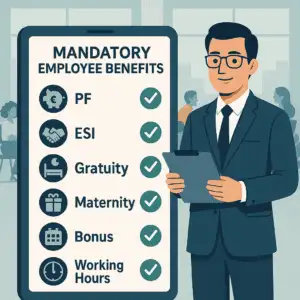
These 7 Employee Benefits Are Required by Law — Are You Offering Them?
These 7 Employee Benefits Are Required by Law — Are You Offering Them?
Introduction
India’s employment laws don’t just exist to complicate payroll — they’re designed to protect employees and encourage fair practices. But even with the best intentions, companies can slip up by missing one crucial detail: mandatory employee benefits. As an HR decision-maker or business owner, you’re not just responsible for disbursing salaries. You’re accountable for ensuring every statutory benefit is properly provided, documented, and reported. Miss a step, and you could face legal penalties, employee grievances, or worse — a damaged reputation.
Let’s explore the seven employee benefits that are legally required in India. These aren’t perks. They are statutory, non-negotiable responsibilities that define compliant, people-first workplaces.
1. Provident Fund (PF): The Retirement Foundation
The Employees’ Provident Fund (EPF) is a must for organizations with 20 or more employees. Both employer and employee contribute 12% of the employee’s basic salary into the fund. This benefit creates financial security for employees and ensures long-term savings.
Failing to contribute correctly or missing deadlines can lead to penalties. That’s why many companies turn to experts like Team Management Services for help with compliance.
2. Employee State Insurance (ESI): Health Coverage for the Lower-Wage Segment
If your company employs 10 or more people earning ₹21,000 or less per month, ESI is mandatory. It covers medical expenses, maternity leave, and even disability benefits. Timely ESI contributions show that your organization values its people — not just their productivity.
3. Gratuity: A Token of Long-Term Appreciation
Gratuity becomes payable once an employee completes five years of continuous service. It’s calculated based on the last drawn salary and years of service. While it might feel like a distant obligation, not budgeting for gratuity payouts can affect cash flow later. Staying prepared is smart HR.
4. Paid Leaves and Holidays: Statutory Time Off Isn’t Optional
The law mandates certain paid leaves — including annual leave, sick leave, and public holidays. Each state has its own rules, so staying updated is key. Offering paid time off isn’t just a rule. It’s a reflection of a company culture that respects work-life balance.
5. Maternity Benefits: Supporting Parenthood with Policy
Under the Maternity Benefit Act, eligible women employees can take 26 weeks of paid leave. This law ensures job protection and health benefits during a crucial time. Organizations that support parental benefits signal care, inclusivity, and long-term thinking.
6. Bonus Payments: Recognizing Contribution by Law
Companies with 10 or more employees are required to pay an annual bonus to those earning ₹21,000 or less per month. The minimum bonus is 8.33% of the salary. Even if your profit margins are tight, bonus compliance isn’t optional. It’s a statutory duty and also a tool for motivation.
7. Working Hours and Overtime Pay: Fair Compensation for Time
The Factories Act and Shops & Establishments Acts regulate working hours and mandate overtime pay. Employees should not work more than 9 hours a day or 48 hours a week without proper compensation. Transparency around time policies protects your business and builds accountability across the board.
Why These Benefits Matter More Than You Think
Statutory benefits aren’t just rules — they’re the basic building blocks of responsible business. Employees notice when they’re missing. So do government inspectors. Getting these wrong can cost you in the form of audits, back-payments, or brand damage.
Why Forward-Thinking Employers Are Registering Under NATS in 2025
Why Forward-Thinking Employers Are Registering Under NATS in 2025
Introduction
In 2025, registering under NATS (National Apprenticeship Training Scheme) is no longer just an option—it’s a smart business move. With industries rapidly evolving, employers who adapt early are gaining the upper hand. From an HR perspective, this isn’t just about compliance or ticking boxes. It’s about building a sustainable talent pipeline that aligns with the future of work.
Today’s workforce is shifting. So, employers need to think ahead, not just react.
What Makes NATS So Relevant for Employers in 2025?
The scheme offers companies a structured way to bring in fresh talent through apprenticeships. But beyond that, registering under NATS lets employers train candidates their way—aligning learning with real-world roles. The government, through NATS, partially supports the stipend paid to apprentices. This means companies get access to energetic young talent while saving on training costs. What’s more, companies are showing social responsibility by actively contributing to skill development. Forward-thinking HR teams see this as an opportunity, not a task.
From an HR Lens: Why You Shouldn’t Wait
For HR professionals, the advantages are clear. When your organisation is registered under NATS, you’re not just filling roles—you’re shaping future employees from day one. Apprentices trained under this scheme often stay longer, learn faster, and align better with company culture. Moreover, NATS registration reflects well on your employer branding. It signals that your organisation values learning and is invested in India’s skilling ecosystem. Candidates notice. So do clients.
Training, Retention, and Culture Fit: A Winning Trio
Traditional hiring can sometimes feel like a gamble. But with apprenticeships, you build talent from the ground up. These trainees get hands-on exposure while learning on the job. That results in better performance and smoother team integration. Also, companies that invest in training tend to retain employees longer. Apprentices appreciate the learning opportunity. In return, they offer loyalty, fresh ideas, and an eagerness to grow with the company. That’s a win for HR and a big win for the business.
How to Get Started with NATS the Right Way
While the process of registering under NATS isn’t complicated, it does require proper documentation and timely follow-ups. That’s where having the right support partner makes all the difference.
At Team Management Services, we assist employers in navigating the entire NATS registration process. From explaining eligibility to coordinating with the appropriate authorities, we help ensure that everything runs smoothly and correctly—saving time and reducing confusion.
Looking to explore NATS for your organisation? Connect with us to get startedand discover how we can support your team in joining the initiative.
Final Thoughts
Registering under NATS in 2025 isn’t just about meeting requirements—it’s a strategic HR move. As industries shift and talent becomes more dynamic, apprenticeship programs will play a key role in helping companies stay ahead.
So, if your organisation is serious about building skills, improving retention, and preparing for the future—now’s the time to act.
Team Management Services is here to support you every step of the way.
NAPS Isn’t Just for Big Corporates — MSMEs Are Benefiting Too
NAPS Isn’t Just for Big Corporates — MSMEs Are Benefiting Too
By Abhijit Divekar • Published: June 19, 2025 • Updated: March 7, 2026
Key Takeaway: The National Apprenticeship Promotion Scheme (NAPS) is not limited to large corporations. MSMEs (Micro, Small, and Medium Enterprises) are among the biggest beneficiaries — receiving government stipend reimbursements of up to ₹1,500/month per apprentice, basic training cost support of up to ₹7,500 per apprentice, and access to a skilled workforce pipeline without long-term employment commitments. With a Third Party Aggregator (TPA) like TMS handling compliance and documentation, MSMEs can start benefiting from NAPS within 2-4 weeks.
Introduction: Why NAPS Is a Game-Changer for Indian MSMEs
When most people hear about the National Apprenticeship Promotion Scheme (NAPS), they assume it is designed for large companies with established HR departments and dedicated training facilities. This perception is outdated and incorrect.
Since its restructuring, NAPS has become one of the most accessible and financially beneficial government schemes for MSMEs in India. The scheme is administered by the Directorate General of Training (DGT) under the Ministry of Skill Development and Entrepreneurship, and it explicitly targets MSMEs as a priority segment for apprenticeship adoption.
India has over 63 million MSMEs employing more than 110 million people. Yet most of these enterprises struggle with two persistent challenges: finding skilled workers and managing the cost of training unskilled hires. NAPS directly addresses both problems by providing financial incentives to employers who engage apprentices — and the government absorbs a significant portion of the training and stipend costs.
With a NAPS Third Party Aggregator (TPA) like Team Management Services handling registration, documentation, and compliance, even MSMEs with no prior apprenticeship experience can start enrolling apprentices within weeks.
What Is NAPS and How Does It Work?
The NAPS apprenticeship scheme was launched by the Government of India to promote apprenticeship training in establishments across all sectors. Under NAPS, employers engage apprentices for a defined training period (typically 6-12 months) and receive financial support from the government toward stipend and training costs.
Key Components of NAPS
Stipend reimbursement: The government reimburses 25% of the prescribed stipend, up to a maximum of ₹1,500 per apprentice per month, directly to the employer
Basic training cost support: For apprentices who require basic training, the government covers the cost up to ₹7,500 per apprentice (for a maximum of 500 hours/3 months of basic training)
No obligation for permanent employment: Employers are not required to offer permanent jobs to apprentices after training completion
Flexible duration: Apprenticeship contracts can range from 6 months to 3 years depending on the trade and skill requirements
Digital portal: The entire process — registration, contract generation, stipend claims — is managed through the government’s apprenticeship portal
Why MSMEs Benefit More From NAPS Than Large Companies
While large corporations can absorb the cost of training programmes, MSMEs operate on tighter margins where every rupee of cost savings matters. Here is why NAPS delivers disproportionate value for smaller businesses:
1. Reduced Hiring Costs
Recruiting skilled workers is expensive for MSMEs — portal listings, screening, interviews, and onboarding can cost ₹15,000-40,000 per hire. Under NAPS, MSMEs engage apprentices at subsidised stipends (significantly below market salaries) and the government reimburses a portion. After the training period, the best apprentices can be converted to permanent employees — essentially giving the MSME a cost-effective trial period with government support.
2. Government Financial Support
For an MSME engaging 10 apprentices under NAPS, the financial benefit breaks down as follows:
Benefit Component
Per Apprentice (12 months)
For 10 Apprentices
Stipend reimbursement (25%, max ₹1,500/month)
Up to ₹18,000/year
Up to ₹1,80,000/year
Basic training cost support
Up to ₹7,500 (one-time)
Up to ₹75,000
Total government support
Up to ₹25,500
Up to ₹2,55,000
For an MSME, ₹2.55 lakh in government subsidies for workforce training represents a significant financial advantage — one that directly improves the bottom line while building a skilled talent pipeline.
3. Compliance Is Simpler Than You Think
Many MSMEs avoid NAPS because they assume the compliance requirements are burdensome. In reality, the Apprentices Act, 1961 (amended in 2014) has been significantly simplified for MSMEs. The key requirements are: registration on the apprenticeship portal, execution of apprenticeship contracts, payment of prescribed stipends, provision of on-the-job training, and periodic progress reporting.
When MSMEs engage a NAPS TPA (Third Party Aggregator), even these requirements are handled by the TPA. The MSME’s only responsibility is providing the workplace and on-the-job training — everything else is managed externally.
4. No Long-Term Employment Obligation
Unlike regular employees who are protected by various labour laws regarding termination and retrenchment, apprentices are engaged under the Apprentices Act. At the end of the training period, the employer has full discretion to offer permanent employment or conclude the engagement. This flexibility is particularly valuable for MSMEs that need to manage workforce costs carefully.
NAPS vs. NATS: Understanding the Difference
Employers often confuse NAPS with NATS (National Apprenticeship Training Scheme). While both promote apprenticeship training, they target different groups:
Feature
NAPS
NATS
Governing body
DGT (Ministry of Skill Development)
BOPT (Ministry of Education)
Target apprentices
ITI graduates, school dropouts, freshers
Engineering graduates, diploma holders
Stipend support
25% reimbursement (max ₹1,500/month)
No direct stipend reimbursement
Training cost support
Up to ₹7,500 per apprentice
Not applicable
Best for MSMEs
✅ Yes — designed for all establishments
Limited — mainly for engineering firms
TPA involvement
✅ TPAs handle end-to-end compliance
Direct engagement with BOPT
For most MSMEs, NAPS is the more relevant and financially beneficial scheme. However, companies in engineering and technology sectors may benefit from engaging both NAPS and NATS apprentices simultaneously.
How a TPA Makes NAPS Effortless for MSMEs
A Third Party Aggregator (TPA) is an organisation authorised by the DGT to facilitate apprenticeship engagements on behalf of employers. For MSMEs, working with a TPA eliminates the administrative burden entirely. Here is what a TPA like TMS handles:
Portal registration: Setting up the employer’s account on the apprenticeship portal and completing all documentation
Apprentice sourcing: Identifying and screening suitable apprentice candidates from ITIs, polytechnics, and skill development centres
Contract execution: Generating and managing apprenticeship contracts through the government portal
Stipend management: Processing monthly stipend payments and filing reimbursement claims with the government
Compliance monitoring: Ensuring all Apprentices Act requirements are met, including training records and progress reports
Government liaison: Handling all communication with DGT, Regional Directorate of Apprenticeship Training (RDAT), and state authorities
With a TPA managing the process, MSMEs can start engaging apprentices within 2-4 weeks — compared to 2-3 months when handling registration and compliance independently.
Frequently Asked Questions
Is NAPS available for MSMEs and small businesses?
Yes, NAPS is specifically designed to include MSMEs. Any establishment with 4 or more workers (including contract workers) is eligible to engage apprentices under the Apprentices Act. There is no minimum company size requirement, and the government actively encourages MSME participation through financial incentives and simplified compliance through TPAs.
How much does NAPS save for an MSME employer?
Under NAPS, the government reimburses 25% of the prescribed stipend up to ₹1,500 per apprentice per month, plus up to ₹7,500 toward basic training costs per apprentice. For an MSME engaging 10 apprentices for 12 months, the total government support can reach ₹2.55 lakh. Additionally, apprentice stipends are significantly lower than regular employee salaries, providing further savings on workforce costs.
Do MSMEs need to hire apprentices permanently after training?
No. Under the Apprentices Act, there is no obligation to offer permanent employment after the apprenticeship period ends. Employers have full discretion to offer regular employment to high-performing apprentices or conclude the engagement at the end of the contract period. This flexibility makes NAPS particularly attractive for MSMEs that want to build skills without long-term headcount commitments.
What is a NAPS TPA and why should MSMEs use one?
A TPA (Third Party Aggregator) is an organisation authorised by the Directorate General of Training to facilitate apprenticeship programmes on behalf of employers. TPAs handle registration, apprentice sourcing, contract management, stipend processing, government reimbursement claims, and compliance monitoring. For MSMEs without dedicated HR departments, a TPA makes NAPS participation virtually effortless — the MSME provides the workplace and training, while the TPA handles everything else.
Which sectors and trades are eligible under NAPS?
NAPS covers designated trades (notified by the government covering manufacturing, services, and technical sectors) and optional trades (defined by the employer based on their industry needs). Sectors ranging from manufacturing, IT, retail, healthcare, hospitality, automotive, logistics, and BFSI are all eligible. MSMEs can also propose new optional trades relevant to their specific business operations through the apprenticeship portal.
Conclusion: MSMEs Should Not Miss the NAPS Opportunity
The National Apprenticeship Promotion Scheme is one of the most underutilised government benefits available to Indian MSMEs. With direct financial subsidies, no permanent employment obligations, and simplified compliance through TPAs, NAPS offers MSMEs a structured, cost-effective pathway to build a skilled workforce.
Every month an eligible MSME delays NAPS adoption is a month of government subsidies and skilled talent pipeline development left on the table.
Abhijit Divekar is the Managing Partner of Team Management Services (TMS), with 19+ years of experience in HR outsourcing, contract staffing, and statutory compliance across India. He has helped 450+ companies build compliant, scalable workforces.
How MYKPY Helps Maharashtra Employers Stay Ahead in a Competitive Market
Why MYKPY Isn’t Just Another Scheme — It’s a Smart Move for Maharashtra Employers
What Is MYKPY and Why It’s Gaining Attention
MYKPY (Mukhyamantri Yuva Karya Prashikshan Yojana) is more than just a stipend-sharing scheme. It’s a government-backed initiative that connects Maharashtra employers with fresh graduates and diploma holders for 6-month on-the-job training. During this period, the state government covers a portion of the stipend, helping employers reduce their hiring and training costs. It gives HR teams a structured way to train new talent while addressing real business needs. It’s not only cost-effective but also strategic—especially for growing businesses that want to build loyal, skilled teams from the ground up.
How MYKPY Works for Employers
Under MYKPY, companies can bring in young professionals as trainees for six months. These candidates work alongside full-time employees, gaining real experience while contributing to business operations.
The government offers partial stipend support, reducing the financial burden on the employer. This lets businesses train fresh talent without committing to full-time salaries right away. It also gives HR leaders time to assess the trainees’ skills, cultural fit, and potential for long-term roles.
Why HR Leaders Are Taking MYKPY Seriously
From an HR perspective, MYKPY isn’t just about saving costs—it’s about shaping your future workforce. Here’s what makes it a strong HR tool:
You get motivated, job-ready trainees.
Training is aligned with your company’s real-time needs.
At the end of six months, you can offer full-time roles to those who’ve already adapted to your systems and culture—improving retention and reducing onboarding time.
In high-demand regions like Mumbai, Pune, and Nagpur, MYKPY helps companies remain competitive by building talent from within.
How MSMEs Can Maximise the MYKPY Advantage
MYKPY is especially useful for MSMEs, which often manage hiring, training, and operations with limited resources.
Here’s how small and mid-sized businesses can benefit:
Train on your terms: Shape the trainee experience based on your daily business needs.
Start small: Bring in one or two trainees to begin, and expand if needed.
Reduce hiring risk: You get to evaluate a trainee’s performance before extending a full-time offer.
Lower costs: With government support on stipends, your overall investment per trainee drops significantly.
It’s a smart, low-risk way to strengthen your team without overextending your budget.
Is Your Business Eligible? Most Likely, Yes
MYKPY is available to:
MSMEs
Startups
NGOs
Any registered business in Maharashtra that complies with employment norms
The process is straightforward, and the focus is clear—help young graduates gain meaningful work experience while supporting businesses with practical, low-cost staffing.
With so many young professionals eager to get started, there’s never been a better time to try MYKPY.
Where Team Management Services Comes In
While MYKPY is a valuable opportunity, dealing with registration and documentation can slow you down. That’s where Team Management Services steps in.
We help employers with:
MYKPY registration
Eligibility checks
Paperwork and compliance
Smooth coordination throughout the 6-month trainee program
So you can stay focused on mentoring future talent—while we handle the rest. Get Started with MYKPYwith Team Management Services.
Why Contract Staffing Makes Statutory Compliance Easier for Employers
Why Contract Staffing Makes Statutory Compliance Easier for Employers
By Abhijit Divekar • Published: June 23, 2025 • Updated: May 13, 2026
Why Contract Staffing Makes Statutory Compliance Easier for Employers
Key Takeaway: Contract staffing helps employers in India offload statutory compliance responsibilities — including PF, ESIC, professional tax, and labour welfare fund obligations — to experienced staffing partners, reducing legal risk and operational burden by up to 60%.
Introduction
In today’s rapidly evolving HR landscape, contract staffing is more than a quick hiring solution — it is a strategic compliance management tool. Indian employers must navigate a complex web of over 40 central and state labour laws, from the Employees’ Provident Fund (EPF) Act and ESIC Act to the Contract Labour (Regulation and Abolition) Act, 1970, and the upcoming new labour codes.
For growing businesses operating across multiple states, maintaining statutory compliance in India becomes increasingly difficult. Each state has its own professional tax slabs, labour welfare fund rates, shops and establishment rules, and minimum wage notifications. A single compliance lapse can result in penalties ranging from ₹10,000 to ₹5 lakh, or even imprisonment under certain provisions.
This is where contract staffing compliance becomes a game-changer. By partnering with a compliant staffing provider like Team Management Services (TMS), employers can transfer the operational burden of workforce compliance to a specialist — while retaining full control over day-to-day work management.
Why Statutory Compliance Gets Complicated Fast
Statutory compliance in India is not a one-time exercise. It involves continuous, time-bound obligations that scale with your workforce size and geographic footprint:
PF (Provident Fund): Monthly filing of ECR (Electronic Challan-cum-Return) for all employees earning up to ₹15,000/month basic. Employer contributes 12% of basic wages. Late payment attracts interest at 12% p.a. plus damages up to 100% of arrears.
ESIC (Employee State Insurance): Applicable to establishments with 10+ employees where gross salary is up to ₹21,000/month. Employer contributes 3.25%, employee 0.75%. Returns filed half-yearly.
Professional Tax: State-specific tax with varying slabs — Maharashtra charges up to ₹2,500/year, Karnataka up to ₹2,400/year, and each state has different due dates and filing processes.
Labour Welfare Fund (LWF): Applicable in 16 states with varying contribution rates — Maharashtra requires ₹12 per employee per half-year (employer share), while other states range from ₹10 to ₹50.
Minimum Wages: Revised periodically by each state government, with different rates for different skill categories, zones, and industries.
Gratuity: Payable to employees completing 5 years of continuous service at 15 days’ wages for every completed year.
Bonus: Under the Payment of Bonus Act, statutory bonus ranges from 8.33% to 20% of earned wages for employees earning up to ₹21,000/month.
As your business scales — adding new locations in Mumbai, Bangalore, Delhi NCR, or Hyderabad — the compliance burden multiplies. Each location introduces new state-specific requirements, registration obligations, and filing deadlines. This is precisely where contract staffing provides measurable relief.
How Contract Staffing Simplifies Compliance: 6 Key Benefits
1. Transfer of Employer Obligations to the Staffing Partner
Under a compliant contract staffing arrangement, the staffing provider becomes the legal employer of the contract workers. This means the staffing partner assumes responsibility for:
PF registration and monthly ECR filing
ESIC registration and contribution payments
Professional tax registration in each applicable state
The client company (principal employer) retains supervisory obligations under the Contract Labour Act but is relieved of the day-to-day compliance execution for the contract workforce.
2. Multi-State Compliance Expertise
A reputable contract staffing company in India like TMS maintains compliance infrastructure across multiple states. With operations spanning 36+ cities, TMS handles state-specific variations in:
Professional tax rates and filing frequencies
Shops and Establishment Act registrations
State-specific minimum wage notifications
LWF contribution schedules and rates
Contract Labour Act licence renewals
This eliminates the need for your internal HR team to track the compliance calendars of every state where you have contract employees — a task that typically requires a dedicated compliance team.
3. Reduced Audit Anxiety and Inspection Readiness
Labour inspections by PF, ESIC, or labour department authorities can happen at any time. When a professional staffing partner manages your contract workforce, they maintain:
Up-to-date statutory registers at each work location
Monthly challan receipts and payment proofs
Employee-wise PF and ESIC contribution statements
Contract labour licence documentation
Wage slip records with proper statutory deduction breakdowns
In TMS’s experience managing over 5,000+ contract employees across India, having audit-ready documentation reduces inspection closure time by approximately 70% compared to companies managing compliance in-house.
4. Workforce Flexibility Without Compliance Risk
One of the most underrated benefits of contract staffing is the ability to scale your workforce up or down without worrying about compliance gaps during transitions. When you hire directly and later need to reduce headcount, you face:
Gratuity obligations for employees with 5+ years of service
Notice period complications under state-specific Shops and Establishment Acts
Industrial Disputes Act provisions (for establishments with 100+ workers)
Full and final settlement compliance, including PF transfer or withdrawal processing
With contract staffing, the staffing partner handles all exit-related compliance. Whether you are scaling a team for a 6-month project or managing seasonal demand spikes, the compliance framework remains intact throughout the employee lifecycle.
5. Technology-Enabled Compliance Tracking
Modern payroll outsourcing and staffing providers use integrated HRMS platforms that automate:
Monthly PF ECR generation and filing
ESIC contribution calculations based on updated wage thresholds
Professional tax deduction as per state-specific slabs
Automated minimum wage updates when state notifications change
Real-time compliance dashboards showing filing status across all locations
This technology layer ensures zero manual errors in compliance calculations — a common issue when businesses manage payroll and compliance on spreadsheets.
6. Protection Under the New Labour Codes
India’s four new labour codes — the Code on Wages, Industrial Relations Code, Social Security Code, and Occupational Safety Code — are expected to consolidate 29 existing labour laws. Key changes affecting contract staffing include:
Revised definition of wages impacting PF and gratuity calculations
Universal social security provisions for gig and contract workers
Simplified registration and compliance procedures
Fixed-term employment provisions replacing some contract staffing arrangements
A compliant staffing partner proactively adapts to these regulatory changes, ensuring your business remains compliant even during the transition period. TMS actively monitors labour code notifications and updates its compliance processes accordingly.
Choosing the Right Contract Staffing Partner for Compliance
Not all staffing providers deliver the same level of compliance assurance. When evaluating a contract staffing company in India, look for:
Compliance Factor
What to Verify
PF & ESIC registration
Verify active PF establishment code and ESIC registration in each state
Contract Labour Licence
Valid licence under Contract Labour (R&A) Act for your specific location
Track record
Zero compliance penalty history, references from existing clients
Technology platform
HRMS with automated PF/ESIC filing, real-time compliance dashboards
Geographic coverage
Active operations and compliance setup in your target cities/states
Insurance coverage
Group medical insurance, workmen’s compensation policy in place
Contract Staffing Compliance vs In-House Compliance: A Quick Comparison
Parameter
In-House Compliance
Contract Staffing
PF/ESIC filing
Internal HR team handles
Staffing partner handles
Multi-state coverage
Requires dedicated compliance team per state
Single partner covers all states
Audit readiness
Depends on internal processes
Always audit-ready (contractual SLA)
Cost
Fixed overhead (salaries + software)
Variable, included in staffing fee
Regulatory updates
Must track independently
Partner provides proactive updates
Penalty risk
Falls entirely on employer
Shared/transferred to staffing partner (per contract)
Frequently Asked Questions
Who is responsible for PF and ESIC compliance in contract staffing?
In a contract staffing arrangement, the staffing provider (contractor) is the direct employer and is primarily responsible for PF and ESIC registration, deduction, and filing. However, under the Contract Labour Act, the principal employer has supervisory responsibility and must ensure the contractor fulfils these obligations. If the contractor defaults, the principal employer becomes liable.
Does contract staffing reduce compliance costs for businesses?
Yes. By outsourcing compliance to a staffing partner, businesses typically save 40-60% on compliance management costs. This includes savings on dedicated compliance staff, state-specific registrations, software licences, and penalty avoidance. The compliance cost is bundled into the staffing service fee.
Is contract staffing legal under Indian labour laws?
Absolutely. Contract staffing is governed by the Contract Labour (Regulation and Abolition) Act, 1970, which provides a legal framework for engaging workers through a contractor. The Act requires both the principal employer and the contractor to obtain licences and comply with specified working conditions, wages, and welfare provisions.
How does contract staffing handle statutory compliance across multiple states?
A pan-India contract staffing company like TMS maintains PF, ESIC, professional tax, and LWF registrations in each state where it operates. The staffing partner handles all state-specific compliance variations — from different professional tax slabs in Maharashtra versus Karnataka to varying LWF contribution rates — through a centralised compliance team and automated HRMS platform.
What happens to compliance when a contract staffing engagement ends?
The staffing partner handles all exit-related compliance including full and final settlement, PF transfer or withdrawal processing, ESIC benefit continuity guidance, gratuity payment (if applicable), and issuance of relieving letters and Form 16. This ensures a clean compliance closure for every exiting contract employee.
Conclusion: Compliance Doesn’t Have to Be Your Burden
Contract staffing is one of the most effective strategies for Indian employers to manage statutory compliance without building a massive internal compliance infrastructure. By partnering with an experienced contract staffing company that has proven multi-state compliance capabilities, businesses can focus on core operations while ensuring every PF challan, ESIC return, and professional tax filing is handled on time, every time.
If your business is expanding across Indian states and struggling to keep up with the compliance demands of a growing contract workforce, talk to TMS today. With 18+ years of experience managing statutory compliance for contract staffing across 36+ cities in India, we can help you build a compliant, scalable workforce.
Last Updated: March 2026
Need Help with Statutory Compliance?
TMS manages EPF, ESIC, Professional Tax, LWF & all labour law compliance for 450+ companies across India. 20 years expertise. Zero penalties guaranteed.
Abhijit Divekar is the Managing Partner of Team Management Services (TMS), with 19+ years of experience in HR outsourcing, contract staffing, and statutory compliance across India. He has helped 450+ companies build compliant, scalable workforces.
Contract Staffing Partners Are Also Your Compliance Managers
Contract Staffing Partners Are Also Your Compliance Managers
Introduction
In the HR world, contract staffing offers a flexible way to manage workforce needs without long-term commitments. But it goes beyond hiring agility. One of its most valuable—yet often overlooked—benefits is its role in managing compliance. Handling statutory obligations like PF, ESI, gratuity, and minimum wage laws takes time and carries legal risk, especially for in-house teams without specialised expertise. A reliable staffing partner doesn’t just provide people—they actively track labour laws, monitor regulatory changes, and manage day-to-day compliance tasks. They take on these responsibilities so your internal HR team can focus on core priorities. In many ways, your staffing partner functions as an extended compliance arm, helping you reduce risk and lighten administrative workloads while keeping your workforce legally aligned.
In this blog, we’ll explore how contract staffing compliance works in practice, which statutory responsibilities shift to the staffing partner, and why more HR teams choose this model to manage legal obligations with greater clarity and control.
Contract Staffing Compliance Goes Beyond Just Hiring
Contract staffing isn’t limited to filling temporary roles. A skilled staffing partner ensures that every contract employee is managed in line with statutory regulations. This includes PF, ESI, bonus, gratuity, professional tax, and minimum wage compliance.
By taking on these responsibilities, the staffing partner helps reduce the employer’s direct compliance workload. Your HR team doesn’t need to chase down labour law changes or coordinate filings—they get support that’s aligned, timely, and reliable.
Avoiding Errors and Penalties with Expert Oversight
Labour laws change frequently. A missed update or late submission can result in penalties or notices from authorities. With a dedicated focus on contract staffing compliance, staffing partners have systems in place to track updates and implement changes without delays.
Moreover, they usually maintain well-organised documentation and generate audit-ready reports. This level of control not only reduces risk—it also gives you peace of mind when inspections happen.
Clear Documentation Without Adding to Your To-Do List
Contract staffing partners who prioritise compliance deliver proper documentation from day one. From appointment letters to compliance reports, every document is standardised and compliant with the law.
Monthly reports detailing statutory contributions, payroll records, and labour registers are shared transparently—giving you full visibility without increasing your administrative burden. It’s a well-managed approach to contract staffing compliance that works quietly in the background.
Why the Right Partner Matters
It’s important to choose a staffing partner that understands the importance of compliance and treats it as a core responsibility. Not all vendors offer the same level of clarity or accountability.
Team Management Services stands out as a contract staffing provider that actively manages compliance on your behalf. Their processes cover documentation, filings, audits, and labour law adherence—giving your business a strong foundation to grow without compliance concerns.
The Practical Advantage for HR
HR teams manage hiring, engagement, and legal compliance—often all at once. But tracking statutory obligations like PF, ESI, and wage laws takes time, especially for lean teams. That’s why many rely on contract staffing partners with strong compliance capabilities. Instead of tracking every regulation or stressing over deadlines, HR teams use the partner’s systems and expertise. These partners handle wage records, file returns on time, and manage backend compliance tasks linked to the contract workforce.
This setup not only reduces errors but also saves time and builds audit confidence. Most importantly, it allows HR to stay focused on strategic work while still meeting compliance requirements. With the right partner, staffing and compliance align smoothly.
Contract Staffing vs In-House Hiring: Which Is Better for Compliance?
Contract Staffing vs In-House Hiring: Which Is Better for Compliance?
By Abhijit Divekar • Published: June 23, 2025 • Updated: May 13, 2026
Contract Staffing vs In-House Hiring — Which is Better for Compliance?
Key Takeaway: Contract staffing shifts compliance responsibility — including PF, ESI, Professional Tax, TDS, bonus, and gratuity — from your company to the staffing partner. For businesses operating across multiple Indian states, this eliminates the need for state-level registrations and reduces compliance risk by 80-90%. In-house hiring gives you direct control but requires dedicated HR infrastructure. The right choice depends on your team size, multi-state presence, and internal compliance capabilities.
Introduction: The Compliance Dimension of Staffing Decisions
When Indian businesses compare contract staffing with in-house hiring, the conversation typically focuses on cost and flexibility. But the compliance dimension — which model better protects your business from regulatory penalties — is often the deciding factor for companies operating at scale.
India’s labour law landscape is among the most complex in the world. With 44 central labour laws (being consolidated into 4 Labour Codes), state-specific rules across 28 states and 8 union territories, and multiple statutory obligations per employee (PF, ESI, PT, TDS, LWF, bonus, gratuity), the compliance burden scales exponentially with every new hire and every new state you operate in.
This guide provides a detailed, data-driven comparison of contract staffing vs in-house hiring from a compliance perspective — helping you determine which model minimises risk while supporting your workforce strategy. Whether you are considering contract staffing services or building an internal HR team, understanding the compliance trade-offs is essential.
Compliance Obligations: What Every Indian Employer Must Handle
Before comparing the two models, it is important to understand the full scope of compliance obligations that apply to every employee in India:
Statutory Obligation
Applicable Law
Employer Contribution/Action
Filing Frequency
Provident Fund (PF)
EPF Act, 1952
12% of basic wages
Monthly ECR filing
Employee State Insurance (ESI)
ESI Act, 1948
3.25% of gross wages
Monthly + half-yearly returns
Professional Tax (PT)
State-specific acts
State-specific slabs (₹150-300/month)
Monthly/quarterly (varies by state)
TDS on Salary
Income Tax Act, Section 192
Per income tax slab rates
Monthly deposit + quarterly Form 24Q
Labour Welfare Fund (LWF)
State-specific LWF acts
₹20-50/employee (varies)
Half-yearly/annually
Bonus
Payment of Bonus Act, 1965
8.33%-20% of basic wages
Annual
Gratuity
Payment of Gratuity Act, 1972
15 days’ wages per year of service
On completion of 5 years
For a company with 100 employees across 5 states, this translates to approximately 60+ compliance filings per month — PF and ESI payments for each state, PT challans per state, TDS deposits, and periodic returns. Missing any single filing triggers penalties that compound rapidly.
Contract Staffing: How Compliance Responsibility Shifts
In the contract staffing model, a staffing company becomes the legal employer of the workers deployed at your premises. Under the Contract Labour (Regulation and Abolition) Act, 1970, the staffing company (contractor) assumes primary responsibility for all statutory compliance obligations.
What the Staffing Company Handles
PF registration and monthly ECR filing for all deployed employees
ESI registration, contribution deposits, and half-yearly returns
Professional Tax registration in each state and challan payments per state-specific schedules
TDS calculation, monthly deposit, and quarterly Form 24Q filing
Labour Welfare Fund contributions per applicable state laws
Bonus calculations and payment under the Payment of Bonus Act
Gratuity provision and payment as applicable
Shops and Establishments Act registration per state
Contract Labour licence maintenance and renewal
What the Client Company Must Do
Obtain a Principal Employer registration under the Contract Labour Act
Maintain records of contract workers deployed at your premises
Ensure the staffing partner holds a valid contractor licence
Verify (periodically) that statutory contributions are being deposited by the contractor
This division of responsibility dramatically reduces the client’s direct compliance workload — from 60+ monthly filings to periodic verification and a single registration requirement.
In-House Hiring: Full Control, Full Responsibility
When you hire employees directly, your company is the legal employer with complete responsibility for every compliance obligation. This means:
State-level registrations: Separate PF, ESI, PT, and Shops & Establishments registrations for each state where you have employees
Dedicated HR/compliance staff: You need personnel who understand multi-state labour laws and can manage ongoing filings
Software and systems: Payroll software capable of handling state-specific deduction rules, tax calculations, and statutory filing formats
Audit and penalty risk: Any filing errors, late payments, or compliance gaps result in penalties and legal notices directly against your company
The Multi-State Challenge
The complexity multiplies with each state you operate in. Professional Tax alone has different slab structures in Maharashtra, Karnataka, West Bengal, Telangana, and other states — each with different filing frequencies and payment deadlines. An employer with workers in 10 states faces 10 different PT compliance calendars, in addition to state-specific ESI branch office registrations and separate Shops & Establishments licences.
Head-to-Head Comparison: Contract Staffing vs In-House Hiring
Your company operates in 3+ states and managing multi-state compliance in-house is impractical
You need to onboard 20-50+ employees quickly for a project or seasonal demand
You want to enter a new city or state without setting up local statutory registrations
Your core business focus does not include HR and compliance management
You need workforce flexibility to scale up or down based on business cycles
When to Choose In-House Hiring
You are building a core team where company culture and long-term loyalty matter
You operate primarily in a single state with a manageable compliance workload
You have an established HR and compliance team capable of handling statutory obligations
The roles require deep institutional knowledge that develops over years of tenure
Your organisation is large enough to absorb the fixed costs of compliance infrastructure
The Hybrid Approach: Best of Both Worlds
Most successful Indian companies use a hybrid staffing model — in-house employees for core functions (management, strategy, key operations) and contract staff for support functions, project-based roles, and variable workloads. This approach provides compliance efficiency for the contract segment while maintaining direct employment relationships for critical roles.
A reliable contract staffing partner like TMS can manage the contract workforce across multiple states while your internal HR team focuses on core employees — giving you the compliance protection of outsourced staffing with the cultural benefits of direct hiring.
Frequently Asked Questions
Is contract staffing better than in-house hiring for compliance?
For companies operating across multiple states with variable workforce needs, contract staffing significantly reduces compliance risk. The staffing company handles all statutory obligations — PF, ESI, PT, TDS, bonus, gratuity — across every state, eliminating the need for your company to maintain multi-state registrations and dedicated compliance staff. However, in-house hiring gives you more direct control, which some organisations prefer for their core team.
What are the compliance risks of in-house hiring in India?
In-house hiring in India requires compliance with PF (EPF Act), ESI (ESI Act), Professional Tax (state-specific), TDS (Income Tax Act), LWF (state-specific), bonus (Payment of Bonus Act), and gratuity (Payment of Gratuity Act). For a company with employees in 5 states, this means 60+ monthly filings. Late or incorrect filings result in penalties — PF delays alone can attract damages of up to 25% of arrears under Section 14B, plus criminal prosecution under Section 406 for non-deposit.
Can a company use both contract staffing and in-house hiring?
Yes, the hybrid model is the most common approach among mid-to-large Indian companies. Core functions — management, strategy, R&D, and key client relationships — are typically staffed with in-house employees. Support functions, project-based roles, seasonal workloads, and multi-state deployments are managed through contract staffing. This approach optimises both compliance efficiency and workforce stability.
What is the role of the principal employer in contract staffing?
Under the Contract Labour Act, the company where contract workers are deployed is classified as the principal employer. The principal employer must obtain a registration certificate, maintain a register of contract workers, and ensure the contractor (staffing company) provides all statutory benefits. While the contractor bears primary compliance responsibility, the principal employer has subsidiary liability — meaning if the contractor fails to pay wages or statutory dues, the principal employer may be required to step in.
Conclusion: Let Your Business Needs Drive the Decision
The choice between contract staffing and in-house hiring is not binary — it is strategic. Companies that match each role to the right employment model based on compliance requirements, scalability needs, and workforce flexibility achieve better outcomes than those that default to a single approach.
For roles where compliance complexity is high and workforce flexibility matters, contract staffing delivers clear advantages. For roles where long-term commitment and cultural integration are priorities, in-house hiring remains the better fit.
Discuss your staffing strategy with TMS — we help companies across India design compliant, flexible workforce models that balance cost, compliance, and talent retention.
Last Updated: March 2026
Need Help with Statutory Compliance?
TMS manages EPF, ESIC, Professional Tax, LWF & all labour law compliance for 450+ companies across India. 20 years expertise. Zero penalties guaranteed.
Abhijit Divekar is the Managing Partner of Team Management Services (TMS), with 19+ years of experience in HR outsourcing, contract staffing, and statutory compliance across India. He has helped 450+ companies build compliant, scalable workforces.
What Every Employer Gets Wrong About Hiring Strategy (And How to Fix It)
What Every Employer Gets Wrong About Hiring Strategy (And How to Fix It)
Introduction: Hiring Isn’t Just Hiring Anymore
Most employers still believe hiring is simply about choosing the best resume from a stack. But in today’s fast-paced and ever-evolving market, that outdated thinking no longer works. A job post alone doesn’t guarantee quality candidates. In fact, relying on instinct or urgency often leads to bad hires, high turnover, and delayed team productivity.
A weak or outdated hiring strategy doesn’t just impact who you bring on board—it affects your company’s ability to grow, adapt, and compete in the long run. Candidates today expect more: purpose, clarity, and alignment with company culture. If your approach doesn’t deliver that, they’ll look elsewhere.
So, what are the most common hiring mistakes employers make? And more importantly—how can you fix them to attract and retain the right talent? Let’s dig into it.
1. Overvaluing Experience, Undervaluing Potential
It’s tempting to pick candidates with the most experience. But that’s not always the smartest choice. Years on paper don’t always mean the right fit for your company culture or future needs.
Fix: Shift your focus to skills, adaptability, and long-term growth potential. People who learn fast and align with your vision often outperform those who are simply “experienced.” Hiring for potential helps build a future-ready workforce—especially in fast-evolving industries.
2. Reacting Instead of Planning
Many companies only start hiring when there’s a resignation or sudden need. This reactive method forces teams into rushed decisions and limited talent pools.
Fix: Build a proactive hiring plan. Create talent pipelines before positions open up. Keep job descriptions ready and stay in touch with passive candidates. A forward-looking hiring strategy gives you the power to choose—not settle.
3. Neglecting Employer Branding
Job seekers today research employers just like companies research candidates. If your company has no visible culture, story, or values, top talent may scroll past without a second thought.
Fix: Invest in your brand image. Highlight your work environment, growth stories, and what makes your company different. Authentic content on your website and social platforms can go a long way. Great candidates are attracted to purpose, not just pay.
4. Mixing Up Recruitment and Strategy
Recruitment fills jobs. A hiring strategy builds teams that align with business goals. Many employers don’t recognize this difference, leading to short-term solutions that create long-term problems.
Fix: Think big-picture. Understand where your company is headed and what kind of people will get you there. Match hiring decisions to business direction. When hiring is strategic, you’re not just filling a seat—you’re fueling momentum.
5. Skipping Data and Feedback
Without data, it’s impossible to improve. Yet many hiring teams don’t track metrics like time-to-hire, cost-per-hire, or candidate experience feedback. This leads to repeated mistakes and lost efficiency.
Fix: Use analytics to learn what’s working and what isn’t. Review interview feedback, assess hiring sources, and ask candidates for their opinions—even the ones who didn’t get selected. Better data equals better hiring decisions.
Final Thought: A Strategy That Grows With You
The truth is, top talent isn’t hard to find—it’s hard to attract with the wrong approach. When you stop treating hiring like a transaction and start treating it like a strategy, everything changes. Your teams get stronger, retention improves and your business grows. Need help building a smarter, future-focused hiring strategy?
Team Management Servicesoffers end-to-end hiring solutions designed for real-world business goals—not just job vacancies.
👋 Hello! Have a question about EOR, Payroll, or Compliance? Reply within 24 hours.