Part of SKAD HR Group — HR for every stage of business  ·  HRTailor.com  ·  HRTailor.AI

Author: Abhijit Divekar

  • Benefits of Outsourcing Statutory Compliance to Experts

    Benefits of Outsourcing Statutory Compliance to Experts

    Benefits of Outsourcing Statutory Compliance to Experts

    Benefits of Outsourcing-TMS

    Introduction

    In today’s fast-paced business world, managing Statutory Compliance is more than just a legal obligation—it’s a crucial element for ensuring the smooth functioning of your company. Statutory compliance refers to the legal framework that governs your business operations, ensuring that all mandatory regulations are met. But, here’s the catch: keeping track of these ever-evolving laws can be overwhelming, especially for smaller businesses or startups that lack the dedicated resources.

    This is where outsourcing statutory compliance to experts comes into play. Whether you’re a small business owner or managing a large corporation, relying on professionals to handle your compliance tasks can be one of the smartest decisions you’ll ever make. Let’s dive into the key benefits of outsourcing this vital responsibility and why it’s a game-changer for your business.

    1. Expert Knowledge and Experience

    Navigating through the maze of local, state, and national laws requires a keen understanding of compliance requirements. Statutory regulations are subject to frequent changes, and staying updated on the latest amendments is essential. When you outsource statutory compliance to experts, you’re tapping into their vast knowledge and experience. These specialists are trained to stay ahead of legal trends and ensure that your business adheres to all necessary guidelines without missing a beat.


    Imagine trying to keep up with tax laws, employee benefits, environmental standards, and more while also running your business. The learning curve can be steep! Experts already have the insights to navigate this complexity, helping you avoid costly mistakes.

    2. Focus on Core Business Activities

    As a business owner, your time is incredibly valuable. By outsourcing statutory compliance, you free up valuable time and energy that would otherwise be spent on learning about complex laws or dealing with compliance-related headaches. This allows you to focus on what really matters: growing your business.


    Whether it’s improving your products, enhancing customer service, or expanding your market reach, outsourcing ensures that you have the bandwidth to dedicate to these core activities.

    3. Reduced Risk of Non-Compliance Penalties

    The consequences of non-compliance can be severe—penalties, legal action, or even the shutdown of your business. Outsourcing statutory compliance significantly reduces the chances of missing critical deadlines or failing to adhere to regulations. Compliance experts are always on top of the latest regulations, ensuring that your business remains compliant at all times.


    By leaving these tasks to professionals, you avoid the risk of incurring penalties, fines, or even reputational damage that could arise from oversight or mishandling of compliance matters.

    4. Cost Savings

    At first glance, outsourcing statutory compliance might seem like an additional expense. However, it’s actually a cost-effective solution in the long run. Hiring in-house compliance teams can be expensive, as it requires ongoing salaries, benefits, and training.


    Outsourcing allows you to pay for exactly what you need, when you need it, without the added financial burden of maintaining an entire department. Additionally, the reduced risk of penalties and fines makes outsourcing a worthwhile investment for businesses of all sizes.

    5. Scalability and Flexibility

    As your business grows, so do the complexities of compliance. New regulations, expanded operations, and additional employees can all introduce new challenges. Outsourcing offers scalability and flexibility to handle these changes seamlessly. Whether you’re expanding into new regions or increasing your workforce, the experts you hire can adapt to your business’s evolving needs.


    This flexibility ensures that your compliance processes stay in tune with your growth trajectory, eliminating the need to constantly adjust your internal resources.

    6. Access to Advanced Technology and Tools

    Professional compliance service providers often have access to sophisticated tools and technologies that streamline the compliance process. These tools help track deadlines, store documents, and monitor regulatory changes efficiently.


    By outsourcing, you get the benefit of these advanced systems without having to invest in expensive software or training programs yourself. This gives you a competitive advantage, as you’re able to handle compliance tasks with greater precision and speed.

    7. Improved Reputation and Credibility

    Businesses that are known for adhering to all regulatory requirements enhance their reputation and build trust with clients, investors, and stakeholders. Outsourcing statutory compliance ensures that your business maintains this positive image. It signals to the world that you take your legal and ethical obligations seriously and are committed to operating within the law.


    This improved reputation can open doors to new partnerships, customers, and funding opportunities, all of which are vital for long-term success.

    8. Stress-Free Compliance Management

    The pressure of staying compliant with numerous regulations can cause a lot of stress for business owners. Compliance tasks are often time-sensitive and require constant attention to avoid penalties. When you outsource this responsibility, the burden shifts away from your shoulders.


    With experts handling the day-to-day compliance tasks, you can rest easy knowing that your business is in good hands. Stress-free management allows you to focus on innovation, customer satisfaction, and overall business growth.

    9. Tailored Solutions for Your Business Needs

    Not all businesses are the same, and neither are their compliance needs. Whether you’re in manufacturing, retail, or service, your business faces unique challenges when it comes to regulatory requirements. Expert compliance service providers offer tailored solutions that fit your business model, industry, and scale.


    By choosing the right experts for your needs, you can ensure that the solutions they offer are specific to your business, enhancing efficiency and compliance management.

    10. Peace of Mind for Stakeholders

    For stakeholders, investors, and partners, the assurance that a business complies with all legal requirements is crucial. Outsourcing statutory compliance provides peace of mind to everyone involved in your company, from your employees to investors and even customers.


    Knowing that compliance is being handled by experts allows stakeholders to focus on their roles without worrying about potential legal issues or non-compliance risks.

    Why Choose TM Services for Your Statutory Compliance Needs?

    When it comes to outsourcing statutory compliance, choosing the right partner is key. Team Management Services offers comprehensive solutions for businesses of all sizes, ensuring that you’re always in compliance with the latest regulations. With a team of dedicated experts, advanced technology, and a tailored approach, TM Services helps you manage statutory compliance effectively, allowing you to focus on growing your business.


    Whether you need help with tax filings, labor laws, or other statutory obligations, TMS provides seamless and stress-free compliance management. Discover how outsourcing statutory compliance to TM Services can be a game-changer for your business today.


  • Compliance Made Simple: How EOR Solves Your Global Payroll Headaches

    Compliance Made Simple: How EOR Solves Your Global Payroll Headaches

    Compliance Made Simple: How EOR Solves Your Global Payroll Headaches

    payroll

    Managing a global workforce can be a rewarding experience, but it also comes with its own set of challenges. One of the biggest hurdles for companies operating across multiple countries is ensuring compliance with local payroll laws and tax regulations. Payroll compliance isn’t just about paying your employees on time; it’s also about adhering to complex, and often changing, regulations that vary from country to country. Without the proper systems in place, this can quickly become overwhelming.


    This is where Employer of Record (EOR) services come into play. Essentially, an EOR allows companies to manage their global teams effectively without getting bogged down by the intricate and time-consuming task of complying with different payroll laws, tax structures, and employment regulations in each country. By partnering with an EOR, businesses can streamline operations, reduce compliance risks, and ensure employees are paid correctly and on time—without the hassle.


    In this blog, we’ll explore how EOR services can make compliance easier, simplify payroll processes, and solve common global payroll headaches. Additionally, we’ll look at how leveraging EOR partnerships can save valuable time and resources, allowing your business to focus on growth and expansion.

    The Challenges of Global Payroll Compliance

    Global payroll compliance involves much more than simply cutting a paycheck. In fact, depending on the country, companies must navigate various complexities, including:


    • Varying tax rates: Income tax, social security contributions, healthcare deductions, and other mandatory taxes can differ widely from one country to another.

    • Employee benefits: Different countries have different mandated benefits, such as paid leave, pension plans, and health insurance, each of which must be properly managed.

    • Labor laws: Local labor laws govern a wide range of employee rights, from working hours and overtime pay to termination procedures and dispute resolution.

    • Currency and exchange rates: Handling payroll across borders means dealing with fluctuating currency exchange rates and managing the complexities of cross-border payment methods.

    • Reporting requirements: Many countries impose strict requirements, compelling employers to submit detailed payroll reports to tax authorities on a regular basis, often with specific deadlines.

    Managing all of these factors while ensuring compliance can quickly become overwhelming, especially for businesses new to global operations. Without the right systems in place, failing to comply with local laws and regulations can lead to hefty fines, reputational damage, or even lawsuits, which can severely impact your business.

    How EOR Makes Global Payroll Compliance Easy

    1. Legal Compliance in Every Country

    One of the primary reasons companies choose EOR services is to ensure compliance with local laws. An EOR stays up-to-date on the ever-changing labor laws, tax regulations, and employment requirements specific to each country, ensuring that your business complies no matter where your employees are located.

    By outsourcing payroll to an EOR, you eliminate the risk of unintentionally violating complex labor laws or missing critical deadlines. This not only eases the burden on your HR team but also guarantees that your employees are paid fully and on time — reducing the risk of non-compliance penalties.


    2. Simplifying Payroll Administration

    Managing payroll across multiple countries can quickly become overwhelming. Different currencies, tax codes, and payroll systems add layers of complexity. An EOR centralizes these processes by taking on the responsibility of everything from salary payments and tax deductions to social security contributions and local employee benefits.

    With the EOR handling these details, your internal team can shift focus to more strategic initiatives such as recruitment, performance management, and employee development — ultimately improving efficiency across the board.


    3. Risk Mitigation

    Navigating international tax laws and employment regulations can expose businesses to significant legal risks. Partnering with an EOR helps mitigate these risks by transferring the responsibility for legal compliance to the service provider. The EOR becomes the official employer of record, shouldering the burden of ensuring compliance with tax filings, employee benefits, and local labor laws.

    This drastically reduces your company’s exposure to legal penalties, disputes, or costly compliance issues, making it a safer route to managing a global workforce.


    4. Speeding Up Market Entry

    Expanding into new international markets often requires a lengthy process to establish local entities and set up a legal framework for hiring employees. This process can be especially time-consuming in countries with complex regulatory environments.

    EOR services enable companies to bypass the often slow and costly process of creating a subsidiary or local office. With an EOR, businesses can hire employees quickly and legally, allowing for faster market entry and quicker scaling in new regions.


    5. Cost-Effective Solution

    Setting up a legal entity in a foreign country is not only expensive but also time-consuming. There are legal fees, administrative costs, and the need to hire local personnel to consider. By partnering with an EOR, companies can reduce these overhead expenses by leveraging the provider’s existing infrastructure and local expertise.

    With an EOR, businesses avoid the costs associated with setting up a new office, managing payroll systems, and dealing with complex compliance — all while significantly cutting operational costs.


    6. Global Talent Pool Access

    One of the biggest advantages of EOR services is the ability to hire talent from anywhere in the world. Companies no longer need to establish a physical presence in each country to expand their workforce. This opens up access to a much broader talent pool, especially in regions where navigating employment laws and payroll compliance can be a challenge.

    Whether hiring full-time employees or contractors, an EOR ensures that all regulatory requirements are met, giving businesses the freedom to focus on finding the best talent for their roles, without the added stress of compliance.


    Conclusion: EOR for Simplified Global Payroll Compliance

    Managing global payroll compliance doesn’t need to be a complex and stressful process. By outsourcing payroll management to an Employer of Record (EOR), businesses can ensure that they stay compliant with local tax regulations, employee benefits laws, and labor practices in each country where they operate. This allows companies to focus on expanding their business and managing employees effectively, without getting bogged down in the nuances of local regulations.


    With TMS (Team Management Services) offering Employer of Record (EOR) services, businesses can seamlessly navigate the complexities of local payroll laws, tax regulations, and labor standards in multiple countries. As your EOR partner, TMS ensures that your company stays compliant with all relevant regulations, handles tax filings, employee benefits, and other legal requirements, while allowing you to focus on expanding and growing your business.

  • Expand Without Borders: How EOR Lets You Hire Worldwide

    Expand Without Borders: How EOR Lets You Hire Worldwide

    Expand Without Borders: How EOR Lets You Hire Worldwide

    Global hiring

    Introduction

    In today’s interconnected world, the idea of expanding a business across borders is no longer just a dream—it’s a feasible reality. The traditional barriers of hiring and managing talent globally, such as different legal systems, payroll complexities, and tax laws, can be overwhelming. This is where Employer of Record (EOR) services come into play, offering a seamless solution to hire employees worldwide without the traditional complications.

    What is Employer of Record (EOR)?

    An Employer of Record is a third-party organization that serves as the legal employer for a company’s remote employees. Instead of establishing a subsidiary in a new country or dealing with intricate local laws, businesses can partner with an EOR to handle all the administrative tasks associated with hiring and managing employees in foreign countries.

    The Employer Of Record takes care of:

    • Payroll processing
    • Benefits management
    • Compliance with local labor laws
    • Tax filings
    • Employee contracts

    By leveraging an EOR, companies can hire employees from anywhere in the world without needing to establish a legal entity in the country.

    Why Businesses Choose EOR for Global Hiring

    As businesses look to expand internationally, traditional hiring methods are not always efficient or feasible. Setting up a local entity in every country where you wish to hire employees is costly, time-consuming, and fraught with legal complexities. An EOR streamlines the process by handling these challenges, making global hiring much more accessible.

    Key Benefits of Using EOR for Global Hiring

    • Cost-Effectiveness: With an International Workforce Solutions, companies can avoid the costs associated with setting up and maintaining a legal entity in foreign countries.
    • Faster Market Entry: This services allow businesses to hire employees quickly, without waiting for the legal paperwork and entity registration to be completed.
    • Legal Compliance: EORs ensure that companies comply with the complex employment laws in each country, reducing the risk of legal issues.
    • Focus on Core Business: Instead of dealing with HR, payroll, and compliance, businesses can focus on their core operations and growth.

    Countries Where You Can Use Employer Of Record (EOR) Services

    With the growing demand for a global workforce, International Workforce Solution services are available in many countries around the world, from North America and Europe to emerging markets in Asia, Africa, and Latin America. Whether you’re looking to hire in popular markets like the USA, UK, or Germany, or in countries with expanding economies like Brazil or India, EOR services can make it possible.

    Top Countries for Employer Of Record Services

    • United States: Hiring across state lines requires attention to federal and state regulations, which an EOR can manage.
    • Canada: With specific labor laws and bilingual employment requirements, Canada is a prime market for EOR solutions.
    • Germany: Known for its strict employment regulations, Germany is another country where EORs provide critical assistance.
    • India: India’s complex labor laws make an EOR essential for businesses that want to hire talent from this growing economy.

    Challenges Overcome by Employer Of Record (EOR)

    Though EOR offers many advantages, businesses still face some challenges. The right EOR can help solve these issues and keep operations smooth.

    • Cultural and Language Barriers: EORs handle communication and localization. This ensures everyone understands each other.
    • Time Zone Differences: Working across time zones is difficult. EORs often provide 24/7 support to manage global teams.
    • Adapting to Local Work Culture: Every country has its own work culture. An experienced EOR bridges this gap. They help local employees feel included.

    Employer Of Record vs. Traditional Expansion: Which is Better?

    While setting up a subsidiary or branch office in another country is a traditional approach to hiring internationally, it comes with significant costs and challenges. In comparison, EOR services are faster, more cost-effective, and flexible.

    Key Differences

    • Time to Market: Traditional expansion can take months, while EOR allows businesses to hire in a matter of weeks.
    • Costs: Establishing a local entity involves legal fees, office space costs, and ongoing administrative expenses, whereas EOR services are more budget-friendly.
    • Risk: Managing local compliance is a huge responsibility. EOR services reduce the risk of mismanaging labor laws and taxes.

    Why Employer Of Record is the Future of Global Workforce Management

    As businesses move toward remote-first or hybrid models, the need for scalable and efficient global hiring solutions will only grow. EORs make it possible to tap into talent pools worldwide without the overhead of international offices or complex legal structures.

    Moreover, with the rise of technology and platforms that facilitate seamless communication, project management, and payroll, EORs are evolving to meet the demands of the modern workforce.

    Unlock Global Talent with EOR Services

    In conclusion, an Employer of Record service is an indispensable tool for any business looking to expand without borders. With its ability to manage the complexities of international employment, EOR helps companies scale their workforce effortlessly across different countries while ensuring compliance with local laws. Whether you’re a startup looking to hire your first remote employee or a multinational corporation expanding into new territories, partnering with an EOR can simplify the hiring process and accelerate global growth. The power to hire the best talent worldwide is now at your fingertips.

    To learn more about how our EOR services can help streamline your global hiring process, visit our Employer of Record Services page for more information.

  • EOR Secrets: Why Companies are Ditching Local Entities for Global Hiring

    EOR Secrets: Why Companies are Ditching Local Entities for Global Hiring

    EOR Secrets: Why Companies are Ditching Local Entities for Global Hiring

    Employer of record (EOR)

    In today’s globalized world, businesses are increasingly looking to tap into international talent. Expanding into new markets offers exciting opportunities, but it also brings challenges—especially when it comes to compliance and payroll. Traditionally, expanding internationally meant setting up local entities, navigating complex tax laws, and managing payroll for each country. But now, companies are discovering a faster and more efficient way: Employer of Record (EOR) services.


    In this blog, we’ll explore why businesses are choosing EOR services over traditional local entities for global hiring, and how it can make international expansion much easier.

    1. Skip the Hassle of Setting Up Local Entities

    Setting up a local entity in a foreign country can take months—or even longer. Companies must deal with local regulations, legal paperwork, and the complexities of taxation. These tasks can drain valuable time and resources.

    With EOR services, businesses don’t need to go through this process. The EOR acts as the legal employer of record, allowing companies to hire workers in new countries without setting up an entity. This means that businesses can start hiring almost immediately and focus on scaling their operations, not paperwork.


    2. Stay Compliant with Local Labor Laws

    Every country has its own labor laws, tax codes, and employee benefit regulations. These rules change frequently, and staying compliant across multiple countries can be a full-time job.

    EOR services ensure that companies remain compliant with all local laws. The EOR stays up-to-date with regulations, ensuring that employees are paid correctly, taxes are filed on time, and benefits are provided according to local rules. By outsourcing these tasks to an EOR, businesses can focus on growing their teams without worrying about legal pitfalls.


    3. Speed Up Your Market Entry

    Expanding into new markets requires time to establish legal entities and meet compliance requirements. In some countries, this process can take months or even years.

    With an EOR, businesses can skip this long process. The EOR already has the legal infrastructure in place, allowing companies to hire employees quickly and legally. This rapid market entry allows businesses to tap into new regions faster, giving them a competitive edge in a global market.


    4. Access Global Talent Without the Complexity

    Today, the world is more interconnected than ever. Businesses want to hire the best talent, regardless of where they’re located. But hiring internationally can be complicated. Different tax structures, payroll systems, and labor laws make global hiring a logistical challenge.

    An EOR makes it easy to hire employees from anywhere in the world. By outsourcing the legal and compliance responsibilities to an EOR, companies can access a much wider talent pool. Whether you’re hiring a developer in India, a marketer in Brazil, or a designer in Germany, an EOR ensures that everything is handled legally and efficiently.


    5. Mitigate Legal Risks

    Expanding into new countries means navigating unfamiliar regulations. Without the right knowledge, companies can easily make costly mistakes. Violating tax laws or failing to comply with labor regulations can result in heavy fines or legal disputes.

    An EOR helps mitigate these risks by taking responsibility for compliance. Since the EOR is the official employer of record, they manage all payroll, benefits, and tax filings. This reduces the risk of penalties or lawsuits, ensuring that businesses can operate smoothly across multiple regions.


    6. Reduce Overhead Costs

    Setting up a legal entity in a new country comes with high costs. These include legal fees, office space, hiring local staff, and managing ongoing compliance. For businesses that are only hiring a small team in a foreign country, these expenses may not be justified.

    By working with an EOR, companies can reduce these overhead costs. They don’t need to set up a physical office or handle the complexities of local payroll. The EOR takes care of everything, allowing businesses to operate efficiently without incurring unnecessary expenses.


    7. Streamline Global Operations

    Managing payroll and compliance across multiple countries can be a logistical nightmare. It requires different systems, currencies, and tax structures—making it difficult to stay organized.

    EOR services simplify global operations by centralizing all payroll and compliance tasks in one place. The EOR handles payroll, taxes, benefits, and local regulations, allowing internal teams to focus on strategic tasks, like employee performance, talent acquisition, and overall growth.


    How EOR Makes Global Payroll Compliance Easy

    1. Legal Compliance in Every Country

    One of the primary reasons companies choose EOR services is to ensure compliance with local laws. An EOR stays up-to-date on the ever-changing labor laws, tax regulations, and employment requirements specific to each country, ensuring that your business complies no matter where your employees are located.

    By outsourcing payroll to an EOR, you eliminate the risk of unintentionally violating complex labor laws or missing critical deadlines. This not only eases the burden on your HR team but also guarantees that your employees are paid fully and on time — reducing the risk of non-compliance penalties.


    2. Simplifying Payroll Administration

    Managing payroll across multiple countries can quickly become overwhelming. Different currencies, tax codes, and payroll systems add layers of complexity. An EOR centralizes these processes by taking on the responsibility of everything from salary payments and tax deductions to social security contributions and local employee benefits.

    With the EOR handling these details, your internal team can shift focus to more strategic initiatives such as recruitment, performance management, and employee development — ultimately improving efficiency across the board.


    3. Risk Mitigation

    Navigating international tax laws and employment regulations can expose businesses to significant legal risks. Partnering with an EOR helps mitigate these risks by transferring the responsibility for legal compliance to the service provider. The EOR becomes the official employer of record, shouldering the burden of ensuring compliance with tax filings, employee benefits, and local labor laws.

    This drastically reduces your company’s exposure to legal penalties, disputes, or costly compliance issues, making it a safer route to managing a global workforce.


    4. Speeding Up Market Entry

    Expanding into new international markets often requires a lengthy process to establish local entities and set up a legal framework for hiring employees. This process can be especially time-consuming in countries with complex regulatory environments.

    EOR services enable companies to bypass the often slow and costly process of creating a subsidiary or local office. With an EOR, businesses can hire employees quickly and legally, allowing for faster market entry and quicker scaling in new regions.


    5. Cost-Effective Solution

    Setting up a legal entity in a foreign country is not only expensive but also time-consuming. There are legal fees, administrative costs, and the need to hire local personnel to consider. By partnering with an EOR, companies can reduce these overhead expenses by leveraging the provider’s existing infrastructure and local expertise.

    With an EOR, businesses avoid the costs associated with setting up a new office, managing payroll systems, and dealing with complex compliance — all while significantly cutting operational costs.


    6. Global Talent Pool Access

    One of the biggest advantages of EOR services is the ability to hire talent from anywhere in the world. Companies no longer need to establish a physical presence in each country to expand their workforce. This opens up access to a much broader talent pool, especially in regions where navigating employment laws and payroll compliance can be a challenge.

    Whether hiring full-time employees or contractors, an EOR ensures that all regulatory requirements are met, giving businesses the freedom to focus on finding the best talent for their roles, without the added stress of compliance.


    Conclusion: The Future of Global Hiring

    As the world becomes more connected, the demand for global talent will only continue to rise. However, managing an international workforce can be complex and costly. Companies that want to expand quickly and efficiently are increasingly turning to EOR services to streamline the hiring process.


    With EOR services, businesses can access a global talent pool, remain compliant with local laws, and reduce operational costs—without the need to set up a local entity. The result? Faster expansion, reduced risk, and the ability to hire the best talent from anywhere in the world.


    With TMS (Team Management Services) offering Employer of Record (EOR) services, businesses can seamlessly navigate the complexities of local payroll laws, tax regulations, and labor standards in multiple countries. As your EOR partner, TMS ensures that your company stays compliant with all relevant regulations, handles tax filings, employee benefits, and other legal requirements, while allowing you to focus on expanding and growing your business.

  • Why Every Company Needs Clear HR Policies

    Why Every Company Needs Clear HR Policies

    Why Every Company Needs Clear HR Policies

    Clear HR Policies-TMS

    Introduction

    In any workplace, clarity is key. When employees know what’s expected of them, how day-to-day situations are handled, and where boundaries lie, the workplace becomes more efficient and less stressful. That’s where HR policies come in, they serve as the written guide for how things should be done, making sure everyone is on the same page.


    Yet, many companies either overlook the need for policies or treat them as just another HR formality. What often gets missed is that well-crafted HR policies do much more than list dos and don’ts. They define how your company operates, how people interact, and how problems are prevented before they even arise.


    But don’t worry—you’re not alone in this. Many businesses start without formal policies and only realise their importance after facing avoidable challenges. In this blog, we’ll break down why clear HR policies matter, what happens when they’re missing, and how companies (just like yours) can put effective, easy-to-follow policies in place without making it complicated.

    What Happens When Everyone Knows the Rules

    • Everyone Knows What to Expect: Employees perform better when they clearly understand what’s expected of them. HR policies lay out the basics—how leaves work, how to give and receive feedback, and what to do in case of a conflict.When companies write things down and share them openly, they reduce confusion. Onboarding becomes smoother. New hires understand how the company operates—right from day one.
    • Fairness Becomes Consistent: Inconsistent rules frustrate teams. When managers make decisions based on individual situations, it leads to confusion and distrust.Clear policies treat everyone equally. Whether it’s about promotions, dress codes, or raising concerns—consistency builds trust. Employees feel safer knowing decisions follow a set standard, not personal preference.
    • Stay Compliant with the Law: Labour laws and workplace regulations change frequently. Companies that follow clear HR policies stay compliant and avoid unnecessary legal risks.Well-written policies cover essential areas like working hours, anti-harassment measures, and employee rights. They do more than prevent fines—they reflect your commitment to fairness and legal responsibility.With guidance from experts like Team Management Services, you can build policies that meet legal requirements and suit your day-to-day operations.
    • Solve Problems Before They Grow: Even small issues can escalate without proper policies. Confusion around work hours, vague leave rules, or unclear remote work expectations can create friction.Strong policies prevent that. Managers make decisions faster, and employees feel confident in their choices. Day-to-day operations become simpler and more efficient.
    • Build a Stronger Company Culture: Company culture goes beyond team lunches and casual Fridays. It’s about how people treat each other every day.HR policies help define that. They support respectful behaviour, promote inclusivity, and give structure to your company’s values. A simple guideline around communication can transform how teams interact and collaborate.
    • Easy Start and Smooth Exit: Clear policies make onboarding less stressful. New employees settle in faster and know how to navigate their new workplace.When someone leaves, structured offboarding ensures a smooth and respectful transition. No confusion, no delays—just a professional end to the working relationship. It’s a sign of a company that values people from start to finish.

    Make Clarity Your Policy

    Clear HR policies aren’t just a nice-to-have—they’re essential. They help teams work more efficiently, cut down on confusion, and support a workplace where fairness is clear and consistent. Whether you’re managing daily operations or meeting legal obligations, strong policies give your business the structure it needs to grow.


    If you’re still using verbal instructions or scattered documents, this is the time to put things in order. Whether you’re setting up policies from scratch or improving what you already have, Team Management Services helps you build HR frameworks that work—for both your team and your business.


    Don’t wait for a problem to push you into action. Take the lead—create your policies now, and bring clarity into every part of your workplace.

  • Top 10 HR Regulations Every Employer Should Know

    Top 10 HR Regulations Every Employer Should Know

    Top 10 HR Regulations Every Employer Should Know

    HR regulations-TMS

    Introduction

    Running a business comes with responsibilities—one of the biggest is understanding the rules that protect both your company and your employees. HR regulations aren’t just legal requirements; they shape how workplaces function, grow, and retain talent.


    But don’t worry—you’re not alone in this. In this blog, we’ll break down the top 10 HR regulations every employer in India should know, and more importantly, why they matter. Whether you’re managing a growing team or just getting started, these regulations will keep your workplace compliant and your people protected.

    1. Payment of Wages Act, 1936

    Timely salary isn’t a luxury—it’s the law. This Act ensures that employees receive their wages on time and without unlawful deductions. It also covers frequency of payment and modes of disbursement.

    If salaries are delayed, it can affect employee trust and trigger legal consequences. Staying aware of this helps avoid issues right at the core of your workforce: their livelihood.

    2. Minimum Wages Act, 1948

    This regulation sets the baseline for fair compensation. Whether you’re hiring blue-collar staff or entry-level professionals, paying below the notified minimum wage is illegal—and unethical.


    Minimum wage rates differ by state, industry, and skill level. Regular updates make it important for employers to stay informed and adjust accordingly.

    3. Employees’ Provident Fund (EPF) Act, 1952

    Think of EPF as a long-term savings tool. It requires employers to contribute a specific portion of an employee’s salary into their provident fund.

    This regulation not only builds employee financial security but also boosts retention. Employers who skip EPF contributions may face fines and damaged reputation.

    4. Employees’ State Insurance (ESI) Act, 1948

    If your organisation employs 10 or more workers earning below a certain threshold, ESI coverage becomes mandatory. It provides medical and financial support in case of illness, injury, or maternity.

    Offering ESI shows your commitment to employee well-being, which in turn strengthens your employer brand.

    5. The Shops and Establishments Act

    This state-specific law governs working hours, overtime, leave policies, and holidays. It’s especially relevant for retail, hospitality, and office-based businesses.


    Although requirements may vary by state, the goal remains the same: protect the rights and dignity of workers in everyday operations.

    6. The Maternity Benefit Act, 1961

    Employers must offer paid maternity leave and protect expecting mothers from unfair dismissal. Today, the law mandates up to 26 weeks of paid leave for eligible women.


    Beyond compliance, respecting maternity rights shows your company values work-life balance and inclusion.

    7. Sexual Harassment of Women at Workplace (Prevention, Prohibition and Redressal) Act, 2013

    Also known as the POSH Act, this law requires every employer to maintain a safe and respectful workplace. It mandates the formation of an Internal Complaints Committee (ICC) and outlines how complaints must be handled.


    Ignoring this regulation is not just risky—it’s damaging to your people and your company culture.

    8. The Factories Act, 1948

    If you run a manufacturing unit, this regulation applies to you. It sets standards for health, safety, welfare, and working conditions.

    Complying with it isn’t just about ticking boxes—it’s about valuing worker dignity and preventing accidents before they happen.

    9. The Equal Remuneration Act, 1976

    This law ensures that men and women are paid equally for similar work. In a time when equity is more than a buzzword, equal pay helps build credibility and employee trust.


    Moreover, this regulation supports diversity in hiring and retention practices.

    10. Industrial Disputes Act, 1947

    When disagreements arise, this Act provides a structured approach to handle layoffs, terminations, and conflicts. It’s designed to protect both employers and employees from abrupt decisions and legal escalations.


    Understanding it in advance allows you to resolve issues with fairness and professionalism.

    Why These Regulations Matter

    Following HR regulations isn’t just about compliance—it’s about creating a workplace where people want to stay. They help:


    • Prevent disputes before they begin

    • Build employee trust

    • Support smooth onboarding and exits

    • Protect your company from legal trouble

    Ignoring them can cost far more than a fine. It can damage morale, reputation, and your ability to grow.

    Need Help Navigating It All?

    Keeping track of every regulation while running your business isn’t easy. That’s where we come in.

    Team Management Services (TMS) partners with companies to take the guesswork out of HR. From documentation and policy creation to audits and compliance tracking, we support your people processes so you can focus on what matters most—building a better business. Explore our HR services and let’s simplify your compliance journey.

    Conclusion: Compliance Is a Smart Business Move

    Clear, up-to-date HR policies aligned with key regulations aren’t just legal tools—they’re business enablers. When people know their rights are protected, they’re more likely to stay, perform, and grow with you.

    Start early. Stay informed. And lean on experts like TMS to build an HR foundation that works.

  • Why Payroll Compliance Is More Than Just Paying Salaries

    Why Payroll Compliance Is More Than Just Paying Salaries

    Why Payroll Compliance Is More Than Just Paying Salaries

    Payroll Compliance-TMS

    Introduction

    Payroll compliance isn’t just about getting salaries out on time—it’s about following laws, building trust, and protecting your business. Many companies think payroll is just a monthly task, but there’s a lot more going on behind those numbers. In this blog, we’ll break down why payroll compliance matters, what risks come with ignoring it, and how you can manage it better.

    It’s About More Than the Payslip

    Sure, paying employees is important—but payroll compliance means doing it legally and fairly. It involves deductions like Provident Fund (PF), Professional Tax, Employee State Insurance (ESI), and Income Tax, all calculated and filed according to government rules. One missed step? It could result in penalties, delayed filings, or worse—legal trouble.

    Laws Change Often—You Need to Stay Updated

    Payroll compliance isn’t a one-time task—it’s a moving target. Labour laws, wage codes, tax slabs, and statutory contributions continue to evolve, often with little warning. A minor change in deduction limits or a new notification from authorities can make your current payroll setup outdated overnight. Without regular updates, businesses risk non-compliance, which can lead to penalties, delayed filings, or employee dissatisfaction. Staying informed and reviewing payroll processes regularly helps companies stay ahead of the curve. It’s not just about avoiding fines—it’s about building a responsible and trustworthy workplace.

    Errors Aren’t Just Mistakes—They’re Liabilities

    Misreporting or delay in compliance filings can lead to penalties. Worse, it can damage employee trust. If someone’s PF isn’t deposited correctly or tax isn’t deducted properly, it directly impacts their financial well-being. Inconsistent payroll practices send the wrong message about your company’s professionalism.

    Builds Trust with Employees and the Government

    When payroll is accurate and compliant, employees feel valued and secure. They know their contributions are being made, and their dues are handled correctly. Simultaneously, the business earns credibility with regulatory bodies, avoiding unnecessary scrutiny or audits.

    Documentation and Transparency Matter

    Payroll compliance depends heavily on accurate and well-maintained documentation. Salary registers, payslips, challans, and statutory filings must be properly recorded and easily accessible. This level of transparency supports smooth audits, reduces last-minute stress during inspections, and allows for better internal reviews. Moreover, it helps leadership make informed decisions backed by real data. Clean records aren’t just paperwork—they’re a key part of running a reliable operation.

    It’s Not Just an HR Task—It’s a Business Responsibility

    Often, payroll is handed off to HR or finance and forgotten. But in reality, it’s a shared responsibility. Leadership, operations, finance, and HR must align to ensure payroll compliance stays on track. Everyone needs to be aware of what’s required and how it impacts the business.

    Technology Helps—But People Make It Work

    Payroll software can handle calculations, generate reports, and speed up routine tasks. However, it’s only as accurate as the inputs and settings it’s given. Skilled professionals are needed to interpret changing laws, validate entries, and ensure filings are on point. Without human oversight, even the best tools can miss important compliance details. So, automation supports the process—but people keep it compliant.

    Managing Multi-State Payroll? Complexity Grows

    When your business spans across different states, payroll compliance becomes more complex. Each state has its own rules for professional tax, labour welfare contributions, and specific registration needs. What works in one state might not apply in another, making standardisation difficult. As a result, businesses must tailor their payroll processes to meet local laws while keeping everything aligned centrally. Ignoring these nuances can lead to costly oversights.

    Mistakes Can Be Expensive

    Late filings, incorrect deductions, or missing declarations can result in heavy penalties. However, the damage goes beyond financial loss. Employees may lose trust if salaries or statutory contributions are mishandled, leading to low morale or even attrition. Moreover, repeated compliance issues can hurt your employer brand and credibility. Over time, fixing these issues costs far more than setting it up right from the start.

    Get Expert Support

    If managing payroll compliance feels overwhelming, you’re not alone. That’s where partnering with professionals like Team Management Services (TMS) comes in. We work with businesses across industries to ensure every part of their payroll process—right from salary structuring to statutory filing—is legally sound and employee-friendly. Explore our HR services to see how we can support your operations.

    Final Thoughts: Don’t Treat Payroll as Just Another Task

    Payroll compliance is part of running a responsible, trustworthy business. It impacts more than just monthly payouts—it shapes how your organisation is perceived by employees, regulators, and future partners. From accurate PF contributions to timely TDS deductions, every detail matters. When done right, payroll compliance safeguards your finances, strengthens employee confidence, and protects your brand’s reputation.


    So, don’t just look at salary figures. Review your processes, identify the gaps, and fix them before they affect your people or your performance. And if the process feels complex, don’t hesitate to reach out to professionals who manage it every day. Firms like Team Management Services can help ensure your payroll systems stay accurate, compliant, and stress-free—for good.

  • Avoiding Penalties: Common Payroll Compliance Mistakes and How to Fix Them

    Avoiding Penalties: Common Payroll Compliance Mistakes and How to Fix Them

    Avoiding Penalties: Common Payroll Compliance Mistakes and How to Fix Them

    Avoiding Penalties-TMS

    Introduction

    Payroll compliance mistakes are more common than most employers realize. From late deposits to misclassification of staff, these issues can lead to legal trouble, employee dissatisfaction, and heavy penalties. For HR teams, the pressure to get it right isn’t just about salaries—it’s about protecting the company.

    That’s where experts like Team Management Services come in. While professional support helps reduce errors, it’s still essential to understand where most companies go wrong and how to avoid those pitfalls.

    Mistake #1: Wrong Employee Classification

    One of the most frequent payroll compliance mistakes is incorrectly classifying full-time employees as independent contractors. This can lead to underpayment of statutory contributions like PF, ESIC, and gratuity. It also impacts income tax deductions and benefits eligibility. Many businesses take this lightly, but the consequences can be serious if caught during an audit. HR teams must review job roles and contracts to ensure each classification aligns with labour law definitions.


    Fix it: Review employment contracts regularly and stick to government classification guidelines. If needed, get legal or HR advice before assigning roles.

    Mistake #2: Missing Statutory Payment Deadlines

    Failing to deposit PF, ESIC, TDS, or professional tax on time is not only a violation but also an expensive one. Penalties, interest, and legal notices are common outcomes of delayed statutory payments. This mistake often happens when there’s no dedicated system or person tracking deadlines. It reflects poorly during inspections and damages employee trust when contributions are delayed. Even a single month’s delay can have lasting consequences for your business.

    Fix it: Set up a payroll calendar. Better still, consider outsourcing to professionals like TMS, who handle compliance every day. Here’s how we can help

    Mistake #3: Incomplete or Outdated Employee Records

    Payroll starts with data—and if that data is wrong or missing, compliance quickly unravels. Incomplete employee records, such as missing PAN numbers or incorrect bank details, can cause errors in salary processing and tax filings. It also complicates PF, ESIC, and gratuity calculations. Many businesses discover these gaps only when an issue arises, making it difficult to fix quickly. HR must treat employee documentation as a living process, not a one-time task.


    Fix it: Build an onboarding checklist that covers all mandatory documents. Do periodic audits to keep records updated and ready for inspection.

    Mistake #4: Overlooking State-Specific Regulations

    India’s labour laws are not one-size-fits-all. Each state has different rules for minimum wages, leave policies, and welfare fund contributions. Businesses that operate in multiple locations often apply central laws uniformly, unknowingly ignoring state-specific requirements. This leads to compliance gaps and penalties from local authorities. Ignorance isn’t a defence when labour officers come knocking.


    Fix it: Keep track of labour law updates for every state you operate in. Don’t assume one rule fits all.

    Mistake #5: Weak Documentation and Record-Keeping

    Payroll isn’t just about paying salaries—it’s about proving that you did it right. Failing to maintain proper records such as salary registers, attendance logs, and payment receipts can get you in trouble during inspections or audits. Many companies assume digital systems take care of this automatically, but that’s not always the case. Without clear documentation, defending your payroll process becomes nearly impossible. Good records show transparency and build trust with both employees and regulators.


    Fix it: Store payroll records securely for at least 8 years. Assign ownership of documentation within your HR team to ensure consistency.

    Mistake #6: Not Sharing Salary Breakups

    In India, it’s mandatory to provide detailed salary slips to employees, yet many companies skip or simplify this step. A vague or missing payslip can trigger employee disputes, especially when deductions seem unclear. It also weakens your ability to prove compliance with statutory contributions. A payslip should clearly show components like basic pay, allowances, PF, ESIC, and tax deductions. This simple document can be your first line of defence if an employee raises a legal concern.

    Fix it: Use a consistent payslip format. Clearly show PF, PT, ESIC, and income tax details every month.

    Mistake #7: Inexperienced Payroll Management

    Payroll is a specialized task that involves laws, numbers, and constant updates. Assigning this responsibility to someone without proper training leads to mistakes that aren’t always immediately visible. From incorrect tax calculations to wrong bonus disbursement, the list of risks is long. It’s not just about the salary figure—it’s about what’s deducted, when, and how it’s reported. HR teams need to treat payroll management as a core compliance function, not just a routine operation.

    Fix it: Train your HR staff or outsource the task to a payroll partner like TMS. With professional handling, your risks drop significantly.

    Final Thoughts: Keep Improving to Stay Compliant

    Avoiding payroll compliance mistakes takes more than just ticking off tasks—it requires ongoing attention, a proactive mindset, and a strong understanding of both central and state-level regulations. Laws don’t stay the same, and neither should your payroll process. As your business evolves, so do the risks involved in managing payroll incorrectly. It’s not about achieving perfection, but about building a reliable system that improves over time and can withstand audits, inspections, and employee queries.

    The right tools, well-trained staff, and updated processes are essential—but even then, it’s easy to miss details that matter. That’s where working with the right HR partner makes a difference. Team Management Services brings industry expertise, real-time knowledge of legal updates, and a practical approach to keeping your payroll compliant from end to end. Discover our HR services and explore how we can support your business with confidence and accuracy.

  • HRMS vs Traditional Payroll: What’s the Real Difference?

    HRMS vs Traditional Payroll: What’s the Real Difference?

    HRMS vs Traditional Payroll: What’s the Real Difference?

    HRMS vs Traditional Payroll-TMS

    Introduction: Choosing the Right Payroll System

    When it comes to managing payroll, every HR team faces the same question: stick with traditional methods or switch to a Human Resource Management System (HRMS)? The decision might seem minor, but it impacts everything—from compliance and reporting to employee satisfaction. Understanding the real difference between HRMS vs traditional payroll isn’t just about convenience. It’s about long-term efficiency, accuracy, and the way your HR department functions.


    At Team Management Services (TMS), we’ve worked with companies on both sides of this debate. So, let’s break down what really sets these systems apart—and which one suits your business best.

    What Is Traditional Payroll?

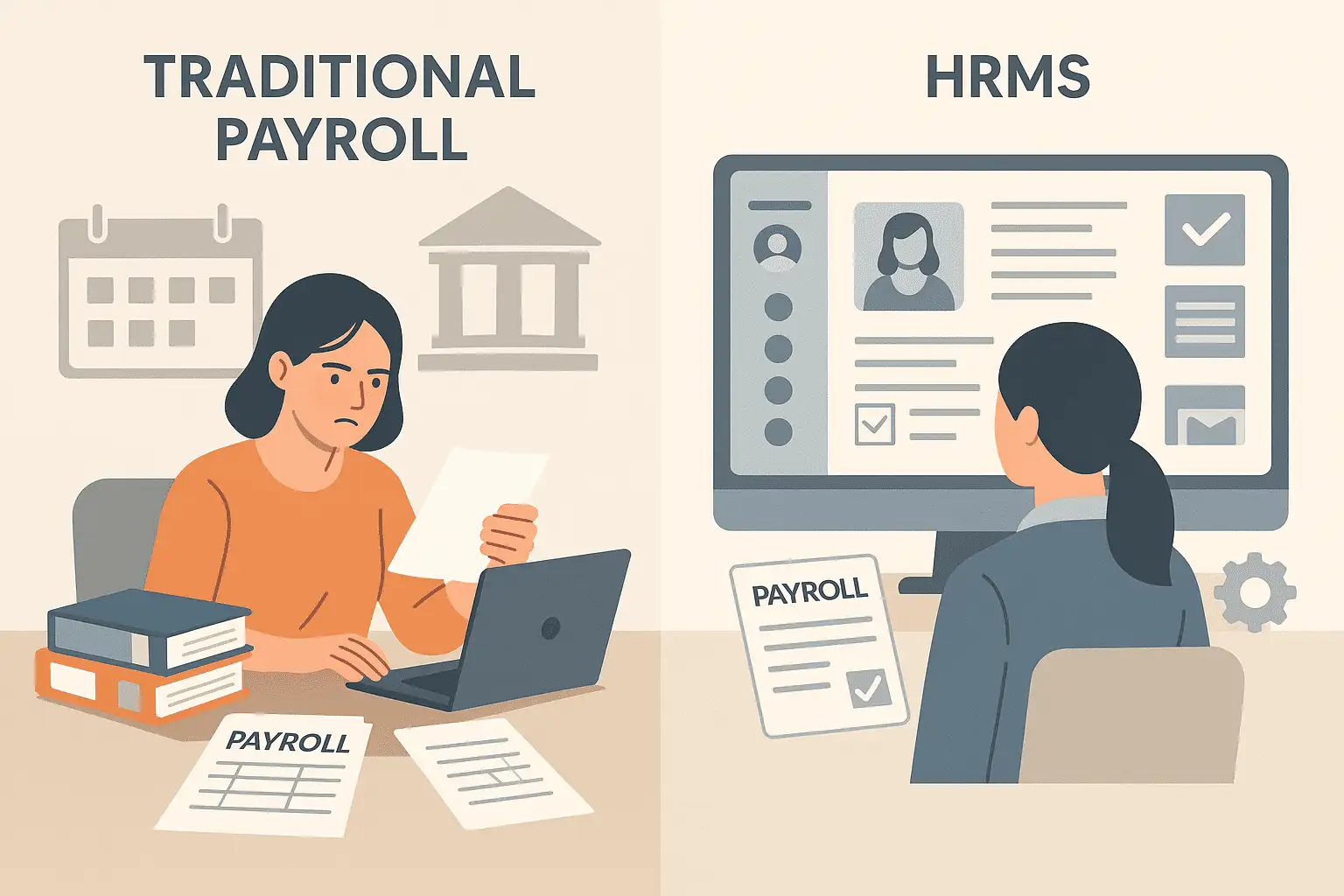
    Traditional payroll refers to manually managing salary calculations, tax deductions, PF, ESI, bonus, and other components. This may involve Excel spreadsheets, paper-based documentation, and limited software tools. While this method has worked for decades, it heavily depends on human accuracy, which increases the chances of errors.

    Moreover, updating statutory laws or adapting to company changes requires HR professionals to keep a constant watch. Time-consuming and prone to mistakes, traditional payroll often ends up costing more in corrections and compliance lapses than businesses expect.

    What Does HRMS Bring to the Table?

    An HRMS (Human Resource Management System) automates core HR functions, including payroll processing. It not only calculates salaries but also updates tax deductions, generates payslips, manages leaves, and integrates attendance data. Most importantly, it keeps up with changing statutory laws without requiring constant manual intervention.


    By reducing repetitive tasks, HRMS allows professionals to focus on people instead of paperwork. It brings transparency to payroll and makes tracking data much simpler. Plus, with role-based access, employees can check their own details without relying on HR for every update.


    HRMS vs Traditional Payroll: Key Differences

    Here’s where the comparison becomes practical. Traditional payroll systems may seem affordable at first, but they often come with hidden costs—errors, delayed filings, and compliance risks. HRMS platforms, while requiring an initial setup, streamline payroll tasks with built-in checks and real-time updates.


    From an HR perspective, one major benefit of HRMS is consistency. With a few clicks, reports are generated, records are archived, and statutory deductions are applied correctly. In contrast, traditional payroll depends too much on memory, manual entries, and follow-ups. For growing companies, this can quickly become unmanageable.

    Which One Works Better for Modern Workplaces?

    In today’s fast-moving work environment, real-time insights, digital access, and automation are no longer optional—they’re expected. Traditional payroll may still work for very small setups, but as teams grow or compliance requirements increase, it tends to fall short. HRMS supports scalability without overloading your team.


    It also improves employee experience. With an HRMS, employees can view payslips, update documents, or apply for leaves without having to wait on someone from HR. That kind of independence reduces errors, builds trust, and improves engagement.

    Is HRMS Always the Right Choice?

    Not necessarily. If you’re a new startup with five employees and minimal compliance needs, traditional payroll may still work in the short term. But for any business looking to scale, reduce risks, and save time, HRMS offers long-term value. It helps standardize processes, maintain audit trails, and keep data secure.

    At TMS, we help companies assess what suits them best—whether that’s streamlining an existing traditional process or transitioning to a smarter HRMS approach.

    Final Thoughts: Let HR Work Smarter, Not Slower

    Understanding the difference between HRMS vs traditional payroll helps HR teams make decisions that go beyond just processing salaries. It’s about choosing systems that support consistency, compliance, and growth. Traditional payroll might offer familiarity, but as your workforce expands and regulations evolve, its limitations become harder to ignore. On the other hand, HRMS gives your team the structure, visibility, and flexibility to manage people and processes more efficiently.

    For companies aiming to grow without getting overwhelmed by manual work or compliance risks, HRMS provides a future-ready foundation. And if you’re unsure about the right fit or how to transition smoothly, Team Management Services (TMS) is here to guide you. Explore our HR solutions and take the first step toward building a smarter, more agile HR function.

  • HRMS Payroll vs. Outsourced Payroll: Which One Fits Your Business?

    HRMS Payroll vs. Outsourced Payroll: Which One Fits Your Business?

    HRMS Payroll vs. Outsourced Payroll: Which One Fits Your Business?

    HRMS Payroll vs. Outsourced Payroll-TMS

    Introduction: Two Paths, One Goal—Paying Right

    When it comes to payroll, every business wants one thing—accuracy. But how you get there can vary. Do you invest in an HRMS and manage payroll in-house, or do you partner with an external payroll service provider? Both routes offer distinct benefits, and choosing between them depends on your company’s size, resources, and long-term goals.

    In this blog, we explore HRMS payroll vs outsourced payroll from an HR perspective. Whether you’re a growing startup or an established company, understanding this difference can help you avoid compliance issues, boost productivity, and align HR strategy with business goals.

    What Is HRMS Payroll?

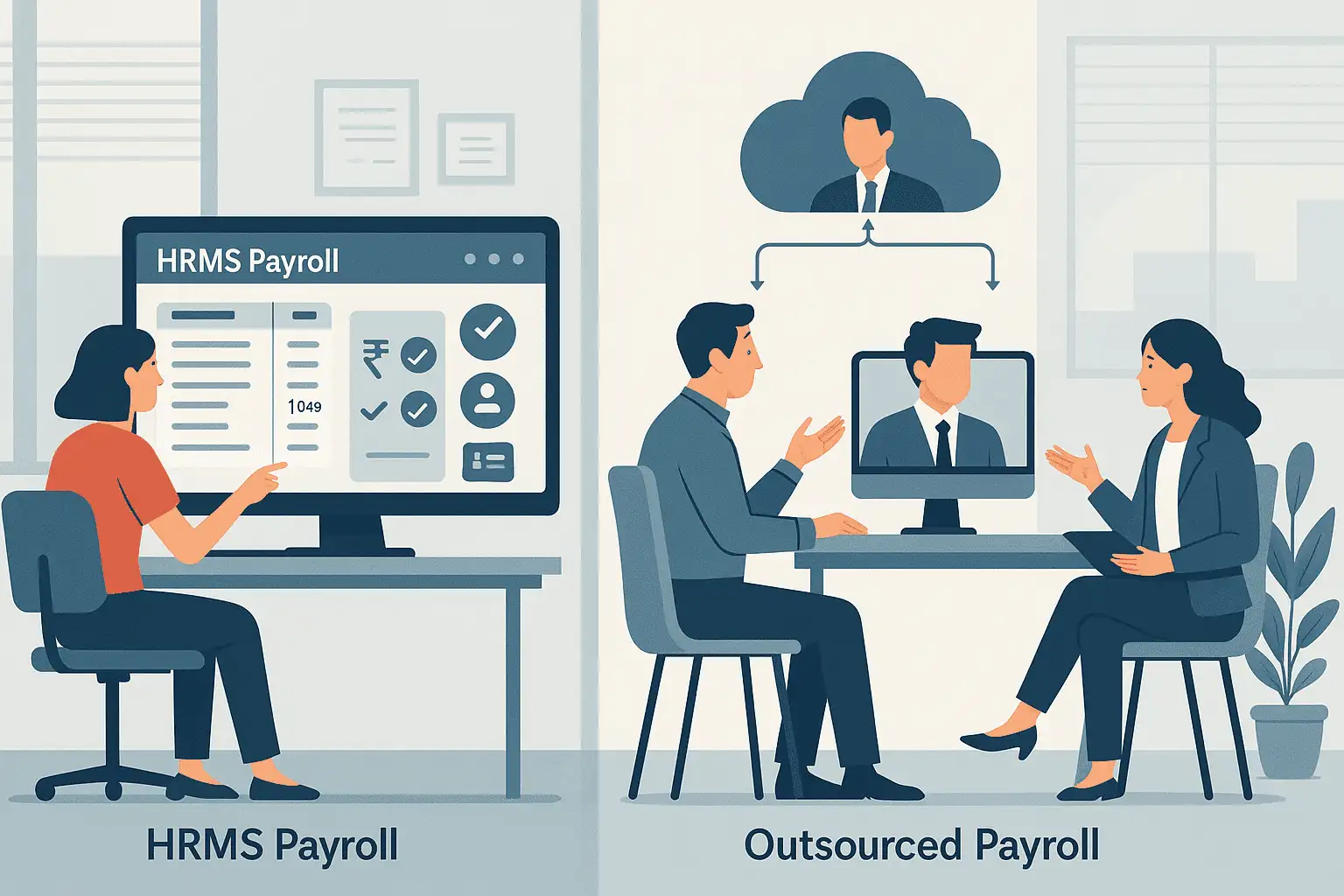
    HRMS payroll is part of a larger Human Resource Management System. It automates the payroll process—from salary calculations and tax deductions to payslip generation and compliance tracking. Integrated modules also handle attendance, leaves, reimbursements, and benefits.

    One major advantage? Everything stays in-house. Your HR team controls every step of payroll processing. But this also means the responsibility for accuracy, software updates, statutory compliance, and system maintenance lies with your team. For companies with experienced HR staff and robust internal processes, HRMS payroll can work well.

    What Is Outsourced Payroll?

    Outsourced payroll means handing over payroll responsibilities to a third-party expert who manages the entire process—from calculating salaries and deductions to handling tax filings, compliance, reports, and sometimes even employee pay-related queries. While your HR team still provides key employee data such as attendance, salary changes, and leave information, the service provider takes care of everything else, ensuring payroll is processed accurately and on time.

    This model removes the need for in-house payroll software or specialized payroll staff, making it ideal for companies with small HR teams or those operating across regions with changing labour laws. However, outsourcing doesn’t mean detachment. A good payroll partner becomes a strategic extension of your team, offering timely communication, adaptability, and industry-specific expertise. The key is choosing a provider who understands your business and builds trust through consistent, reliable service.

    HRMS Payroll vs Outsourced Payroll: Key Differences

    The main difference lies in control vs delegation. With HRMS payroll, you own the process. You can customize workflows, monitor errors instantly, and make quick changes internally. Outsourced payroll, on the other hand, gives you time back—your HR team can focus on core functions while specialists manage compliance and payouts.


    Another factor is cost. HRMS requires software investment and trained staff. Outsourcing involves service fees but may save money on recruitment, training, and penalties from compliance errors. So the real question becomes: are you ready to manage payroll complexity, or would you rather focus your energy elsewhere?

    So, Which Payroll Option Fits Your Business?

    Begin by assessing your HR team’s capacity. Do they have the time and expertise to manage payroll software, stay updated on legal changes, and handle employee concerns? If yes, an HRMS payroll system might suit you well. It offers better control, integrates with other HR functions, and gives clear visibility over payroll operations.

    On the other hand, if your team is overloaded or you’re managing operations across regions with varying compliance needs, outsourcing payroll may be more effective. It lets experts handle the complexities, reduces risk, and ensures timely salary processing. In some cases, a hybrid model works best—using HRMS for internal tracking and outsourcing for processing and compliance. That way, you balance control with expert support.

    Final Thoughts: You Don’t Have to Choose Alone

    Whether you’re leaning toward HRMS payroll or considering outsourcing, the right decision depends on your business structure, team capacity, and growth plans. Each option has its own value. HRMS gives you more control and internal visibility, while outsourcing offers relief from operational load and reduces compliance risks. It’s not about which approach is universally better—it’s about choosing the one that fits your current needs and supports future scalability.

    At Team Management Services (TMS), we help businesses assess these needs with clarity. Whether you’re looking to build an internal payroll system through HRMS or want experts to take over the entire payroll process, we can guide you. Our support goes beyond just tools—we offer practical, people-focused payroll solutions. Explore more on HRMS vs Traditional Payroll to compare options and take a confident step toward the right payroll model for your business.