Part of SKAD HR Group — HR for every stage of business  ·  HRTailor.com  ·  HRTailor.AI

Author: Abhijit Divekar

  • What is Contract Staffing? Meaning & Benefits in India

    What is Contract Staffing? Meaning & Benefits in India

    What is Contract Staffing? Meaning & Benefits in India

    Illustration of payroll outsourcing in India with woman on laptop, contract clipboard, rupee coin, and India map.

    Introduction

    Businesses in India are changing faster than ever. Projects start and end in months, customer needs shift overnight, and new technologies can make skills outdated almost immediately. In such an environment, hiring permanently for every role is not always practical. It is costly, risky, and often too slow for today’s pace.This is why many companies turn to contract staffing.

    In simple words, contract staffing means hiring people on a fixed-term basis to fill specific roles or projects. Instead of adding them as permanent employees, these workers are engaged either directly on a contract or through a staffing partner. The staffing partner usually manages HR tasks like payroll, compliance, and legal formalities. Think of it like this: you get the right person for the time you need, without carrying the long-term burden when the work is done. You pay for contribution, not long-term promises. This flexibility is exactly what makes contract staffing so important in India today.

    The Emotional Side of Hiring

    Hiring is not just about numbers or filling vacancies. It is about people, their lives, and the future of businesses. A wrong hire can damage morale. A delay in hiring can slow down growth. Many HR leaders and founders admit that hiring decisions make them anxious — and frontline managers often feel the pressure of delivering projects without enough hands on deck.


    Contract staffing eases that pressure. It allows businesses to bring in skilled people quickly. At the same time, it offers professionals meaningful short-term opportunities. When handled well, contract staffing creates a win-win: business goals are achieved while workers get real exposure and growth.

    How Contract Staffing Works — Step by Step

    Let’s break it down into simple steps:

    1. Identify the need
      A company notices a gap — maybe a project deadline, seasonal demand, or missing skills.
    2. Choose a model
      The company decides whether to hire through a staffing partner or directly on fixed-term contracts.
    3. Pick a staffing partner (if applicable)
      If using an agency, the partner sources candidates, conducts interviews, and manages payroll and compliance.
    4. Create a job brief
      The business defines the role, skills, duration, and deliverables clearly.
    5. Sourcing and screening
      Candidates are interviewed, skill-tested, and background checked.
    6. Onboarding
      Contract staff are oriented, given access to tools, and introduced to reporting managers.
    7. Deployment and supervision
      The staff work under the client company’s supervision, but remain on the staffing partner’s payroll.
    8. Review and renewal
      At the end of the contract, performance is reviewed. The contract can end, extend, or even lead to a full-time hire.

    It looks simple, but success depends on clear contracts, good communication, and fair treatment.

    Common Models of Contract Staffing in India

    1. Payrolled Contracting (via staffing agency)
      The staffing partner acts as the official employer. They manage salary, PF, ESI, and taxes. The worker serves the client company daily.
    2. Fixed-term direct contracts
      The company hires directly on a fixed contract. The company itself handles payroll and compliance.
    3. Project-based staffing
      Staff are hired for the duration of a project. Once the project ends, contracts close.
    4. Contract-to-hire
      Staff are hired temporarily with the option to become permanent if both sides are happy.

    Each model fits different needs. Many companies prefer the first one — payrolled contracting — because it reduces administrative headaches.

    Real-World Examples of Contract Staffing in India

    1. E-commerce during festival season
      A retailer’s orders triple during Diwali. They hire 300 contract workers for three months in warehouses and customer support. The staffing partner manages payroll. Once the season ends, the company avoids layoffs.
    2. IT product launch
      A software firm needs 10 QA engineers for six months. Contractors complete the release while the core team focuses on new features.
    3. Manufacturing peak period
      A factory experiences seasonal demand. Skilled technicians are hired on contract for three months to meet production deadlines.
    4. Healthcare surge
      A hospital brings in extra nurses and support staff during high patient inflow, ensuring care quality without long-term hiring spikes.

    These everyday scenarios show how contract staffing solves timing and budget challenges across sectors.

    Benefits of Contract Staffing for Employers

    1. Flexibility and speed
      Scale teams up or down quickly without the delays of permanent recruitment.
    2. Cost control
      Avoid long-term salary commitments, benefits, and heavy onboarding expenses.
    3. Access to niche skills
      Hire experts for short-term specialized projects without committing permanently.
    4. Compliance support
      Staffing partners manage PF, ESI, payroll taxes, and legal filings.
    5. Trial before commitment
      Evaluate workers on real projects. If they perform well, convert them to permanent roles.
    6. Operational focus
      HR spends less time on routine hiring, freeing managers to focus on results.

    Benefits of Contract Staffing for Employees

    1. Skill growth
      Exposure to multiple projects across industries enhances experience.
    2. Flexibility
      Short-term roles allow professionals to choose work that fits their goals.
    3. Faster entry into the workforce
      Fresh graduates or career switchers can get relevant experience quickly.
    4. Path to permanent roles
      Many contract staff are converted to full-time employees if they perform well.

    Contract roles are not second-best — they often open doors to bigger opportunities.

    Risks and Drawbacks

    • For Employers

      1. Contract staff may feel less loyalty.
      2. Training investments may not last if staff leave.
      3. Knowledge gaps appear when contractors exit.
      4. Agency fees and rehiring cycles can add hidden costs.

      For Employees

      1. Job insecurity due to fixed tenure.
      2. Limited benefits compared to permanent roles.
      3. Slower career progression unless conversion paths are clear.

      These challenges are real but manageable with respect, clarity, and fair contracts.

    Compliance and Legal Basics in India

    Hiring contract staff in India means following certain rules:

    • Employer of Record (EOR): If an agency is used, they handle payroll, PF, ESI, and taxes.
    • Contracts: Must clearly define role, pay, duration, notice period, confidentiality, and termination terms.
    • Minimum wages: Salaries must meet or exceed state-specific minimum wages.
    • Taxation: TDS and GST responsibilities must be clarified in the contract.
    • Intellectual property: Ensure IP created during work is assigned properly.
    • Social security: PF and ESI contributions are usually managed by the staffing partner.

    Because labor laws vary by state and sector, always confirm with a trusted partner or legal advisor.

    How to Choose the Right Staffing Partner

    Here’s a practical checklist:

    1. Do they have industry experience in your sector?
    2. What is their screening process — do they conduct background and skill checks?
    3. Can they demonstrate compliance track record?
    4. Do they offer speed and reach — time-to-fill and candidate pool size?
    5. Is pricing transparent? Any hidden fees?
    6. Do they provide service-level guarantees (like replacement guarantees)?
    7. How do they manage data security and IP protection?
    8. Do they understand your company culture?

    A reliable staffing partner feels like an extension of your HR team.

    Best Practices for Onboarding and Managing Contract Staff

    • Contract staffing is not a magic solution for all hiring needs. But when used wisely, it helps companies stay nimble, cut costs, and access talent quickly. It also gives professionals valuable exposure, flexibility, and career opportunities.

      If your business in India faces sudden project demands, seasonal hiring spikes, or niche skill gaps, contract staffing can give you the speed and control you need. Start with a clear job brief, pick a trusted staffing partner, and create fair terms. Respect and inclusion make the difference between short-term hires and long-term success.

    Conclusion

    Contract staffing is not a magic solution for all hiring needs. But when used wisely, it helps companies stay nimble, cut costs, and access talent quickly. It also gives professionals valuable exposure, flexibility, and career opportunities.


    If your business in India faces sudden project demands, seasonal hiring spikes, or niche skill gaps, contract staffing can give you the speed and control you need. Start with a clear job brief, pick a trusted staffing partner, and create fair terms. Respect and inclusion make the difference between short-term hires and long-term success.

    Scale smarter with TMS’s Contract Staffing services — flexible, reliable, and built for your business needs.

    Whether for short-term projects or specialized roles, TMS provides the right talent—fast, compliant, and hassle-free.

    FAQs

    Contract staffing helps companies fill short-term, project-based, or skill-specific roles without committing to long-term employment. It allows organisations to stay flexible, manage fluctuating workloads, and access specialised talent quickly.

    Permanent hiring involves long-term employment, full benefits, and direct company liability. Contract staffing, on the other hand, involves hiring workers for a fixed period or project. These workers typically receive payroll, compliance, and HR support from a staffing firm instead of the client company.

    Contract staffing works best for project-based roles, seasonal demand, temporary backfills, skill-intensive assignments, IT projects, and roles with unpredictable workload cycles. It’s also ideal for companies testing new markets or expanding cautiously.

    Yes. Contract staffing is fully legal when done under the Contract Labour (Regulation and Abolition) Act and other applicable labour laws. 

    Yes. Statutory benefits like PF, ESI, bonus, gratuity eligibility, and paid leaves apply to contract employees if they meet eligibility criteria. The responsibility for providing these benefits typically rests with the staffing provider.


  • EOR India: Smooth Hiring for Chinese Expansion

    EOR India: Smooth Hiring for Chinese Expansion

    EOR India: Smooth Hiring for Chinese Expansion

    Smooth Hiring for Chinese Expansion

    Introduction

    India is a top destination for Chinese companies seeking global growth. The country offers skilled professionals, cost advantages, and a strong economic outlook. Yet, setting up a legal entity can be complex and expensive. An Employer of Record (EOR) in India makes hiring smooth, compliance simple, and expansion cost-effective. With support from RIC cooperation, Chinese firms can scale confidently.

    Why Chinese Companies Use an Employer of Record in India

    An Employer of Record in India allows Chinese businesses to operate quickly without creating a subsidiary. The EOR becomes the legal employer and manages:


    • Payroll and taxes.
    • Employee contracts and benefits.
    • Compliance with Indian labor laws.

    This reduces risks and enables companies to focus on growth.

    Smooth Hiring Without a Local Entity

    Hiring employees abroad usually requires establishing a branch or subsidiary. With EOR, Chinese companies can achieve smooth hiring without a local entity. The EOR handles legal and HR tasks, while you direct daily work and performance.

    Benefits of EOR for Chinese Expansion in India

    Working with an EOR in India provides multiple advantages:


    1. Quick Market Entry – Hire in weeks instead of months.
    2. Lower Costs – Avoid heavy entity setup expenses.
    3. Full Compliance – Stay aligned with Indian regulations.
    4. Scalable Teams – Add or reduce staff easily.
    5. Risk Reduction – Minimize exposure to penalties or disputes.

    For more on workforce support, explore our HR Outsourcing services.

    RIC Cooperation and Business Growth

    The RIC cooperation between Russia, India, and China is driving new trade and investment opportunities. By choosing EOR, Chinese firms can align with this alliance, strengthen partnerships, and secure long-term growth in the Indian market.

    Conclusion

    Expanding into India doesn’t need to be complicated. With an Employer of Record, Chinese companies can simplify compliance, reduce costs, and hire smoothly. Backed by RIC cooperation, EOR ensures sustainable and successful business expansion in India.

    Ready to explore India’s opportunities under the new India–China Alliance?
    Partner with TMS’s Employer of Record (EOR) services and expand into India—faster, smarter, and 100% compliant.

  • What is Talent Acquisition? A Step-by-Step Guide for Businesses

    What is Talent Acquisition? A Step-by-Step Guide for Businesses

    What is Talent Acquisition? A Step-by-Step Guide for Businesses

    Illustration of talent acquisition in India with handshake, recruiter, candidate profile, magnifying glass, and India map.

    Introduction

    In today’s competitive business world, finding the right people isn’t just about filling a seat — it’s about building a team that drives growth, innovation, and long-term success. This is where talent acquisition comes in.


    Many people confuse talent acquisition with recruitment, but they are different. Recruitment is about filling immediate vacancies. Talent acquisition, on the other hand, is a strategic, long-term approach to attracting, evaluating, and retaining top talent that aligns with your company’s goals and culture. Whether you are a startup founder, a small business owner, or a first-time HR manager, understanding talent acquisition is essential. This guide breaks it down in easy-to-understand language, step by step.

    What is Talent Acquisition?

    Talent acquisition is a long‑term approach to hiring. Instead of reacting when a role opens, companies build a steady pipeline of candidates who match the skills and culture they’ll need next quarter—or next year. That means clear roles, strong employer branding, proactive sourcing, thoughtful assessments, and a smooth onboarding. If “where do we begin?” is the question, this step‑by‑step overview is a helpful map of process and strategy. (Talent acquisition Guides)

    Why Talent Acquisition Matters?

    Hiring the wrong person can cost time, money, and team morale. According to industry studies, a bad hire can cost a company up to 30% of that employee’s annual salary in lost productivity, training, and replacement costs.

    Talent acquisition helps businesses:

    • Attract the right people for current and future needs.
    • Reduce turnover by hiring employees who fit the company culture.
    • Plan strategically for growth instead of reacting to immediate hiring needs.
    • Build a talent pipeline for critical roles.

    In short, talent acquisition is a proactive, strategic approach rather than a reactive one.

    Talent Acquisition vs Recruitment

    AspectRecruitmentTalent Acquisition
    FocusImmediate hiring for open positionsLong-term strategic hiring and workforce planning
    ScopeShort-term needsBuilds a talent pool for future needs
    ApproachTransactionalStrategic, relationship-driven
    MetricsTime-to-fill, cost-per-hireQuality of hire, retention, employer brand impact

    Key Components of Talent Acquisition

    1. Workforce Planning

    Before hiring, businesses need to understand their current team and future needs. Workforce planning involves:

    • Assessing current skills and gaps.
    • Predicting future hiring needs based on business goals.
    • Planning budgets and timelines for hiring.

    Example: A startup planning to launch an e-commerce platform may anticipate needing developers, designers, and marketing specialists over the next 12 months. Workforce planning helps align hiring efforts with these future requirements.

    2. Employer Branding

    Your company’s reputation as an employer plays a huge role in attracting top talent. Employer branding includes:

    • Company culture and values.
    • Employee testimonials and success stories.
    • Social media presence and career pages.

    Example: If a company promotes employee learning opportunities and flexible work culture online, it is more likely to attract candidates who value growth and work-life balance.

    3. Sourcing Talent

    Sourcing is about finding potential candidates, even if they aren’t actively looking for a job. Methods include:

    • Job portals like Naukri, LinkedIn, and Indeed.
    • Employee referrals.
    • Social media channels.
    • Campus recruitment and career fairs.
    • Engaging passive candidates through direct outreach.

    Tip: Passive candidates (those not actively looking for a job) are often high performers. Talent acquisition strategies focus on nurturing relationships with them.

    4. Screening and Selection

    After sourcing, candidates are evaluated through:

    • Resume and profile screening.
    • Phone or video interviews.
    • Skill assessments or tests.
    • Behavioral interviews to assess cultural fit.

    Practical Advice: Create a structured interview process to reduce bias and ensure candidates are assessed fairly. Include managers and team members in interviews to get multiple perspectives.

    5. Candidate Experience

    Candidate experience refers to how applicants feel during the hiring process. Positive experiences improve your employer brand, while negative experiences can harm it.

    • Communicate clearly about timelines and next steps.
    • Provide feedback, even to candidates who aren’t selected.
    • Simplify application processes — avoid long, confusing forms.

    Example: A startup that sends personalized rejection emails is more likely to be recommended by candidates in the future, compared to a company that ignores applicants.

    6. Onboarding

    Talent acquisition doesn’t end with a job offer. Onboarding is the process of integrating new hires into the company.

    • Introduce them to teams and mentors.
    • Provide training and tools needed for success.
    • Communicate company values, culture, and processes.

    Impact: Effective onboarding increases retention and accelerates productivity. Research shows that well-onboarded employees are 69% more likely to stay with a company for three years.

    7. Metrics and Continuous Improvement

    Talent acquisition is a data-driven process. Metrics to track include:

    • Time-to-hire
    • Cost-per-hire
    • Quality of hire
    • Retention rate
    • Candidate satisfaction

    Regularly analyzing these metrics helps refine the process and improve hiring outcomes.

    Talent Acquisition Channels

    1. Job Portals: Platforms like Naukri, LinkedIn, Monster — quick access to a large candidate pool.
    2. Employee Referrals: Encourage your team to recommend candidates. Referred hires often stay longer and perform better.
    3. Social Media: Promote your employer brand through Instagram, LinkedIn, or Twitter.
    4. Campus Hiring: Target colleges for fresh talent in specialized fields.
    5. Staffing Agencies & Contract Partners: Useful for niche skills or short-term projects.

    Common Challenges in Talent Acquisition

    1. Skill Shortages: Finding the right skill set, especially in niche fields like AI, cybersecurity, or fintech.
    2. High Competition: Top talent is always in demand, making it difficult for SMEs to attract candidates.
    3. Cultural Fit: Hiring candidates who align with company values can be tricky.
    4. Budget Constraints: Especially for startups, balancing salaries, perks, and benefits is challenging.
    5. Retention: Attracting talent is only half the battle — retaining them is equally important.

    Best Practices for Effective Talent Acquisition

    • Define clear job descriptions that outline roles, responsibilities, and expectations.
    • Invest in employer branding — even small companies can highlight learning opportunities and culture.
    • Use technology like Applicant Tracking Systems (ATS) to streamline recruitment.
    • Maintain a talent pipeline by keeping in touch with potential candidates.
    • Provide a great candidate experience — communicate promptly, be transparent, and treat candidates with respect.
    • Measure and iterate — track key metrics and continuously improve processes.

    Talent Acquisition Trends for 2025–26

    1. AI and Automation: Screening resumes and scheduling interviews using AI to save time.
    2. Remote Hiring: Hiring candidates from anywhere in India (or globally) to widen the talent pool.
    3. Gig and Contract Talent: Companies are increasingly using contract or project-based employees for flexibility.
    4. Focus on Diversity and Inclusion: Building diverse teams to foster innovation.
    5. Employee Value Proposition (EVP): Highlighting career growth, learning, and wellness benefits to attract top talent.

    Why SMEs Should Care About Talent Acquisition

    Many small and mid-sized companies think strategic talent acquisition is only for big corporations. That’s not true. SMEs benefit by:

    • Building a strong team that drives growth from the early stages.
    • Reducing turnover costs by hiring candidates who fit culture and roles.
    • Saving time and effort by proactively sourcing candidates instead of constantly reacting to vacancies.

    Example: A small tech startup that builds a pipeline of software developers can avoid hiring delays when a critical project begins.

    Step-by-Step Talent Acquisition Process

    1. Understand Business Needs: Forecast roles based on growth plans.
    2. Build Employer Brand: Promote company culture and values.
    3. Source Candidates: Use multiple channels to reach the right talent.
    4. Screen and Evaluate: Assess skills, experience, and cultural fit.
    5. Engage and Communicate: Maintain a positive candidate experience.
    6. Select and Offer: Make timely offers with competitive packages.
    7. Onboard Effectively: Provide training, mentors, and a welcoming environment.
    8. Measure and Improve: Track metrics like retention, quality of hire, and candidate satisfaction.

    Conclusion

    Talent acquisition is more than just filling vacancies — it’s about building the foundation for long-term success. By focusing on strategy, employer branding, candidate experience, and continuous improvement, businesses of all sizes can attract and retain top talent.For SMEs, startups, and even large enterprises, investing in talent acquisition ensures faster growth, better productivity, and lower turnover costs.


    At Team Management Services (TMS), we help companies develop smart talent acquisition strategies — from sourcing top candidates to onboarding and retention. Build the right team, faster, and focus on growing your business with confidence.

    Partner with TMS’s Talent Acquisition Services to build stronger teams—faster, smarter, and stress-free.

    From defining roles to setting up sourcing channels, structuring interviews, and creating a repeatable pipeline, TMS makes hiring calm, consistent, and effective.

    FAQs

    Talent acquisition is a long-term strategy focused on building talent pipelines, employer branding, and future workforce planning. Recruitment is more transactional, centered on filling immediate open positions.

    Yes — even small companies can benefit from talent acquisition by building a proactive hiring strategy, reducing time-to-fill, and avoiding hiring panic during growth phases.

    Absolutely. With a proactive and strategic approach, TA teams can target specialised talent, nurture relationships, and fill niche roles more effectively than reactive recruiting.

    A long-term approach helps companies avoid delays, attract better candidates, and fill roles faster because the pipeline is already warm.

    It uses structured assessments, better screening, and long-term planning to ensure candidates fit both the role and the company culture.

  • Cost Breakdown: Is Contract Staffing Really Cheaper for Businesses?

    Cost Breakdown: Is Contract Staffing Really Cheaper for Businesses?

    Cost Breakdown: Is Contract Staffing Really Cheaper for Businesses?

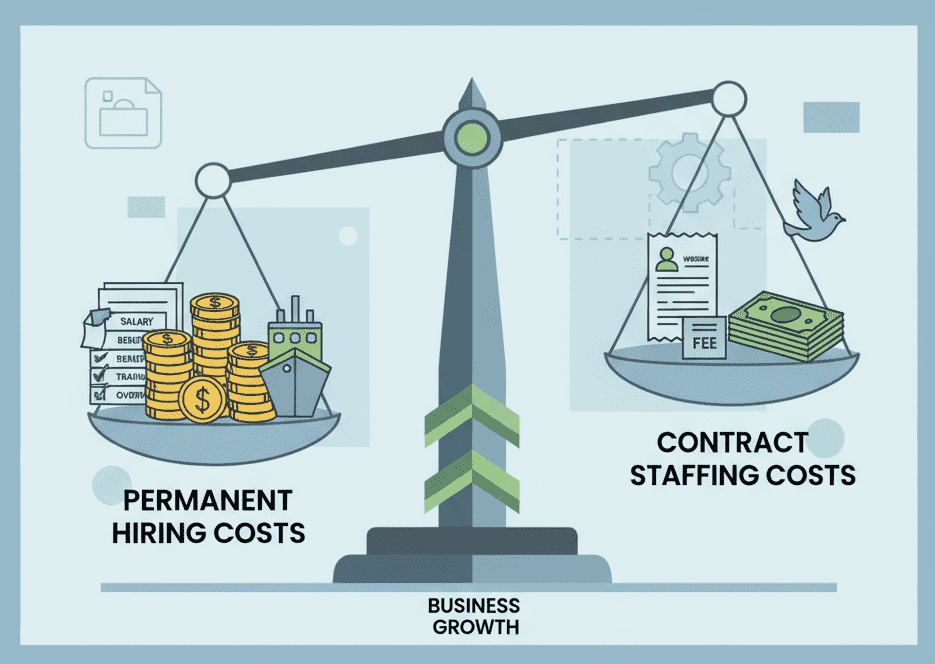
    Business decision concept: Comparing permanent hiring costs versus contract staffing costs on a scale.

    Introduction

    Every HR or business leader eventually asks: “Is contract staffing really cheaper than hiring permanent employees?”

    The short answer? It depends.

    Contract staffing looks attractive at first glance: no long-term salaries, reduced benefits, and flexible exits. But beneath the surface, there are hidden costs like agency fees, onboarding, and knowledge loss. At the same time, there are savings you can’t ignore — speed of hiring, reduced legal risk, and avoiding severance packages.

    This blog breaks it down into clear, honest numbers so you can make the right decision for your business in India.

    The Direct Costs You Avoid with Contract Staffing

    1. Fixed salaries
      Permanent employees must be paid every month, regardless of business cycles. Contract staff are paid only for the period they are needed.

    2. Employee benefits
      Medical insurance, gratuity, paid leave, maternity/paternity benefits, and retirement benefits all add up for permanent hires. Contract staff usually don’t get the same package.

    3. Severance and layoffs
      Letting go of permanent staff can involve notice pay, legal risk, and sometimes union involvement. With contract staff, contracts naturally expire.

    4. Recruitment overhead
      Permanent recruitment involves job ads, long interviews, background checks, and joining bonuses. Staffing partners absorb much of this cost.

    The Costs You Still Pay

    1. Salary or wages
      Contract staff are paid for their work hours, usually through the staffing agency.

    2. Agency/service fees
      Staffing firms charge a markup on salaries, typically 10–25%. This covers their payroll, compliance, and HR administration.

    3. Onboarding & training
      Even contract staff need orientation, software access, and sometimes technical training.

    4. Supervision and management
      Managers still need to spend time guiding and reviewing contract staff.

    The Hidden Costs Many Forget

    1. Knowledge loss
      When contract staff leave, the expertise they built may walk out the door. Unless documented, you may need to train someone new.

    2. Cultural gaps
      Contract workers may feel less attached to the company, which can affect team cohesion. Extra effort is needed for integration.

    3. Frequent rehiring
      Short-term contracts can mean higher turnover, which requires repeated onboarding.

    4. Quality risks
      If not well-screened, contract staff may underperform. Replacing them costs time and money.

    The Real Savings Beyond Payroll

    1. Faster hiring speed
      Staffing agencies maintain pre-vetted candidate pools. Filling roles in days instead of months saves opportunity cost.

    2. Compliance outsourcing
      PF, ESI, labor law filings, and tax deductions are managed by the staffing partner — saving HR effort and legal risk.

    3. Reduced bench cost
      You don’t carry idle employees when projects end. This keeps your payroll lean.

    4. Flexibility ROI
      Being able to scale up during demand peaks (festivals, product launches, seasonal manufacturing) and scale down later prevents both overstaffing and understaffing losses.

    ROI — How to Measure

    To decide if contract staffing is cheaper, calculate:

    Total Cost of Permanent Hire
    = Salary + Benefits + Recruitment + Severance Risk + Compliance + Idle Time

    Total Cost of Contract Hire
    = Wages + Agency Fees + Training + Replacement/Turnover + Knowledge Risk

    Now compare both against business outcomes achieved (projects delivered, revenue generated).

    If a role is critical for 3+ years, permanent hiring may be cheaper. If it’s a 6–12 month project, contract staffing almost always wins.

    Example Scenarios — Cost Comparisons

    IT Project Team (6 months)

    • Permanent hire cost: ₹8,00,000 (CTC) + ₹1,00,000 benefits + ₹50,000 recruitment = ₹9,50,000
    • Contract hire cost: ₹8,00,000 wages + ₹1,20,000 agency fee + ₹30,000 training = ₹9,50,000
    • Result: Same upfront cost, but contract staff can exit without severance. Permanent staff may sit idle later. 

    Seasonal Retail Workforce (3 months, 100 workers)

    • Permanent hire: Not practical — would cost ₹2 crore+ annually, plus layoffs.
    • Contract hire: ₹50 lakh for 3 months (including agency fee).
    • Result: Massive savings. Perfect case for contract staffing.

    Specialized Consultant (1 year)

    • Permanent hire: ₹18 lakh salary + ₹3 lakh benefits + ₹1 lakh recruitment = ₹22 lakh.
    • Contract hire: ₹20 lakh package + ₹3 lakh agency fee = ₹23 lakh.
    • Result: Contract hire slightly costlier, but you avoid long-term obligation. Flexibility is worth it if demand is uncertain.

    When Contract Staffing is Truly Cheaper

    • Short-term projects (under 12 months)
    • Seasonal demand spikes (festivals, audits, launches)
    • Niche or specialized skills where long-term need is unclear
    • Startups and SMEs needing flexibility with cash flow
    • Industries with fluctuating workloads (IT, manufacturing, retail, healthcare)

    When Permanent Hiring May Be Better

    • Stable, ongoing roles like operations, finance, customer success.
    • Critical leadership positions where cultural continuity is key.
    • High training investment roles (where knowledge retention is crucial).
    • Brand-building roles where employee loyalty is needed.

    How to Maximize ROI from Contract Staffing

    1. Plan ahead — Don’t wait until you’re desperate; define needs clearly.
    2. Pick the right partner — Choose agencies with transparent pricing and compliance expertise.
    3. Onboard smartly — Give contract staff the tools and context they need fast.
    4. Track hidden costs — Document turnover, training, and lost knowledge.
    5. Blend models — Use a mix of permanent and contract staff to balance stability with flexibility.

    Cost Breakdown – A Clear Example (Simple Math)

    Sometimes the best way to understand if contract staffing is cheaper is by looking at the numbers. Here’s a simple, hypothetical example:

    Scenario:

    • Permanent hire: Monthly gross salary = ₹50,000
    • Contract arrangement through agency: Agency bill = ₹60,000 per month for the same role

    Permanant Hire – Year 1 :

    • Annual gross salary = ₹50,000 × 12 = ₹600,000
    • Estimated employer benefits & contributions (medical, PF, gratuity, insurance, training) = ₹120,000 (approx. 20% of gross)
    • Recruitment cost (one-time) = ₹60,000
    • Total Year 1 cost = ₹780,000

    Contract Hire via Agency – Year 1 :

    • Agency bill = ₹60,000 × 12 = ₹720,000
    • Agency handles payroll & compliance (so statutory costs are built in)
    • Total Year 1 cost = ₹720,000

    ⚖️ Comparison:

    • Permanent (Year 1): ₹780,000
    • Contract (Year 1): ₹720,000
    • Estimated saving in Year 1 = ₹60,000

    ⚠️ Reality check:

    • Agency fees may be higher for niche or senior roles.
    • Permanent hires may turn out cheaper over multiple years if they stay.
    • Contracting reduces severance and long-term liabilities.
    • Hidden costs like training or coordination can tilt the balance either way.

    Takeaway: This simple example shows why many companies save in the short term with contract staffing. Want to go deeper into saving strategies? Check out our guide.

    Conclusion

    So, is contract staffing really cheaper? The honest answer is: sometimes yes, sometimes no.

    For roles tied to projects, seasonal cycles, or uncertain demand, contract staffing almost always reduces cost and risk. For long-term, business-critical roles, permanent hiring is usually the smarter financial choice.

    The key is not to look only at salary. Factor in benefits, severance, compliance, risk, and opportunity cost. That’s the real cost picture.

    At Team Management Services (TMS), we’ve helped businesses calculate these trade-offs and build blended teams that save money while staying agile. If your company wants to cut costs without cutting quality, contract staffing with TMS may be your best bet.

    Scale smarter with TMS’s Contract Staffing services — flexible, reliable, and built for your business needs.

    Whether for short-term projects or specialized roles, TMS provides the right talent—fast, compliant, and hassle-free.

  • Contract-to-Hire Conversion: Pros, Process, and Pitfalls

    Contract-to-Hire Conversion: Pros, Process, and Pitfalls

    Contract-to-Hire Conversion: Pros, Process, and Pitfalls

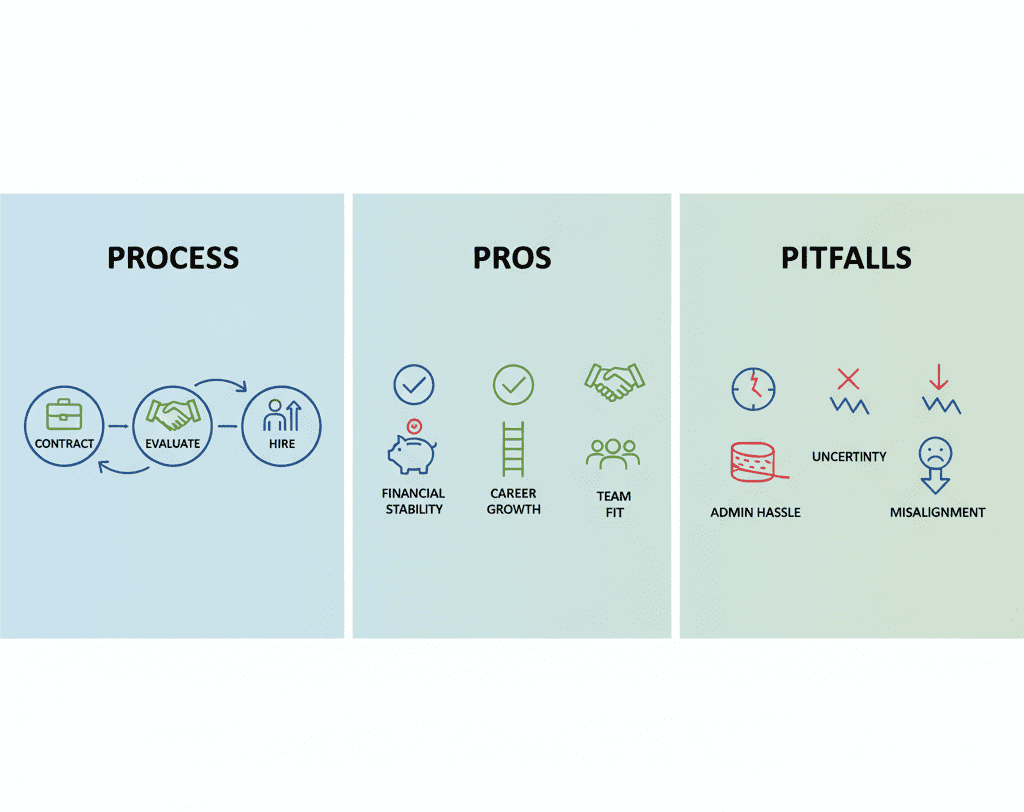
    Horizontal infographic showing the contract-to-hire conversion process with icons representing the pros and pitfalls in a clean, minimalist style.

    Introduction

    Hiring is never just about filling a seat. It’s about trust, culture, performance, and long-term stability. For many companies in India, contract staffing has become a lifesaver — helping meet seasonal spikes, project deadlines, or urgent skill shortages.

    But what happens when a contract employee proves themselves and feels “too good to let go”? That’s where contract-to-hire (C2H) conversion comes in.

    In this model, businesses start with an employee on a contract basis and later convert them into a full-time role. Done right, it gives companies a “trial run” before making a permanent commitment. But done poorly, it can cause confusion, frustration, and even loss of great talent.

    This blog is your human, practical guide to contract-to-hire:

    • What it means in India.

    • Why companies use it.

    • Step-by-step process of conversion.

    • Pros and pitfalls for employers and employees.

    • Best practices to get it right.

    What is Contract-to-Hire Conversion?

    Contract-to-hire is a staffing model where a person first joins as a contract employee, usually through a staffing partner or fixed-term contract. After a trial period (say, 6–12 months), the company may offer them a permanent role — if both sides are happy.


    Think of it like a “try-before-you-buy” model for talent. Businesses test performance and cultural fit before making a long-term hire. Employees, meanwhile, also get to evaluate whether the company is the right place for them.

    Why Companies Use Contract-to-Hire in India

    1. Reduce Hiring Risk
      Hiring mistakes are expensive. With C2H, companies can assess real-world performance before investing in full-time benefits and payroll.
    2. Faster Onboarding
      Contract hiring is usually quicker than permanent recruitment. Businesses fill urgent roles fast, then decide later on long-term fit.
    3. Flexibility for Projects
      If the project ends or priorities shift, companies can let the contract expire instead of struggling with layoffs.
    4. Access to Specialized Skills
      Sometimes, niche talent is available only via contract. C2H allows companies to secure that skill and later retain it permanently if needed.
    5. Stronger Employer Branding
      When companies offer clear C2H paths, it signals fairness and opportunity — attracting better candidates.

    Why Employees Value Contract-to-Hire

    1. Path to Stability
      Instead of short contracts ending suddenly, employees see a real chance of getting absorbed full-time.
    2. Chance to Prove Themselves
      C2H gives workers time to showcase skills, adapt to culture, and earn trust.
    3. Career Growth
      Permanent conversion often comes with benefits, appraisals, and clear growth plans.
    4. Mutual Evaluation
      Just as companies test employees, workers also get to check if the company aligns with their values, leadership style, and career goals.

    The Contract-to-Hire Conversion Process — Step by Step

    1. Initial Contract Agreement
      The employee joins through a staffing agency or fixed-term contract. The agreement clearly mentions the possibility of C2H.
    2. Defined Trial Period
      Usually 6–12 months. During this time, both employer and employee evaluate performance, culture fit, and future role alignment.
    3. Performance Reviews
      Managers conduct structured reviews during the contract period. Metrics are set upfront — not just output, but also teamwork and adaptability.
    4. Business Need Assessment
      The company checks if a long-term role is justified — budget, project pipeline, and headcount approvals matter here.
    5. Conversion Discussion
      If both sides are satisfied, HR and the employee discuss terms of permanent employment — salary, benefits, designation.
    6. Formal Absorption
      The staffing partner transitions payroll, and the employee moves to the company’s rolls with a permanent offer letter.

    Real-World Examples in India

    1. IT Services
      A Bengaluru-based IT firm hired 20 developers on contract for a product launch. After the release, 12 high performers were converted to full-time, saving recruitment time and ensuring cultural continuity.

    2. Healthcare
      A hospital in Pune brought in nurses on contract during a pandemic surge. Post-crisis, many were absorbed permanently due to proven dedication.

    3. Startups
      A Delhi-based fintech startup used C2H for data analysts. Instead of committing to permanent roles in early growth, they tested performance. Later, 70% were absorbed full-time.

    Pros of Contract-to-Hire

    For Employers

    • Lower risk of bad hires.

    • Flexibility in workforce planning.

    • Reduced upfront recruitment costs.

    • Seamless conversion if the fit is right.

    For Employees

    • Clearer career path compared to pure contract work.

    • Time to showcase ability.

    • Higher chance of long-term benefits.

    • Less pressure compared to immediate permanent hiring.

    Pitfalls & Risks

    For Employers

    • Unclear Expectations: If conversion terms aren’t defined, employees may feel misled.

    • Higher Agency Fees: Staffing partners may charge more for C2H models.

    • Team Dynamics: Permanent staff may see contract workers as “outsiders.”

    • Talent Loss: If conversion is delayed, good talent may leave for other permanent offers.

    For Employees

    • Uncertainty: No guarantee of permanent absorption.

    • Unequal Treatment: Sometimes not included in full benefits during contract phase.

    • Emotional Stress: Constantly waiting for “conversion decision” can affect morale.

    • Short-Term Risk: If performance metrics aren’t clear, workers may feel judged unfairly.

    Best Practices for Successful Contract-to-Hire

    For Employers

    1. Set Clear Terms — Mention conversion possibility, criteria, and timelines in the contract.

    2. Transparent Communication — Regular updates on performance and business needs reduce anxiety.

    3. Equal Respect — Treat contract staff as part of the team; don’t isolate them.

    4. Objective Reviews — Use structured metrics, not just manager impressions.

    5. Plan Budgets Early — Secure approval for permanent roles before promising conversion.

    For Employees

      1. Clarify Conversion Path — Ask about criteria, timelines, and chances during hiring.

      2. Focus on Performance — Show measurable results during the contract period.

      3. Engage with Teams — Build relationships with managers and peers to prove cultural fit.

      4. Document Achievements — Keep track of contributions for appraisal discussions.

      5. Stay Flexible — Have backup options in case conversion doesn’t happen.

    Legal & Compliance Aspects in India

    • Fixed-Term Employment Rules: Governed by Indian labour law, contracts must specify duration, role, and terms.
    • Statutory Benefits: During the contract, staffing partners handle PF, ESI, gratuity (if applicable).
    • Offer Letters for Conversion: Must clearly transition employee rights from contract to permanent.
    • Notice Periods: Ensure clarity on termination terms for both sides.
      Tip: Always involve your staffing partner or legal advisor to keep conversions smooth and compliant.

    Conclusion

    Contract-to-hire can be a win-win strategy for businesses and employees. It reduces hiring risks, offers flexibility, and creates a fair path to permanency. But it only works when expectations are clear, timelines are honored, and respect is mutual.

    At Team Management Services (TMS), we’ve guided many companies through successful contract-to-hire transitions — ensuring agility for businesses and stability for employees

    Scale smarter with TMS’s Contract Staffing services — flexible, reliable, and built for your business needs.

    Whether for short-term projects or specialized roles, TMS provides the right talent—fast, compliant, and hassle-free.

  • Payroll Outsourcing vs In-House Payroll: Which is Better for Your Business?

    Payroll Outsourcing vs In-House Payroll: Which is Better for Your Business?

    Payroll Outsourcing vs In-House Payroll: Which is Better for Your Business?

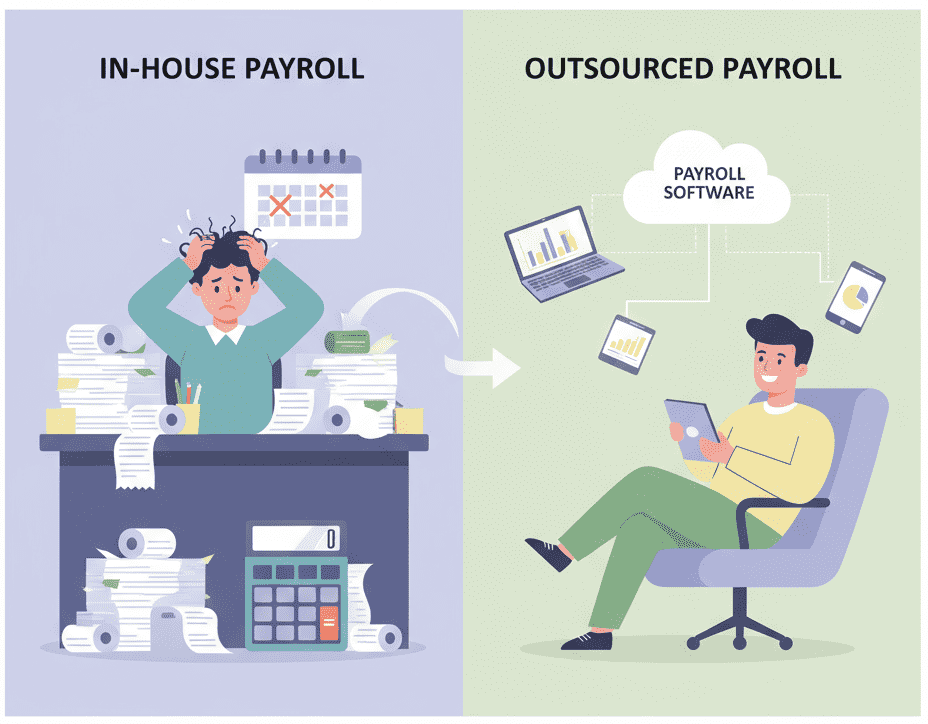
    In-house vs. outsourced payroll: a visual comparison showing a stressed vs. a calm work environment.

    Introduction

    Payroll is one of the most important but also one of the most time-consuming responsibilities in any organization. Paying employees on time, calculating deductions, managing compliance, and keeping accurate records are not just administrative tasks—they directly affect employee satisfaction, trust, and even your company’s reputation. But when it comes to managing payroll, every business faces a key decision: should we keep payroll in-house, or should we outsource it to a professional payroll partner?

    This question has become even more relevant in India and globally, where businesses of all sizes are under constant pressure to save costs, improve compliance, and scale quickly. In this blog, we will break down both models in detail, explain their pros and cons, and guide you on how to decide what fits your business best.

    What Is In-House Payroll?

    In-house payroll means your company manages payroll entirely on its own. You (or your HR/finance team) use payroll software or manual processes to calculate salaries, taxes, contributions (PF, ESI), and generate payslips.


    Key activities in in-house payroll include:

    • Collecting employee attendance and leave data.

    • Calculating salaries, overtime, and variable pay.

    • Deducting taxes (TDS) and statutory contributions (PF, ESI, gratuity).

    • Filing returns with government authorities.

    • Issuing payslips and salary credits.

    • Maintaining payroll records for audits.

    This gives companies full control, but it also means taking responsibility for accuracy, compliance, and penalties if something goes wrong.

    What Is Payroll Outsourcing?

    Payroll outsourcing means hiring an external partner (like Team Management Services – TMS) to handle payroll operations on your behalf. You simply share employee and attendance data, and your partner manages the calculations, compliance, filings, and disbursement.

    Key activities in outsourced payroll include:

    • Salary calculation and disbursement.

    • PF, ESI, PT, and TDS deductions and filings.

    • Handling changes in tax or labor law automatically.

    • Generating payslips and reports.

    • Securing sensitive payroll data with high standards.

    Outsourcing frees your HR and finance teams from routine tasks, reduces risks, and helps you scale without worrying about payroll complexity.

    Payroll Outsourcing: Pros and Cons

    Pros

    • Saves time: HR can focus on talent management instead of salary calculations.

    • Compliance made easy: Payroll partners stay updated with tax and labor law changes.

    • Cost control: Predictable fees and reduced chances of penalties.

    • Data security: Professional firms use secure systems to protect employee data.

    • Scalability: Adding or removing employees is quick and hassle-free.

    Cons

    • Less control: You depend on an external partner for timely processing.

    • Cost for very small teams: For startups with just a few employees, outsourcing may feel like an extra expense.

    • Vendor reliability: Choosing the wrong partner can lead to errors or delays.

    In-House Payroll: Pros and Cons

    Pros

    • Full control: You manage everything in-house and have complete visibility.

    • Customization: Policies, deductions, and reports can be tailored to your exact needs.

    • Direct employee interaction: Queries and corrections are resolved faster within the company.

    Cons

    • High cost: Salaries of payroll staff, software licenses, and penalties add up.

    • Time-consuming: HR staff spend too much time on admin instead of strategy.

    • Compliance risk: Missing an update in tax or labor law can lead to fines.

    • Scaling issues: Adding more employees increases complexity and workload.

    Payroll Outsourcing vs In-House Payroll — Key Factors

    When choosing between in-house and outsourcing, most businesses look at 5 factors:

    In-House Payroll:

    1. Cost: Requires staff salaries, software investment, training, and risk of penalties.

    2. Compliance: HR needs to track every new law update.

    3. Scalability: Expanding teams make payroll more complex and resource-heavy.

    4. Technology: You need to buy and update payroll software regularly.

    5. HR Focus: HR teams spend most of their time on admin.

    Outsourcing Payroll

    1. Cost: Predictable monthly fee, often cheaper in the long run.
    2. Compliance: Payroll partners take full responsibility for legal compliance.
    3. Scalability: Payroll firms scale easily with your growth.
    4. Technology: Technology comes included in the service.
    5. HR Focus: HR teams can focus on recruitment, culture, and strategy.

    Cost Snapshot: Example

    To understand the financial difference, let’s take a hypothetical example:

    1. In-house payroll team (for 100 employees):

      • Payroll executive salary = ₹40,000/month × 12 = ₹480,000/year.

      • Payroll software license = ₹100,000/year.

      • Penalties/mistakes (average) = ₹50,000/year.

      • Total = ₹630,000/year.

    2. Outsourced payroll service (100 employees):

      • Average service fee = ₹400 per employee/month × 100 × 12 = ₹480,000/year.

      • Total = ₹480,000/year.

    While these numbers are examples, they show why outsourcing often works out cheaper and more predictable.

    When Should You Choose In-House Payroll?

    • If you’re a very small company (less than 10–15 employees).

    • If your payroll requirements are extremely simple (fixed salaries, no complex compliance).

    • If you already have trained HR/payroll staff in-house.

    When Should You Choose Payroll Outsourcing?

    • If your company is growing and you don’t want payroll to slow you down.

    • If you want to avoid penalties and ensure compliance.

    • If you want to reduce admin burden on your HR team.

    • If your company has employees across states or countries, making compliance more complex.

    Conclusion

    Payroll is more than just processing salaries—it’s about trust, accuracy, and compliance. Whether you keep payroll in-house or outsource it, the right choice depends on your company size, growth stage, and budget.

    At Team Management Services (TMS), we’ve helped companies across industries simplify payroll, cut costs, and focus on growth instead of admin headaches. If you’re looking for a trusted payroll partner who understands compliance and culture, TMS is here to help.

    Partner with TMS’s Payroll Outsourcing Services and expand into India—faster, smarter, and 100% compliant.

    From accurate payroll processing to tax compliance and seamless employee management, TMS keeps your workforce worry-free and future-ready.

  • Is Payroll Outsourcing Only for Big Companies? The SME Perspective

    Is Payroll Outsourcing Only for Big Companies? The SME Perspective

    Is Payroll Outsourcing Only for Big Companies? The SME Perspective

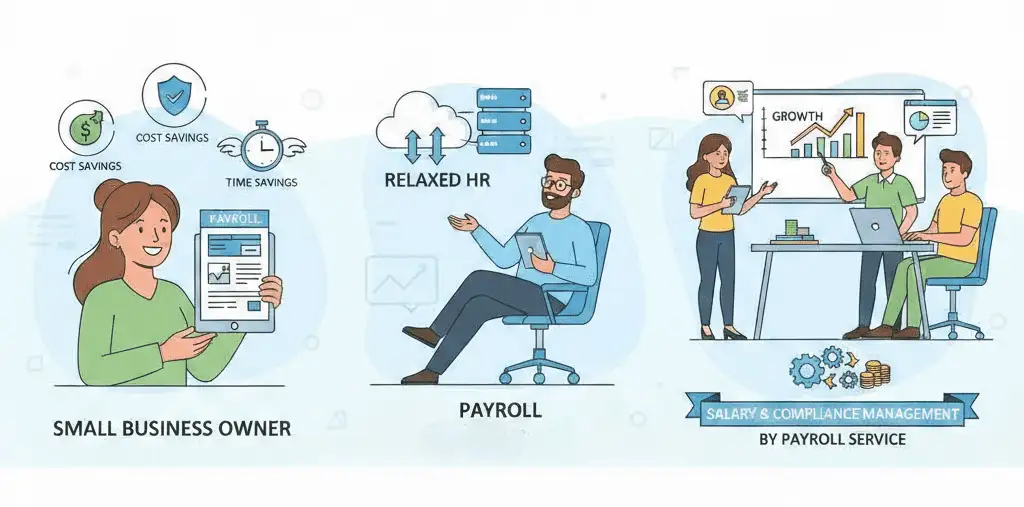
    A payroll service manages compliance, allowing an SME team to focus on growth, new markets, and happy clients.

    Introduction

    Payroll outsourcing is often seen as a tool for big companies, especially MNCs that employ thousands of workers across countries. But here’s the truth: small and medium-sized enterprises (SMEs) can benefit even more from payroll outsourcing than large corporations.


    Why? Because SMEs usually work with leaner teams, smaller budgets, and tighter timelines. A single payroll mistake can create compliance risks, employee dissatisfaction, and unexpected costs. By outsourcing payroll, SMEs can focus on what matters most: growth, customers, and innovation. This blog clears the air. We’ll explain why payroll outsourcing is not just for large enterprises, but also a smart, cost-effective, and stress-free solution for SMEs in India and worldwide.

    What is Payroll Outsourcing?

    Payroll outsourcing means giving the responsibility of managing employee salaries, deductions, compliance, and reporting to an external expert provider. Think of it this way: instead of hiring payroll staff and buying payroll software, you pay a specialized firm to run payroll for you. They act as your payroll department — but outside your office.


    A payroll outsourcing partner typically handles:

    • Salary calculations — based on attendance, leaves, and allowances.
    • Tax deductions (TDS) — ensuring correct income tax is deducted.
    • Provident Fund (PF) & ESI contributions — as per Indian laws.
    • Gratuity and bonus calculations.
    • Payslip generation for employees.
    • Filing of returns with government authorities.
    • Year-end reports for audits and compliance.

    In short: payroll outsourcing is about making sure employees are paid correctly, on time, and in compliance with all laws — without the business owner or HR team having to do all the heavy lifting.

    Why SMEs Hesitate?

    Before we talk about benefits, let’s address the common reasons SMEs avoid outsourcing:

    1. “It’s too expensive.”
      Many small business owners believe payroll outsourcing is only affordable for big firms. In reality, outsourcing often costs less than hiring a full-time payroll officer.

    2. “We don’t have enough employees to outsource.”
      Even if you have 10, 20, or 50 employees, payroll outsourcing makes sense. Errors cost money, and compliance doesn’t get easier with fewer employees.

    3. “We’ll lose control.”
      Outsourcing doesn’t mean giving up control. You set the rules, while the payroll partner follows them.

    4. “It’s only for MNCs with global teams.”
      Nope. SMEs in India are outsourcing payroll to handle local compliance and free up their HR from repetitive admin work.

    Once these myths are cleared, the benefits become obvious.

    Why Payroll Outsourcing Works So Well for SMEs

    Benefits of Payroll Outsourcing to SMEs:

    1. Cost Savings
    2. Time Efficiency
    3. Compliance Without Headaches
    4. Scalability Made Easy
    5. Better Technology at Lower Cost
    6. Data Accuracy & Security
    7. Peace of Mind

    For a detailed explanation of each benefit, read this blog.

    Case Examples — How SMEs Use Payroll Outsourcing

    1. A 20-member IT startup in Pune
      The founder outsourced payroll after losing 2 weeks each month on compliance. Now, salaries go out in minutes, and the founder focuses on client acquisition.

    2. A 50-person manufacturing unit in Gujarat
      Compliance around PF and ESI was too much for their small HR team. Outsourcing saved them from multiple notices and penalties.

    3. An e-commerce SME scaling during festivals
      With seasonal staff joining in hundreds, payroll became unmanageable. Outsourcing provided smooth processing during peaks.

    These real stories prove that outsourcing payroll is not just for MNCs — SMEs use it daily to simplify life.

    Payroll Outsourcing for SMEs vs. Big Companies

    SMEs and MNCs both benefit, but in different ways.

    • For MNCs, outsourcing solves scale and multi-country compliance.

    • For SMEs, outsourcing solves time, money, and expertise gaps.

    In fact, SMEs often see faster ROI because they run leaner.

    When Should an SME Outsource Payroll?

    You should start considering payroll outsourcing if:

    • Payroll mistakes or delays have already hurt employee trust.

    • HR is spending more time on admin than on people and strategy.

    • Compliance updates and filings feel overwhelming to manage.

    • The company is scaling quickly and payroll can’t keep up.

    • Budget doesn’t allow for hiring full-time payroll staff.

    If even one of these situations sounds familiar, it’s the right time to explore outsourcing payroll.

    Things SMEs Should Check Before Choosing a Payroll Partner

    1. Experience with SMEs — not just large enterprises.

    2. Transparent pricing — no hidden costs.

    3. Compliance expertisePF, ESI, TDS, Shops Act.

    4. Technology access — employee portals, payslips, reports.

    5. Data security — encryption and confidentiality policies.

    6. Scalability — can they handle growth quickly?

    7. Customer support — responsive and approachable.

    A good partner becomes more like an extended HR team than an external vendor.

    Conclusion

    Payroll outsourcing is not only for big companies. In fact, SMEs can see bigger benefits because every saved rupee and every saved hour matters more when teams are lean.

    For small and medium-sized businesses, outsourcing payroll means:

    • Lower costs compared to hiring in-house payroll staff.

    • Freedom from compliance risks.

    • More time for growth and strategy.

    • Happier employees thanks to accurate, timely payroll.

    At Team Management Services (TMS), we’ve helped hundreds of SMEs simplify payroll, reduce risks, and free up their teams to focus on growth. Whether you employ 10 people or 1,000, payroll outsourcing can give you a real competitive advantage.

    Partner with TMS’s Payroll Outsourcing Services and expand into India—faster, smarter, and 100% compliant.

    From accurate payroll processing to tax compliance and seamless employee management, TMS keeps your workforce worry-free and future-ready.

  • Statutory Compliance vs. Labour Law Compliance: What’s the Difference?

    Statutory Compliance vs. Labour Law Compliance: What’s the Difference?

    Statutory Compliance vs. Labour Law Compliance: What’s the Difference?

    Infographic showing the benefits of payroll outsourcing: a happy business owner, relaxed HR, and a team focused on growth.

    Introduction

    If you run a business in India, you’ve probably heard people talk about statutory compliance and labour law compliance. Many times, these two terms are used interchangeably. Even HR professionals and business owners sometimes assume they mean the exact same thing. But here’s the truth: they are not identical.


    While labour law compliance is a part of statutory compliance, the two are not the same. To make it easier, think of statutory compliance as the big umbrella of all laws a company must follow, and labour law compliance as one important section under that umbrella, specifically focused on employees and workplace rules. This blog will explain the difference in the simplest way possible. We’ll also cover why it matters for businesses, what happens if you ignore it, and how companies can stay compliant without stress.

    Simple Guide to understand Indian Labour laws.

    What is Statutory Compliance?

    Let’s start with the basics.

    • Statutory: Required by law.

    • Compliance: Following rules or regulations.

    So, statutory compliance means following all the laws related to employment. It ensures your company operates within the rules set by the government and protects both the business and its employees.

    In HR, statutory compliance mainly includes:

    • Paying salaries on time and correctly.

    • Social security contributions like Provident Fund (PF) and Employees’ State Insurance (ESI).

    • Managing working hours, leave, overtime, and holidays.

    • Ensuring workplace safety and health.

    • Maintaining fairness, equality, and preventing harassment.

    • Following rules for termination, retrenchment, or layoffs.

    • Keeping proper records and filing statutory reports.

    Simply put: if you hire people, you must follow the laws that protect them.

    What is Labour Law Compliance?

    Now, labour law compliance is a little more specific. It only deals with laws that relate to workers, employees, and the employer-employee relationship. In simple words, labour laws are about people at work — how they are hired, paid, treated, and protected.

    Labour law compliance means your company is following rules such as:

    • Factories Act, 1948 → Ensuring safe working conditions, rest hours, and maximum working hours in factories.

    • Minimum Wages Act, 1948 → Paying employees at least the government-decided minimum wages.

    • Payment of Wages Act, 1936 → Making sure salaries are paid on time and without wrongful deductions.

    • Industrial Disputes Act, 1947 → Fairly handling strikes, disputes, and layoffs.

    • Shops and Establishments Act → Rules about working hours, holidays, and leave for office and shop employees.

    • Maternity Benefit Act, 1961 → Providing maternity leave and benefits to women employees.

    So labour law compliance is all about making sure your employees’ rights are protected and that the company maintains healthy workplace practices.

    In short:

    • Statutory compliance = ALL laws (big picture).

    • Labour law compliance = Employee laws (smaller picture).

    Where Do They Overlap?

    Here’s where the confusion happens: labour laws are a major part of statutory compliance.

    That’s why people often use both terms as if they mean the same thing.

    For example:

    • PF, ESI, and gratuity → These are statutory requirements and also part of labour law.

    • Health and safety rules in factories → Again, these come under both statutory and labour laws.

    So, you can say:
    All labour law compliance is statutory compliance, but not all statutory compliance is labour law compliance.

    Example to Understand Better

    Let’s say you run a company.

    • You file GST and pay corporate income tax on time → This is statutory compliance but not labour law compliance (because it doesn’t deal with employees).

    • You pay PF and ESI contributions → This is both statutory compliance and labour law compliance.

    • You make sure employees get minimum wages and maternity benefits → This is labour law compliance and therefore also statutory compliance.

    See the difference?


    Comparison of Statutory Compliance and Labour Law Compliance (for employer reference).
    Aspect Statutory Compliance Labour Law Compliance
    Scope Covers all laws for business (tax, corporate, HR, safety, etc.) Covers only employment and worker-related laws
    Focus Business obligations broadly Employee rights and employer-employee relations
    Example GST filing, PF submission, environmental laws Minimum wages, working hours, maternity leave
    Who enforces it? Various government bodies (Income Tax Dept., GST Dept., Labour Ministry, etc.) Labour departments, labour courts, inspectorates

    Why Do Businesses Confuse the Two?

    There are three big reasons:

    1. Overlap in HR-related laws → Since PF, ESI, bonus, and gratuity are both statutory and labour requirements, people assume the terms are the same.

    2. Complex legal language → Many acts and rules are written in technical terms that aren’t easy to understand.

    3. Multiple departments → Different government bodies enforce different laws, making compliance a maze for companies.

    Why Is Compliance So Important?

    Some employers think compliance is just “paperwork.” But in reality, it affects your company in big ways:

    1. Avoiding penalties and fines:
      Non-compliance can lead to heavy penalties. For example, late PF submission attracts damages and interest.

    2. Protecting your business license:
      Severe non-compliance can even lead to cancellation of licenses or closure notices.

    3. Building employee trust:
      When salaries, PF, and ESI are handled correctly, employees feel secure and valued.

    4. Company reputation:
      In today’s world, even one compliance scandal can damage a brand’s image in the market.

    5. Smooth operations:
      Compliant companies don’t have to waste time dealing with government notices, court cases, or legal disputes.

    Common Mistakes Employers Make

    Here are some errors that businesses often fall into:


    Focusing only on tax compliance and ignoring labour laws.

      • Using outdated knowledge (laws change frequently).

      • Not filing returns on time.

      • Misclassifying employees (contract vs. permanent) to avoid compliance.

      • Assuming small companies don’t need to comply. (Even small firms must follow basic labour laws like minimum wages and ESI if they cross certain employee limits.)

    How Can Businesses Stay Compliant Without Stress?

    • Compliance can feel overwhelming because of frequent law changes and multiple filings. That’s why many companies partner with HR compliance experts or outsourcing firms.

      These experts:

      • Keep track of updates in laws.

      • Handle PF, ESI, bonus, gratuity filings.

      • Ensure tax and GST are submitted on time.

      • Prepare compliance reports for audits.

      • Reduce the risk of penalties.

    Conclusion

    • Statutory compliance = The big umbrella of all laws a business must follow.

    • Labour law compliance = A subset of statutory compliance, focusing only on employees and workplace rules.

    • Both are crucial — ignoring them can harm your finances, your reputation, and even your ability to run a business.

    Partnering with experts like Team Management Services (TMS) ensures that your company stays 100% compliant across all areas — whether it’s statutory or labour law requirements.

    Stay compliant with  Statutory Compliance Services—no stress, no penalties, just smooth business operations.

    ✅ From labor laws to regulatory filings, TMS ensures every compliance requirement is met—accurately and on time.

  • HR Statutory Compliance Checklist for 2025-2026

    HR Statutory Compliance Checklist for 2025-2026

    HR Statutory Compliance Checklist for 2025-2026

    HR Statutory Compliance Checklist for 2025-2026

    HR compliance checklist illustration with a calendar, check marks, and an HR manager in an office setting.

    Introduction

    For any business in India, following statutory compliance in HR isn’t optional — it’s mandatory. Missing deadlines or failing to follow labour laws can lead to penalties, lawsuits, and even reputational damage.

    Yet, many startups and SMEs struggle because compliance rules keep changing every year. That’s why having a clear compliance checklist for 2025-2026 is crucial. This blog breaks down every major requirement in simple words so even first-time founders, HR managers, or small business owners can understand.

    1. Provident Fund (PF) Compliance – EPF Act, 1952

    What it is: (Provident Fund Compliance)A law for saving money for employees’ retirement via regular contributions.

    • Who it applies to: Companies with 20+ employees.

    • What to do:

      • Register with the EPFO.

      • Deduct 12% of basic salary + DA from employee wages.

      • Contribute the employer’s share (another 12%).

      • File Electronic Challan-cum-Return (ECR) every month.

    • Why important: Ensures retirement savings and is closely monitored by the EPFO.

    2. Employee State Insurance (ESI) – ESI Act, 1948

    What it is: A social security law providing health, maternity, and sickness benefits to workers.

    • Who it applies to: Establishments with 10+ employees (threshold varies by state).

    • What to do:

      • Deduct 0.75% of wages from employees.

      • Contribute 3.25% of wages as employer.

      • Submit monthly returns and contributions online.

    • Why important: Provides medical, sickness, maternity, and accident benefits.

    3. Professional Tax (PT)

    What it is: A state tax on salaried employees and professionals.

    • Who it applies to: Depends on state laws (mandatory in Maharashtra, Karnataka, West Bengal, etc.).

    • What to do:

      • Deduct PT from salaries as per state slabs.

      • Deposit monthly/quarterly depending on rules.

      • File returns as scheduled.

    • Why important: State-level compliance — fines are strictly imposed.

    4. Income Tax (TDS on Salaries) – IT Act, 1961

    What it is: Law requiring employers to deduct tax from employee salaries and report to government.

    • Who it applies to: All employers paying salaries.

    • What to do:

      • Deduct TDS every month based on employee declarations.

      • Deposit with the government by the 7th of next month.

      • File quarterly TDS returns (Form 24Q).

      • Issue Form 16 annually to employees.

    • Why important: Non-compliance attracts heavy penalties from the Income Tax Department.

    5. Gratuity – Payment of Gratuity Act, 1972

    What it is: Law that pays long-serving employees a lump sum when they leave.

    • Who it applies to: Companies with 10+ employees.

    • What to do:

      • Pay gratuity to employees completing 5 years of service.

      • Calculate at 15 days’ wages for each year of service.

    • Why important: Protects employee rights and prevents disputes at exit.

    6. Bonus – Payment of Bonus Act, 1965

    What it is: A law that ensures employees get a yearly bonus if the employer qualifies.

    • Who it applies to: Companies with 20+ employees.

    • What to do:

      • Pay annual bonus to eligible employees earning up to ₹21,000/month.

      • Bonus = 8.33% to 20% of annual salary/wages.

    • Why important: Legally binding and directly linked to employee morale.

    7. Shops & Establishments Act (State-specific)

    What it is: State-level law regulating hours, holidays, leaves, and working conditions in shops and offices.

    • Who it applies to: Almost all businesses (shops, offices, startups).

    • What to do:

      • Register your office/shop within the prescribed timeline.

      • Maintain records of attendance, salary, and holidays.

      • Renew registration as per state rules.

    • Why important: Covers working hours, leave, and employee conditions.

    8. Maternity Benefit Act, 1961

    What it is: Law protecting women employees during pregnancy and after childbirth.

    • Who it applies to: Companies with 10+ employees.

    • What to do:

      • Provide 26 weeks of paid maternity leave.

      • Offer work-from-home flexibility where possible.

      • No discrimination against women employees.

    • Why important: Non-compliance can attract lawsuits and reputational harm.

    9. Equal Remuneration Act & POSH Act

    What it is: Laws ensuring fairness, preventing workplace harassment, and equal pay for equal work.

    • Equal Remuneration: Ensure equal pay for men and women doing the same work.
    • POSH Act (Prevention of Sexual Harassment):
      • Set up an Internal Complaints Committee (ICC).

      • Conduct awareness training for employees.

      • Submit annual compliance reports.

    10. Contract Labour (Regulation & Abolition) Act, 1970

    What it is: A law regulating how companies engage and treat contract workers.

      • Who it applies to: Companies employing 20+ contract workers.

      • What to do:

        • Register establishment under the Act.

        • Ensure contractors provide PF, ESI, and wage benefits.

      • Why important: Principal employer (you) is held liable if contractor fails.

    11. Factories Act, 1948 (for Manufacturing Units)

    What it is: A workplace safety law for factories and industrial establishments.

      • Who it applies to: Manufacturing companies.

      • What to do:

        • Maintain health, safety, and welfare provisions.

        • Track working hours and overtime rules.

      • Why important: Directly tied to worker safety — highly regulated.

    12. Annual Compliance Calendar 2025-2026 – Deadlines to Track

    • What it is: A yearly compliance routine covering monthly, quarterly, and annual filings.

      Here’s a quick reminder of recurring deadlines most companies must follow:

      • Monthly: PF, ESI, TDS challans & returns.

      • Quarterly: TDS return filing, PT returns (state-specific).

      • Annually: Bonus payments, Form 16, gratuity settlements, annual returns under Shops & Establishments / Factories.

    13. Updates & Anticipated Changes for 2026

    Looking ahead, several statutory updates are expected to affect HR compliance in India in 2026:

    • Labour Codes Roll-Out:
      The central government is continuing the phased implementation of the four consolidated Labour Codes — Wage Code, Social Security Code, Industrial Relations Code, and Occupational Safety & Health Code. State governments are finalizing draft rules, which will standardize wage calculations, overtime rules, and social security contributions. Employers should anticipate new reporting formats and compliance schedules.
    • Changes to Wages & Overtime:
      With the Wage Code, the definition of basic pay and overtime rules may be updated. Companies will need to revise salary structures to comply with minimum basic pay thresholds and overtime calculations.
    • Extended Social Security Coverage:
      The Social Security Code now plans to include gig and platform workers under statutory benefits such as maternity, health insurance, and pensions. HR teams should be ready to register these workers once the rules are finalized.
    • ESIC One-Time Dispute Resolution:
      The ESIC is running a temporary amnesty and dispute resolution scheme through 2026. This helps employers resolve past compliance disputes, including missed contributions or penalties, encouraging proper registration and reducing litigation.
    • State-Level Amendments:
      Certain states have already amended local labour laws, such as Shops & Establishments regulations, working hours, and night-shift rules for women. Employers need to monitor state notifications in addition to central legislation.

    In short, 2026 will require HR teams to monitor both central code rollouts and state-specific rules closely. Preparing in advance will help avoid penalties and ensure smooth operations.

    Quick HR Statutory Compliance Checklist for 2025-2026

    • PF registration, contributions & monthly ECR.

    • ESI registration & monthly filings.

    • Professional Tax (if applicable).

    • TDS deductions & Form 16.

    • Gratuity & bonus obligations.

    • Shops & Establishments registration.

    • Maternity Benefit compliance.

    • Equal pay and POSH requirements.

    • Contract labour compliance.

    • Factory compliance (if applicable).

    • Monitor updates from Labour Codes and ESIC amnesty schemes.

    Conclusion

    Statutory compliance can feel overwhelming, especially for startups and SMEs that don’t have a large HR team. But with a clear checklist and the right partner, staying compliant in 2026 becomes much easier.


    At Team Management Services (TMS), we’ve helped businesses of all sizes manage compliance seamlessly — from PF/ESI filings to handling audits and inspections. If you want peace of mind and freedom to focus on growth, TMS can be your trusted compliance partner.

    Stay compliant with  Statutory Compliance Services—no stress, no penalties, just smooth business operations.

    ✅ From labor laws to regulatory filings, TMS ensures every compliance requirement is met—accurately and on time.

    If you’ve ever wished HR processes could be simpler, faster, and way less manual — you’ll want to read this. We’ve unpacked how AI is making HR more human again. Explore the world’s first AI platform built for HR Professionals, Candidates, Employees & Employers. Learn more about AI in Human Resources and AI-powered HR operations.

  • Talent Acquisition vs. Recruitment: Key Differences Leaders Must Know

    Talent Acquisition vs. Recruitment: Key Differences Leaders Must Know

    Talent Acquisition vs. Recruitment: Key Differences Leaders Must Know

    A split-screen graphic comparing short-term Recruitment and long-term Talent Acquisition with colorful, minimalist icons.

    Introduction

    Hiring the right people is one of the biggest challenges for any business. But here’s where many companies get confused: they often use the words “recruitment” and “talent acquisition” as if they mean the same thing. The truth? They are not the same.


    Recruitment is about filling jobs quickly. Talent acquisition, on the other hand, is about building a long-term strategy to attract and retain the best people. Think of it like this:

    • Recruitment = putting out a fire.
    • Talent acquisition = building a strong fire prevention system.

    In this blog, we’ll break down what each means, how they’re different, and why every growing company — whether a startup, SME, or enterprise — needs to understand both.

    What is Recruitment?

    Recruitment is the process of finding and hiring someone to fill a vacant position. It usually starts when a job opens up and ends when someone is hired.


    Key traits of recruitment:

    • Short-term focus – It’s about immediate needs.
    • Transaction-driven – Post job, collect CVs, interview, hire.
    • Reactive process – Starts only when there’s a vacancy.
    • Metrics – Success is often measured by time-to-fill and cost-per-hire.

    Example: A sales executive resigns suddenly, and the HR team rushes to hire a replacement within 30 days.

    Recruitment is important — without it, companies can’t keep business running. But it alone isn’t enough for long-term growth.

    What is Talent Acquisition?

    Talent acquisition goes beyond recruitment. It’s a strategic process of building relationships, mapping future talent needs, and attracting skilled professionals before you even need them.

    Key traits of talent acquisition:

    • Long-term focus – Not just today’s vacancy, but tomorrow’s growth.
    • Relationship-driven – Engages with talent over time, not just at the point of hire.
    • Proactive process – Builds a pipeline of talent before a role opens up.
    • Metrics – Measured by quality of hire, retention rates, and employer branding impact.

    Example: A growing IT company predicts they’ll need cloud engineers next year. They start building connections with potential candidates now, attend tech events, and showcase their culture on LinkedIn to attract talent early.

    Talent acquisition ensures that when the time comes, you already know where to find the right people.

    Talent Acquisition vs Recruitment: Key Differences

    AspectRecruitmentTalent Acquisition
    FocusImmediate hiring for open positionsLong-term strategic hiring and workforce planning
    ScopeShort-term needsBuilds a talent pool for future needs
    ApproachTransactionalStrategic, relationship-driven
    MetricsTime-to-fill, cost-per-hireQuality of hire, retention, employer brand impact

    Why Businesses Need Both?

    It’s not about choosing one over the other. Businesses need recruitment and talent acquisition together.

    • Recruitment keeps the business running. It ensures immediate gaps don’t stop operations.

    • Talent acquisition builds the future. It ensures your company grows with the right people.

    Benefits of Combining Both:

    1. Less Panic Hiring – You’re not stuck rushing when someone leaves.

    2. Better Cultural Fit – TA ensures new hires align with company values.

    3. Stronger Employer Brand – Candidates see you as an attractive workplace.

    4. Lower Turnover – Good planning leads to employees staying longer.

    5. Reduced Costs – You don’t need to pay agencies every time you hire.

    Challenges in Talent Acquisition

    1. Skill Shortages: Finding the right skill set, especially in niche fields like AI, cybersecurity, or fintech.
    2. High Competition: Top talent is always in demand, making it difficult for SMEs to attract candidates.
    3. Cultural Fit: Hiring candidates who align with company values can be tricky.
    4. Budget Constraints: Especially for startups, balancing salaries, perks, and benefits is challenging.
    5. Retention: Attracting talent is only half the battle — retaining them is equally important.

    Challenges in Recruitment

    • High competition – Finding candidates fast is tough.

    • Quality issues – Speed may compromise fit.

    • High turnover – Quick hires often don’t stay.

    • Dependency on job portals – Limits reach.

    Real-Life Examples of Recruitment vs. Talent Acquisition

    To make the difference clearer, let’s look at some real scenarios:


    • Recruitment Example (Short-Term Need):
      A logistics company suddenly gets a large shipment order during the holiday season. They immediately need 50 delivery drivers for the next three months. The HR team posts ads on job boards, screens applications, and quickly hires drivers. The process ends once the drivers are hired. This is pure recruitment.

    • Talent Acquisition Example (Long-Term Strategy):
      Now imagine a tech startup that plans to expand into three new cities next year. Instead of waiting until the expansion begins, they start building relationships with local universities, participate in job fairs, and create internship programs months in advance. When the expansion finally happens, they already have a list of qualified candidates who trust their brand. This is talent acquisition.

    Both are successful — but serve very different purposes.

    The Future of Recruitment and Talent Acquisition

    Work is changing fast, and so are hiring practices. Here’s what leaders should know:

    1. Technology is reshaping recruitment. AI-powered tools now screen resumes, schedule interviews, and even assess candidates’ skills. This means recruitment is becoming faster and less manual.

    2. Remote and hybrid work models are here to stay. Talent acquisition strategies must now look beyond local talent pools. Employers are hiring across states — sometimes across countries — making workforce planning even more important.

    3. Gig and freelance work is rising. Instead of hiring full-time employees, many businesses now rely on gig workers. Talent acquisition needs to consider building relationships with freelancers and contractual workers too.

    4. Employer brand matters more than ever. Candidates research companies before applying. A strong presence on LinkedIn, Glassdoor, or even social media is no longer optional — it’s part of talent acquisition.

    5. Retention is part of acquisition. Finding talent is hard, but keeping them is harder. Companies with a focus on culture, career growth, and wellbeing will retain their best people longer.

    Common Mistakes Leaders Make

    • Thinking recruitment and TA are the same – They serve different goals.

    • Ignoring workforce planning – No forecasting means future struggles.

    • Not investing in branding – Without employer branding, top talent ignores you.

    • Relying only on agencies – Outsourcing everything is costly long term.

    • Hiring only for skills, not culture – Leads to poor team alignment.

    Practical Tips for Leaders and HR Teams

    • Don’t wait for vacancies to open — start networking with potential candidates now.

    • Invest in employee experience. Happy employees become brand ambassadors, attracting more talent.

    • Use recruitment software to speed up short-term hiring.

    • Track both sets of metrics: speed and cost (for recruitment) and quality and retention (for TA).

    • Balance urgency with strategy — fill immediate needs but always plan for the future.

    Conclusion

    Recruitment and talent acquisition may seem like two sides of the same coin, but they play unique roles in building a successful organization. Recruitment is like firefighting — it solves immediate problems. Talent acquisition is like city planning — it prepares for growth.

    In today’s competitive job market, leaders cannot afford to ignore either one. Companies that master both are not only able to hire fast but also hire smart. They attract, engage, and retain the kind of people who drive long-term success.


    The key takeaway? Recruitment helps you survive today. Talent acquisition helps you win tomorrow.


    At Team Management Services (TMS), we’ve helped startups, SMEs, and large enterprises build stronger teams by balancing both approaches. Whether you need urgent hiring or a long-term workforce strategy, our talent acquisition expertise ensures you find the right people — faster, smarter, and hassle-free. 

    Partner with TMS’s Talent Acquisition Services to build stronger teams—faster, smarter, and stress-free.

    From defining roles to setting up sourcing channels, structuring interviews, and creating a repeatable pipeline, TMS makes hiring calm, consistent, and effective.