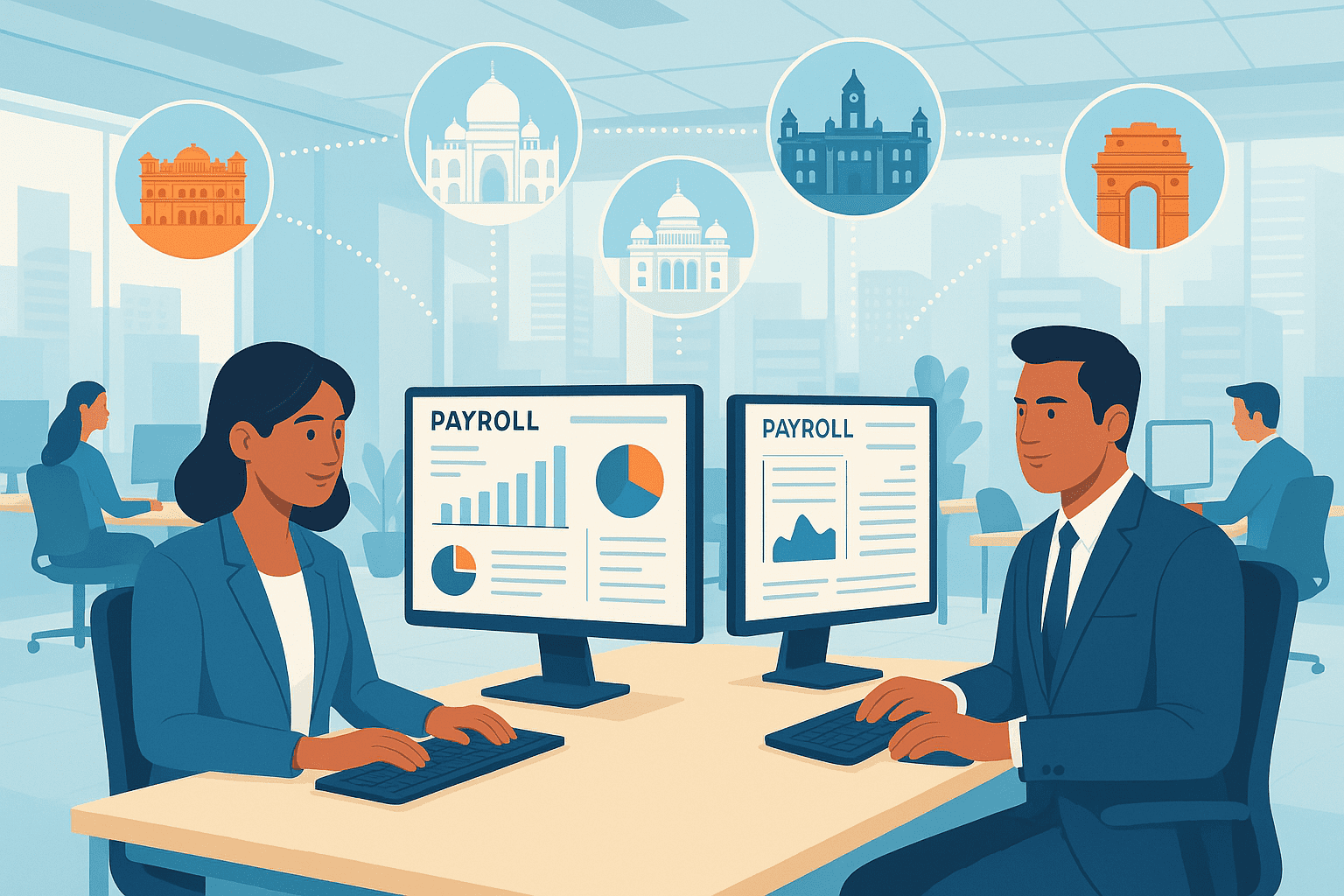
Running payroll across multiple Indian states means applying a different set of rules in each one. Professional tax, minimum wages, labour welfare fund and state filing deadlines all vary by state, so a single national payroll run will not stay compliant without state-level logic. Managing payroll across multiple cities in India can be challenging. Different states have their own labour laws, statutory deductions, and reporting requirements. Combine this with varied pay structures, allowances, and benefits, and the complexity multiplies. For HR and payroll teams, errors can lead to fines, employee dissatisfaction, and operational delays. A structured approach to multi-state payroll helps companies stay compliant, efficient, and employee-focused while reducing risks and workload.
Why Multi-State Payroll Management Matters
As a result, India’s workforce is distributed across hundreds of cities and towns. For example, companies operating in multiple locations face varying tax rates, professional tax slabs, and state-specific labour regulations. Ignoring these can result in penalties and strained employee relations. Beyond compliance, proper multi-state payroll management ensures timely payments, boosts morale, and strengthens employer credibility. With remote work and regional expansion growing, companies need scalable, robust payroll systems capable of handling diverse city requirements.
Common Challenges in Multi-State Payroll
Managing payroll across multiple locations involves challenges such as:
Statutory differences: PF, ESI, Professional Tax, and state-specific rules
Complex employee structures: Different pay scales, bonuses, and allowances
Data accuracy: Consolidating attendance, leave, and overtime across cities
Timely compliance: Meeting deadlines for tax deposits and filings
Communication gaps: Coordinating between local HR teams and central payroll
Companies without structured processes risk errors, delays, and non-compliance penalties.
Step 1: Centralize Payroll Data and Standardize Policies
Create a central database of all employees across cities. Master data such as bank accounts, tax IDs, attendance records, and benefits. Standardize codes for allowances, deductions, and pay elements. Maintain clear payroll policies for leave encashments, overtime, bonuses, and allowances. Document these in a centralized HR manual accessible to all city offices. Centralization and standardized policies reduce errors, ensure consistent payroll processing. Provide HR and finance teams with real-time data for smooth reporting and audits.
Step 2: Understand Local Compliance and Leverage Automation
Specifically, each Indian state has unique statutory obligations, including professional tax slabs, labour welfare contributions, and holiday policies. Use payroll systems that automatically adjust for state-specific rules and keep HR teams updated on regulatory changes. Combine this with automation to consolidate data, calculate taxes and statutory contributions, generate payslips, and handle multiple pay cycles efficiently. Automation minimizes human errors, ensures compliance, and frees HR teams for strategic tasks.
Step 3: Implement Approval Workflows and Conduct Parallel Payroll Runs
Set up robust approval workflows for attendance, overtime, deductions, and leave verification. Assign local HR managers to validate data before central processing and establish clear escalation paths for discrepancies. Before going live, run parallel payroll cycles to compare results with existing payroll. This ensures correct salaries, accurate statutory filings, and identifies any discrepancies, reducing errors at scale.
Step 4: Communicate Clearly and Perform Regular Audits
Inform employees about salary structures, deductions, payslip formats, payroll cut-off dates, and channels to report discrepancies. Clear communication reduces disputes and saves HR time. Schedule regular audits to verify tax deposits, attendance, leave records, and proper application of allowances and deductions. Proactive monitoring maintains employee trust, ensures compliance, and keeps payroll processes running smoothly.
Step 5: Partner Strategically and Continuously Optimize
Engage payroll outsourcing partners for centralized multi-state payroll processing, statutory compliance, reporting, and employee support. Track KPIs such as payroll accuracy, query resolution times, compliance deadlines, and processing costs. Gather feedback, review systems, and implement improvements regularly. Continuous optimization allows companies to scale efficiently, reduce administrative burden, and maintain operational excellence across all locations.
Frequently Asked Questions
What makes multi-state payroll complex?
Each state sets its own professional tax, minimum wages, and rules. Filings differ by location.
How do companies manage it?
They centralise payroll with state-specific configuration. Accuracy improves.
Can multi-state payroll be outsourced?
Yes. Many firms hand it to a specialist.
What happens if a state rule is missed?
Penalties apply. Compliance tracking is essential.
Run Payroll Right with TMS
Accurate, compliant payroll needs a specialist partner. Therefore, TMS covers the full stack:
- Payroll outsourcing: salaries, PF, ESIC, PT, and TDS processed accurately.
- Statutory compliance: labour-law filings under the Codes now in force.
- HR outsourcing: payroll plus the wider HR function under one team.
- Contract staffing: deploy and payroll a flexible workforce.
Conclusion
Managing multi-state payroll in India can be complex, with varying compliance requirements, employee expectations, and operational challenges. Effective management requires careful planning, accurate centralized data, understanding local regulations, automation, and standardized policies. Conducting parallel payroll runs, maintaining clear employee communication, and performing regular audits further ensures accuracy and compliance. Partnering with experts like Team Management Services (TMS) can simplify this process, offering end-to-end payroll outsourcing, statutory compliance management, timely salary processing, and reliable employee support. By combining structured processes with professional support, companies can efficiently manage payroll across multiple cities, reduce administrative burden, enhance employee trust, and maintain operational efficiency. Learn more about TMS HR Services