Part of SKAD HR Group — HR for every stage of business  ·  HRTailor.com  ·  HRTailor.AI

Author: Abhijit Divekar

  • Why India Is Becoming the #1 Destination for Global EOR in 2025–2030

    Why India Is Becoming the #1 Destination for Global EOR in 2025–2030

    Why India Is Becoming the #1 Destination for Global EOR in 2025–2030

    Global EOR

    Introduction

    Global expansion has always come with a mix of excitement and anxiety. Companies dream of tapping into new markets, hiring brilliant talent, and building borderless teams. Yet they also fear dealing with foreign regulations, confusing tax systems, and employment laws that shift with little warning. As the world becomes more interconnected, leaders are searching for countries that offer stability, skill, cost efficiency, and compliance clarity. India has emerged as that rare combination. And from 2025 to 2030, it’s not just rising — it’s becoming the top global hotspot for Employer of Record (EOR) solutions.


    Many businesses are discovering that India delivers more than a workforce. It provides a system that supports global hiring with speed, compliance, and deep capability. Even companies exploring other Asian or European markets often find themselves circling back to India for its unmatched advantages. Let’s explore why India is quickly becoming the world’s #1 destination for global EOR.

    1. A Talent Market Unlike Any Other

    India doesn’t just have a large talent pool. It has one that’s evolving rapidly. Skills that took decades to mature in other countries are developing at lightning speed here.

    Employers consistently praise the proficiency of Indian professionals in fields like:

    • Technology and AI

    • Finance and accounting

    • Digital marketing

    • Customer success

    • HR operations

    • Product development

    • Research and analytics

    Beyond technical strength, the adaptability of the Indian workforce stands out. Professionals in India have learned to balance global workflows, cross-cultural communication, and dynamic tech platforms with impressive ease.

    This combination is almost impossible to replicate at scale anywhere else. And EOR models make it even easier for companies to hire quickly without setting up local entities or dealing with complicated registrations.

    2. Powerful Cost Efficiency With High-Quality Output

    Cost is not the only factor that brings companies to India, but it undeniably shapes the decision. The difference is that cost efficiency here rarely compromises quality. Salaries remain competitive, operational expenses are significantly lower, and companies save massive amounts by not building local entities.


    Through EOR services, these cost efficiencies multiply because legal, administrative, and compliance burdens disappear instantly. When businesses compare India to other emerging markets, the gap becomes obvious. Few countries offer the same balance of affordability and capability. This is one of the reasons global companies increasingly shift their long-term hiring plans toward India for 2025–2030.

    3. A Regulatory Environment Growing More Business-Friendly

    India once had a reputation for complicated labor laws. That perception is slowly fading. Over the last few years, the government has introduced reforms to simplify compliance, encourage foreign investment, and build global trust. Policies supporting digital documentation, streamlined payroll frameworks, and faster establishment processes help reduce friction. Even tax filings and statutory contributions are becoming more predictable and transparent than they were in the past.


    EOR providers in India keep track of these shifts daily. Because they understand how to navigate both traditional rules and modern updates, companies expanding into India gain confidence they wouldn’t have on their own. This growing clarity in the compliance landscape plays a major role in India’s rise as the top EOR destination for the coming decade.

    4. Infrastructure That Supports Global-Scale Remote Work

    India’s digital infrastructure has grown exponentially. Internet penetration is massive. Cloud adoption is universal. Tech-driven processes are integrated into nearly every industry. These advancements allow companies to hire remote employees across India with almost no disruption. Even teams spread across multiple states collaborate as smoothly as those in one office. Add EOR support into the mix, and global companies can onboard employees within days — even in regions where labor rules differ. India’s infrastructure eliminates unnecessary downtime, making it an ideal environment for distributed global teams.

    5. A Mature EOR Ecosystem With Deep Domestic Expertise

    India has seen an explosion of global hiring models in the past decade. As a result, the country now has one of the most mature EOR ecosystems in the world. Providers here understand the nuances of:

    • State-level labor regulations

    • Regional tax variations

    • Local statutory rules

    • Social security norms

    • Contract structures

    • Onboarding protocols

    This depth of knowledge ensures fewer surprises and fewer compliance risks. Companies expanding into high-risk or highly regulated markets often use India as a core talent base because the EOR framework is predictable and stable.

    Some providers, including Team Management Services, have built strong reputations by supporting enterprises and fast-growing startups with reliable payroll, HR, and compliance solutions. They’ve helped shape India into a preferred EOR region by offering transparent processes and consistent delivery.

    6. India’s Strategic Location for Global Operations

    Time zones matter more than companies realize. India’s time zone sits at the ideal midpoint between the East and West, making real-time collaboration smoother. Teams in India can overlap with operations in Europe, the Middle East, Australia, and parts of the U.S. For global companies operating round-the-clock, this creates a natural extension of productivity. EOR hiring amplifies this flexibility by reducing the time it takes to fill roles that must sync with international workflows.

    7. Stability in Uncertain Global Markets

    While many regions face political instability or shrinking labor markets, India is growing steadily. A young workforce, rising digital adoption, and government support toward globalization create long-term predictability. Companies expanding into new territories often prioritize markets that feel safe, sustainable, and future-proof. India provides that stability, and EOR frameworks strengthen it further. As markets fluctuate worldwide, India stands out as a place where compliance risks are manageable and growth remains consistent.

    8. The Growing Reputation of India as a Global Talent Headquarters

    From 2025 to 2030, India is projected to contribute significantly to the global remote workforce. International companies are shifting entire departments to India — not as outsourced teams, but as integral parts of their organizations. What makes this trend so powerful is that it’s not driven only by cost. It’s driven by skill, loyalty, and global adaptability. EOR hiring allows businesses to plug directly into this talent movement without dealing with entity set-up or complicated payroll systems. India has become more than a talent destination. It’s becoming a global employment hub.

    9. Why India Will Remain #1 Through 2030

    Many countries may rise in popularity for global hiring, but few match India’s combination of:

    • Large-scale skilled workforce

    • Strong tech ecosystem

    • Improved regulatory clarity

    • Mature EOR service industry

    • Natural time zone advantages

    • Cost flexibility

    • Sustainable economy

    These factors are not temporary trends. They’re long-term structural advantages.

    As companies seek reliability, speed, and compliance support, India stands out as the most strategic and future-ready location for EOR operations.

    A Thought to Close With

    Every global expansion story is built on trust. Teams trust leaders. Leaders trust markets. Markets trust stability. India has managed to earn that trust through consistency and evolution. Companies that once hesitated are now investing confidently because the country offers an environment where global hiring can scale without fear.


    And with the right EOR partner, the transition becomes even smoother. Whether organizations are entering India for the first time or expanding deeper, expert guidance makes a difference — and teams like Team Management Services have quietly supported that journey for years. India isn’t just rising. It’s becoming the foundation of global workforce strategy from 2025 to 2030.

    FAQs

    They can be, especially due to state-level variations. That’s exactly why companies use EOR services — the provider handles compliance, payroll, and contracts so businesses avoid legal risk.

    An EOR becomes the legal employer on your behalf. You manage the employee’s work, while the EOR manages payroll, taxes, benefits, onboarding, and statutory compliance.

    Absolutely. EOR providers already navigate state-by-state differences in employment law and payroll requirements, making multi-state hiring simple.

    Yes. India’s young population, growing digital infrastructure, steady economic growth, and improving regulatory environment make it one of the most reliable long-term hiring destinations.
  • How Remote Employers Are Facing Compliance Complexities — And Why EOR Is the Answer

    How Remote Employers Are Facing Compliance Complexities — And Why EOR Is the Answer

    How Remote Employers Are Facing Compliance Complexities —
    And Why EOR Is the Answer

    EOR Compliance

    Introduction

    Managing a remote workforce sounds modern and flexible—but behind the scenes, employers often face a maze of rules, scattered obligations, and shifting legal risks. As global hiring becomes more common, companies are discovering that compliance is no longer a simple checklist. Instead, it’s becoming one of the biggest challenges in remote work.


    From worker classification errors to cross-border payroll laws, companies are now dealing with complexities that didn’t exist just a few years ago. A single slip can trigger fines, back payments, investigations, or even hiring restrictions. And when teams are distributed across multiple countries, the risk multiplies.


    This is where an Employer of Record (EOR) becomes a strategic advantage. Instead of trying to decode each country’s employment laws, companies are choosing EOR partners to handle compliance, payroll, contracts, onboarding, and risk management—allowing them to hire globally with confidence. With rising legal scrutiny and constant regulatory changes, EOR Compliance has become one of the safest ways to employ in remote environments.

    Let’s break down why compliance is becoming more complicated and why EOR has emerged as the smartest solution for global teams.

    The New Reality: Why Remote Employers Struggle With Compliance

    Remote hiring opens access to a global talent pool, but it also exposes companies to unfamiliar legal systems. Each country has its own rules, and employers must comply even if they don’t have a local presence.

    Below are the most common compliance issues remote employers face globally:

    1. Misclassification Is More Common Than Ever

    One of the biggest risks remote companies face is misclassifying employees as independent contractors. Countries like India, Brazil, Canada, the UK, and the EU are tightening their definitions of employment relationships. Even minor mistakes—like setting fixed working hours or providing tools—can legally reclassify a contractor as an employee.

    Penalties may include:

    • Retroactive taxes

    • Social security back payments

    • Employee benefits obligations

    • Penalty fees

    • Audits or legal claims

    An EOR ensures workers are hired under the correct legal classification to avoid these consequences.

    2. Country-Specific Labor Laws Are Constantly Changing

    Every country has its own rules around:

    • Minimum wages

    • Maximum work hours

    • Paid leave

    • Overtime

    • Notice periods

    • Gratuity or severance

    • Public holidays

    • Employment contracts

    Remote employers often miss updates, especially when hiring across multiple markets. EORs track all changes in real time and apply them correctly, protecting companies from non-compliance.

    3. Payroll Regulations Are Deeply Localized

    Handling payroll for remote teams is never one-size-fits-all. Foreign exchange rules, country-specific payroll taxes, mandatory bonuses, and social security contributions make things complicated.

    For example:

    • India requires PF, ESIC, PT, and gratuity compliance

    • Brazil mandates 13th-month salary and FGTS contributions

    • Mexico requires INFONAVIT and IMSS

    • The UK has auto-enrollment pensions

    If payroll is processed incorrectly—even unintentionally—the employer risks audits or financial penalties. EORs manage country-specific payroll rules with precision.

    4. Data Protection and Employee Privacy Laws Are Expanding

    Remote work increases data exchange across borders. Laws like GDPR (Europe), PDPA (Singapore), and DPDP Act (India) regulate how employee data must be stored, processed, and transferred.

    Companies unfamiliar with these regulations can unknowingly violate privacy laws.

    EORs maintain compliant data processes and secure employee information as per local and international standards.

    5. Cross-Border Taxation Gets Complicated Quickly

    Remote employees working in another country may trigger:

    • Permanent establishment (PE) risk

    • Corporate tax obligations

    • Individual tax complexities

    • Double taxation issues

    This can happen even with a single employee. EORs shield companies from establishing taxable presence while ensuring employees meet local tax requirements.

    Why EOR Has Become the #1 Answer to Remote Compliance Risks

    EOR services are designed to eliminate the legal and administrative burdens of hiring abroad. Instead of setting up an entity or navigating complex rules independently, companies rely on EORs to employ on their behalf.

    Below are the biggest advantages of relying on EOR services.


    1. Full Compliance From Day One

    An EOR becomes the legal employer and ensures:

    • Contracts meet local labor laws

    • Payroll is processed correctly

    • Taxes are submitted

    • Benefits are aligned with national standards

    • Terminations follow legal procedures

    This reduces legal exposure significantly while maintaining a compliant workforce.


    2. Zero Entity Setup Needed

    Setting up a legal entity in another country can take months and require:

    • Incorporation paperwork

    • Local director appointments

    • Tax registration

    • Banking

    • Compliance audits

    • Ongoing reporting

    An EOR eliminates all of this, enabling hiring in days, not months.


    3. Standardized HR Processes Across All Countries

    Instead of juggling different rules and systems, companies gain unified HR operations through:

    • Consolidated payroll

    • Centralized reporting

    • Uniform onboarding

    • Streamlined communication

    This saves time, reduces errors, and improves global team management.


    4. Employee Benefits That Match Local Standards

    Compliance isn’t only about avoiding penalties—it’s also about offering what local employees expect. An EOR ensures access to compliant benefits such as:

    • Medical insurance

    • Retirement schemes

    • Country-specific allowances

    • Statutory bonuses

    This improves retention and reduces legal risk.


    5. Built-In Protection From Misclassification

    Since the EOR becomes the legal employer, companies avoid classification errors. This is especially relevant for companies previously hiring contractors in markets where regulations have become stricter.


    6. Faster International Expansion

    Remote employers often want to scale quickly without dealing with administrative barriers. EORs make this possible by:

    • Onboarding employees quickly

    • Handling documentation

    • Managing local compliance

    • Ensuring smooth monthly payroll

    This simplifies expansion into new markets with minimal disruption.

    Why EOR Compliance Matters More Than Ever

    As global labor laws evolve, governments are becoming stricter about employer obligations. Companies that ignore compliance risks may face:

    • Costly penalties

    • Loss of business licenses

    • Employee lawsuits

    • Visa or hiring restrictions

    • Forced shutdowns of foreign operations

    This is why EOR Compliance has become a strategic priority rather than a backup option. It’s a way to expand confidently without risking legal complications.

    Conclusion: Why EOR Is the Smartest Path Forward

    Remote work has created opportunities but also introduced complex responsibilities. Companies now face rules that differ dramatically from country to country, with compliance laws growing more detailed every year. Instead of losing time and resources trying to manage all these obligations internally, partnering with an EOR ensures safe, fast, and compliant hiring.


    A reliable EOR partner protects organizations from payroll errors, legal exposure, misclassification, and cross-border risks—while allowing them to focus on growth. For companies expanding into India or other emerging markets, this approach provides confidence, stability, and ease of scaling.


    A trusted provider like Team Management Services (TMS) supports organizations with fully compliant hiring, country-specific payroll, and risk-free workforce expansion—making it easier for employers to grow their global teams without fear of compliance issues.

    FAQs

    An EOR manages employment contracts, payroll taxes, statutory benefits, labor law requirements, and termination procedures. This ensures all employees are legally hired, paid correctly, and managed according to local regulations.

    Yes. An EOR minimizes compliance errors, protects companies from misclassification issues, and ensures payroll accuracy. It also shields organizations from permanent establishment risks while handling every legal obligation locally.

    Absolutely. Startups, SMEs, and fast-growing companies benefit from EOR because it eliminates the need for entity setup and reduces operational costs. It allows them to hire globally without long-term commitments or administrative burdens.

    A staffing agency assists with recruitment, but an EOR becomes the legal employer. The EOR manages contracts, compliance, payroll, benefits, and regulatory filings, while the company still controls day-to-day work responsibilities.

  • How Manpower Temp Agencies Are Helping Quick-Commerce & Retail Firms Scale Fast

    How Manpower Temp Agencies Are Helping Quick-Commerce & Retail Firms Scale Fast

    How Manpower Temp Agencies Are Helping Quick-Commerce & Retail Firms Scale Fast

    Manpower Temp Agencies

    Introduction

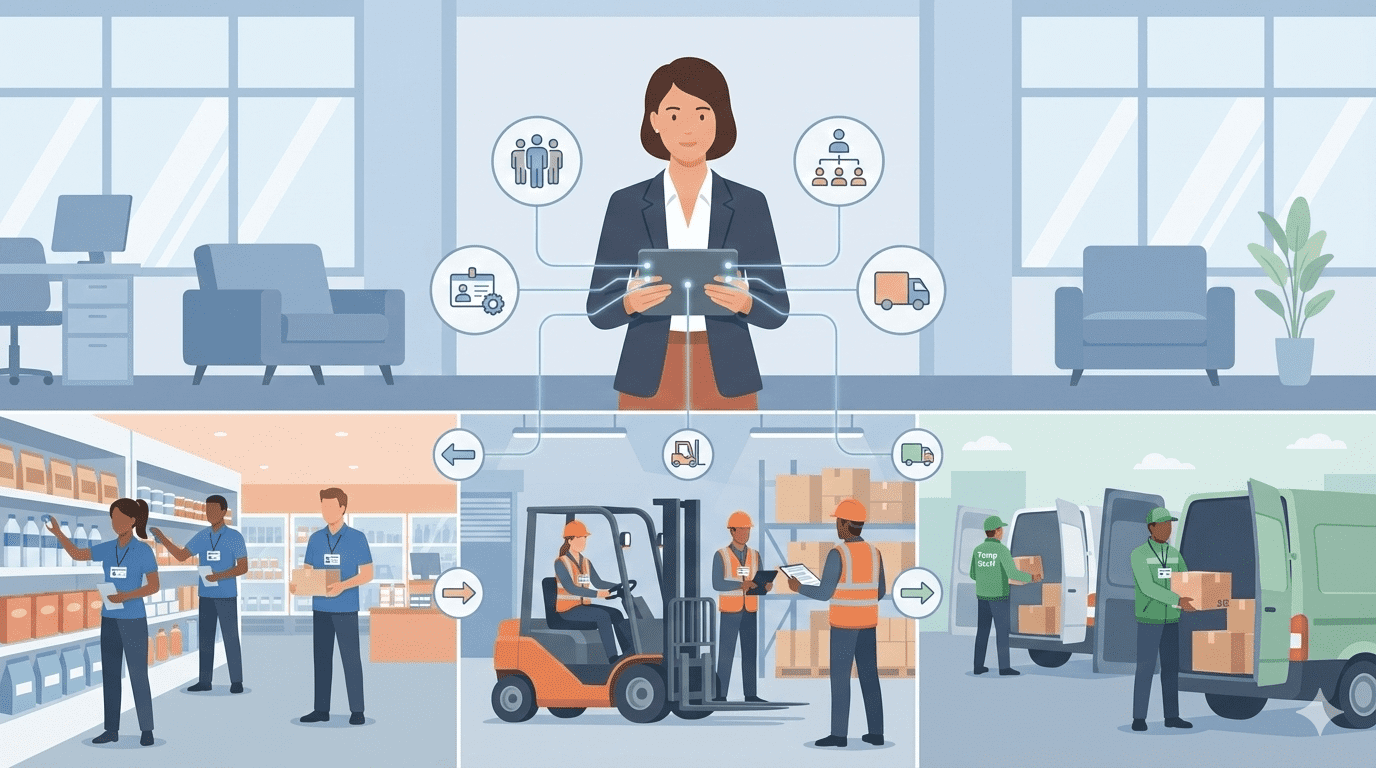
    Quick-commerce and modern retail operate on one unforgiving rule: speed decides success. Whether it’s a sudden spike in online orders, festival sales, new store launches, or same-day delivery promises, these businesses must scale operations instantly—without disrupting service quality. However, scaling people is far harder than scaling technology.


    Permanent hiring takes time. Training cycles are long. Compliance adds another layer of complexity. This is where manpower temp agencies have become critical partners for retail and quick-commerce companies that need workforce agility without long-term risk.


    Instead of slowing down growth, these agencies enable businesses to respond to demand in real time—efficiently, legally, and cost-effectively.

    Why Workforce Agility Matters More Than Ever

    Quick-commerce and retail businesses face unpredictable demand patterns. A single promotion, weather change, or festive season can double workforce requirements overnight.

    Common challenges include:

    • Sudden order surges

    • High attrition rates

    • Multi-city operations

    • Seasonal staffing needs

    • Tight delivery timelines

    • Compliance-heavy employment laws

    Traditional hiring models simply cannot keep up with this pace. Temporary staffing has emerged as the most practical solution.

    The Role of Manpower Temp Agencies in High-Velocity Industries

    Manpower temp agencies act as workforce enablers. They supply trained, job-ready personnel exactly when and where businesses need them—without the administrative burden.

    These agencies support roles such as:

    • Warehouse associates

    • Delivery executives

    • Store helpers

    • Cashiers

    • Inventory staff

    • Customer support agents

    • Backend operations staff

    The biggest advantage? Speed without risk.

    How Temp Staffing Helps Quick-Commerce Firms Scale Faster

    1. Rapid Workforce Deployment

    Quick-commerce thrives on immediacy. Temp agencies maintain ready talent pools that can be deployed within days—or even hours.

    This allows businesses to:

    • Launch operations in new areas quickly

    • Handle flash sales and peak demand

    • Scale delivery capacity instantly

    Speed becomes a competitive advantage, not a bottleneck.

    2. Flexible Staffing Without Long-Term Commitments

    Demand in retail and quick-commerce fluctuates constantly. Temporary staffing offers flexibility to:

    • Increase headcount during peak seasons

    • Reduce workforce during slow periods

    • Avoid unnecessary fixed payroll costs

    This flexibility protects margins while supporting growth.

    3. Reduced Hiring and HR Overhead

    Recruitment, onboarding, documentation, payroll, and exits consume time and resources. Temp agencies handle these responsibilities end-to-end.

    Businesses benefit by:

    • Saving recruitment costs

    • Reducing HR workload

    • Eliminating administrative delays

    Internal teams can focus on operations and customer experience instead.

    4. Compliance-Managed Workforce

    Employment compliance in India is complex. It includes:

    Manpower temp agencies act as the legal employer, ensuring:

    This shields businesses from penalties and legal exposure.

    Key Advantages for Operations and Supply Chain Teams

    For warehouse and logistics operations, manpower temp agencies offer:

    • Scalable labour for sorting, packing, and dispatch

    • Quick replacements for absenteeism

    • Consistent productivity during peak periods

    This ensures supply chains remain uninterrupted—even under pressure.

    Why This Model Works Better Than Direct Hiring

    AspectDirect HiringTemp Staffing
    Hiring SpeedSlowFast
    Compliance RiskHighManaged
    Cost FlexibilityLowHigh
    ScalabilityLimitedOn-Demand
    HR EffortHeavyMinimal

    For fast-moving industries, the choice is clear.

    Choosing the Right Manpower Temp Agency

    Not all agencies deliver the same value. Businesses should evaluate partners based on:

    • Industry experience in retail or quick-commerce

    • Strong compliance knowledge

    • Multi-city hiring capability

    • Fast deployment timelines

    • Transparent pricing

    • Reliable support teams

    A dependable partner ensures growth without disruption.

    How Professional Staffing Partners Add Long-Term Value

    While temp staffing is often seen as a short-term solution, the right partner creates long-term stability by:

    • Maintaining workforce continuity

    • Improving operational efficiency

    • Reducing legal and compliance risk

    • Supporting expansion plans

    Companies that scale successfully treat staffing as a strategic function, not a reactive one.

    Conclusion: Scaling Fast Without Losing Control

    Quick-commerce and retail businesses cannot afford slow hiring cycles, compliance gaps, or workforce disruptions. Operating in a high-pressure environment means every delay directly impacts customer experience, service levels, and revenue performance.

    While manpower-led models help organisations respond quickly to demand, long-term stability comes from strong HR foundations. This is where structured HR services, compliant employment models, and payroll accuracy play a critical role. By outsourcing complex responsibilities such as statutory compliance, payroll management, employee transitions, and structured hiring, businesses gain the flexibility to scale while staying fully aligned with local labour regulations.

    Partners like Team Management Services (TMS) support growing organisations through end-to-end HR services, Employer of Record (EOR) solutions, compliant contract staffing through payroll transfer, recruitment support, and payroll outsourcing. This enables retail and quick-commerce companies to scale operations confidently, reduce administrative pressure, and maintain control—without compromising on compliance or workforce quality.

    FAQs

    Quick-commerce businesses face unpredictable demand and tight delivery timelines. Temp staffing allows them to scale manpower instantly without long hiring processes or long-term commitments.

    Yes. When hired through a professional temp agency, workers are employed under compliant contracts with statutory benefits managed by the agency.

    Absolutely. Established agencies can deploy manpower across multiple cities simultaneously, making them ideal for fast retail and logistics expansion.

    Yes. Temp staffing reduces recruitment costs, HR overhead, and fixed payroll expenses—making it a more flexible and financially efficient option for high-growth businesses.

  • Top Staffing Firms in India for 2026: A Review of Services, Strengths, and Specialties

    Top Staffing Firms in India for 2026: A Review of Services, Strengths, and Specialties

    Top Staffing Firms in India for 2026: A Review of Services, Strengths, and Specialties

    Top staffing firms in India for 2026

    Introduction

    Workforce dynamics in India are changing faster than most companies expected. Digital transformation, sectoral shifts, and growing talent gaps are pushing organisations to rely on staffing partners for speed, scale, and compliance. As 2026 approaches, businesses are no longer looking for just staffing providers—they are looking for strategic workforce partners who can help them stay agile.

    This review highlights some of India’s top staffing firms for 2026, organised by what they do best. Each firm brings its own strengths to the table, and understanding their specialties can help leaders choose the right partner for their workforce needs.

    Leaders today face a deeper question:

    1. Best for Contract Staffing & Workforce Agility: Team Management Services (TMS)

    TMS stands out for companies that need reliable, fast, and compliant contract staffing support. Unlike firms that focus primarily on large-scale recruitment, TMS specialises in helping organisations manage fluctuating workloads, multi-city expansions, and project-based hiring without adding administrative pressure to internal teams.

    Their approach combines quick deployment with strong compliance discipline. From payroll accuracy to statutory filings, TMS ensures that clients experience a smooth setup with minimal HR intervention. This makes them an ideal partner for businesses facing unpredictable hiring patterns or tight delivery timelines.

    Where TMS excels:

    Rapid deployment of contract staff

    • End-to-end compliance handling
    • Transparent payroll processes
    • Ready talent networks
    • Smooth replacements and workforce continuity

    Companies that want a flexible workforce model without compromising on control or compliance consistently benefit from TMS’s contract staffing expertise.

    2. Preferable for Large-Scale Hiring: Randstad India

    Randstad remains one of the most established staffing firms in India. Their strength lies in volume hiring and nationwide coverage. With strong technology integration and data-driven workforce planning, Randstad supports companies that need predictable, scalable hiring across multiple locations.

    They offer permanent recruitment, contract staffing, RPO, and project hiring solutions across sectors such as manufacturing, IT, retail, and BFSI.

    A permanent employee grows with the team, learns the organisation’s culture, and becomes a dependable force over time. Companies that want continuity, loyalty, and deep product understanding still rely heavily on full-time talent.

    But this stability comes with commitments—financial and operational.

    3. For Global Standards and Compliance: Adecco India

    Adecco brings international staffing expertise to Indian operations. Their structured processes and compliance-first approach make them a preferred partner for multinational companies with strict governance requirements.

    Adecco’s solutions are suitable for organisations that need consistent service delivery across several cities and states, especially in industries where compliance mistakes can be costly.

    On the other hand, contract staffing offers predictability. Companies know exactly what they will spend each month, and they avoid additional overheads attached to long-term employees. When businesses need to react quickly—scale up, slow down, or pivot—contract staffing prevents unnecessary financial strain.

    A startup founder once explained it perfectly:
    “Permanent hiring gives me depth. Contract staffing gives me speed.”

    Both are valuable—but in different ways.

    4. Suitable for High-Speed Deployment: TeamLease

    TeamLease is known for its ability to deploy staffing at scale, often within short timelines. Their reach, combined with their extensive candidate network, allows them to support companies with large workforce demands—particularly in logistics, telecom, e-commerce, and BFSI.

    A distinguishing advantage is their investment in skilling programs, which helps bridge workforce capability gaps

    5. Best for Integrated Workforce Solutions: Quess Corp

    Quess Corp offers a wide range of services beyond staffing, making it a suitable partner for enterprises looking for bundled HR solutions. From workforce management to technology solutions and facility operations, Quess provides a multi-layered workforce ecosystem.

    Their staffing vertical is especially strong in delivering large teams for industrial, tech, and service-driven operations.

    6.  Recommended for Specialised Technical Talent: Kelly Services

    Kelly Services has built its reputation around sourcing niche talent in engineering, scientific roles, and IT. Companies that require specialised skills prefer Kelly because they actively reach passive talent pools—candidates who aren’t always visible on job portals.

    Kelly is particularly effective for organisations where technical precision and skill fit matter more than hiring volume.

    Where India’s Staffing Industry Is Heading in 2026

    A few trends are shaping staffing strategies this year:


    Demand for flexible workforce models is rising.

    Companies want agility without long-term liabilities, driving interest in contract staffing.

    Compliance and documentation standards are becoming stricter.

    Businesses need partners who understand state-wise regulations and maintain error-free processes.

    Skill-based hiring is replacing qualification-heavy screening.

    Staffing firms are shifting towards competency-driven talent identification.

    Hiring timelines are shrinking.

    Fast deployment is no longer an advantage—it’s an expectation.

    Technology is reshaping workforce management.

    From digital onboarding to automated payroll, staffing partners that embrace tech deliver a smoother client experience.

    These shifts explain why choosing the right staffing firm is now a strategic decision rather than a transactional one

    A Practical Next Step for Businesses Evaluating Staffing Partners

    If your organisation is exploring contract staffing, working with a provider that understands compliance, speed, and operational nuances can make a significant difference. TMS offers flexible, reliable, and well-structured contract staffing solutions tailored to India’s changing workforce needs.

    Whether you’re scaling for a project, entering new markets, or balancing workload spikes, TMS helps companies stay agile without adding HR complexity.

    A strategic staffing partner doesn’t just fill roles—it strengthens your organisation’s ability to grow with confidence.

    FAQs

    Because businesses need faster hiring, flexible workforce models, and strong compliance support as demand patterns become more unpredictable.

    Ideally every 12–18 months, especially as workforce strategies and regulatory requirements evolve.

    Relevant expertise, compliance capability, and deployment speed.

    By managing compliance, workforce continuity, and operational complexity.

  • How IT Staffing Agencies Source High-Demand Tech Talent in IndiaReal Tactics & Tools

    How IT Staffing Agencies Source High-Demand Tech Talent in IndiaReal Tactics & Tools

    How IT Staffing Agencies Source High-Demand Tech Talent in India
    Real Tactics & Tools

    IT Staffing Agencies

    Introduction

    India’s tech talent market is no longer driven by resumes and job portals alone. As demand rises for skills like cloud engineering, cybersecurity, data platforms, DevOps, and full-stack development, companies are discovering that hiring the right people is less about posting roles—and more about knowing where to look.

    High-demand tech professionals are rarely “available.” Most are already working, selectively open to change, and approached frequently. This reality has transformed how IT staffing agencies operate. Success now depends on precision sourcing, deep networks, and execution discipline.

    This blog takes you inside the real tactics and tools IT staffing agencies use in India to identify, engage, and deploy high-demand tech talent—beyond the surface-level methods most people assume.

    Some organisations need talent for a defined project. Others manage recurring seasonal demand. Many require stable teams without committing to permanent headcount. Each situation calls for a different contract staffing model.

    Understanding these models—and selecting the right one—can improve cost control, productivity, and workforce stability. This blog explains the three most widely used contract staffing models in India: project-based, seasonal, and long-term staffing, along with when and why each one works best.

    Why Traditional Hiring Fails for High-Demand Tech Roles

    Posting a job description and waiting for applications no longer works for niche or in-demand tech skills. The best candidates are passive, time-poor, and highly selective. Many never apply at all.

    IT staffing agencies solve this problem by reversing the approach. Instead of attracting talent, they go directly to it—using systems, relationships, and data built over time.

    This shift from reactive hiring to proactive sourcing is what separates effective IT staffing partners from standard recruiters.

    Curated Talent Pools Built Over Years, Not Weeks

    One of the strongest advantages IT staffing agencies bring is ready access to pre-qualified talent pools. These are not static resume databases. They are living networks built through continuous engagement.

    Agencies maintain detailed records of:

    • Technology stacks and hands-on experience
    • Project exposure and domain familiarity
    • Availability timelines and notice periods
    • Past performance feedback

    Because these relationships already exist, agencies can respond quickly when a new requirement arises. This is why companies working with staffing partners often fill roles in days rather than months.

    Smarter Use of ATS and Recruitment Technology

    Modern IT staffing is driven by intelligent systems, not spreadsheets. Advanced Applicant Tracking Systems (ATS) help agencies map talent accurately and reduce guesswork.

    These platforms allow recruiters to:

    • Segment candidates by skill depth rather than keywords
    • Track role movement and availability
    • Eliminate duplicate profiles
    • Shortlist with precision

    More importantly, ATS tools integrate sourcing channels into one workflow, allowing recruiters to act faster without sacrificing accuracy.

    Technology doesn’t replace recruiters—it amplifies their effectiveness.

    Direct Sourcing Through Professional Networks

    LinkedIn remains essential, but effective sourcing goes far beyond sending bulk messages. Experienced IT staffing agencies use role-specific, personalised outreach designed to start conversations, not push offers.

    Recruiters study candidate profiles carefully before reaching out. They focus on relevance, project alignment, and long-term growth rather than immediate job changes.

    Over time, these conversations build trust. When the right opportunity appears, engagement happens naturally.

    Engaging Passive Talent Without Pressure

    Most high-demand tech professionals are not actively looking for jobs. Agencies engage them through career discussions, not aggressive pitches.

    These conversations explore:

    • Project complexity
    • Technology relevance
    • Work environment
    • Long-term learning

    When candidates feel respected rather than targeted, trust builds. This human approach remains one of the most powerful sourcing tools—especially for senior and niche roles.

    Balancing Speed With Technical Validation

    Speed matters in IT hiring, but rushing without validation creates long-term problems. Effective IT staffing agencies streamline early-stage screening to protect both clients and candidates.

    Initial technical checks, skill alignment discussions, and role clarity happen before profiles reach the client. This reduces interview fatigue and improves hiring outcomes.

    The result is faster hiring without compromising quality.

    Deployment Readiness Beyond Hiring

    Sourcing talent is only one part of the process. Deployment must be smooth for business continuity.

    IT staffing agencies ensure:

    • Documentation readiness
    • Compliance alignment
    • Payroll integration
    • Seamless onboarding

    For contract and project-based IT roles, this operational support is just as important as technical sourcing.

    Why Companies Prefer IT Staffing Partners for Critical Tech Roles

    High-demand tech hiring involves uncertainty, competition, and tight timelines. Companies rely on IT staffing agencies because they offer:

    • Faster access to skilled professionals
    • Reduced internal hiring burden
    • Market-aligned guidance
    • Compliance-ready deployment
    • Workforce flexibility

    Instead of starting from scratch each time, organisations benefit from established sourcing ecosystems

    How IT Staffing in India Is Evolving

    The future of IT staffing is more focused and outcome-driven. Agencies are shifting from volume-based recruitment to precision talent sourcing.

    Key changes include:

    • Skill-first hiring
    • Project-based deployment
    • Hybrid and remote talent models
    • Faster turnaround expectations

    Agencies that adapt to these shifts continue to add value in a rapidly changing tech landscape.

    How TMS Delivers High-Demand IT Talent with Precision

    At Team Management Services (TMS), IT staffing goes beyond filling roles. Our approach focuses on connecting businesses with the right technology professionals while ensuring operational simplicity.

    TMS supports organisations across India with:

    • Contract IT staffing
    • Project-based tech teams
    • Long-term IT resource deployment
    • Employer of Record (EOR) support
    • Payroll outsourcing and workforce compliance

    With an extensive talent network, experienced recruiters, and strong compliance processes, TMS enables companies to scale technology teams quickly and confidently—without adding HR complexity

    When sourcing high-demand tech talent feels difficult, the right staffing partner makes all the difference.

    FAQs

    High-demand tech professionals are usually already employed and rarely apply to job postings. Staffing agencies engage them directly through networks, communities, and long-term relationships.

    Agencies analyse project exposure, hands-on experience, and contributions within developer communities such as open-source platforms to evaluate practical skill depth.

    Smooth onboarding, compliance alignment, and payroll integration ensure that talent becomes productive without operational delays.

    No. It also includes workforce execution elements such as onboarding support, payroll coordination, and compliance management.

  • Contract Staffing in India: What Employers Need to Know About Flexible Workforce Models in 2026

    Contract Staffing in India: What Employers Need to Know About Flexible Workforce Models in 2026

    Contract Staffing in India: What Employers Need to Know
    About Flexible Workforce Models in 2026

    Contract staffing in India

    Introduction

    Business models in 2026 look very different from what they were a few years ago. Companies are scaling faster, entering new markets quickly, and responding to demand that changes almost overnight. At the same time, cost control, compliance, and workforce efficiency have become boardroom-level priorities.

    In this environment, rigid hiring models no longer work for many organisations. Employers need flexibility without losing control. They need speed without legal exposure. And they need workforce models that adapt as the business evolves.

    This is where contract staffing has become a strategic workforce solution rather than just a short-term arrangement.

    Understanding Contract Staffing in the Indian Context

    Contract staffing refers to a structured employment model where employees are deployed to a company but are on the payroll of a third-party employer. The individual works under the company’s day-to-day supervision, while employment administration is handled separately.


    In India, this model operates under clearly defined labour laws and compliance frameworks. When implemented correctly, it allows businesses to scale teams while staying aligned with statutory requirements.

    Why Contract Staffing Is Growing Rapidly in India

    Several factors are driving the adoption of contract staffing across industries:

    • Rapid business expansion and project-based hiring

    • Seasonal and demand-driven workforce needs

    • Skill-specific roles with defined timelines

    • Cost optimisation without permanent headcount increase

    • Increased focus on compliance and risk management

    By 2026, more employers are expected to adopt flexible workforce structures as part of long-term workforce planning.

    Key Industries Using Contract Staffing Models

    Contract staffing is no longer limited to manufacturing or logistics. Today, it is widely used across:

    • IT and technology services

    • Retail and supply chain operations

    • Quick-commerce and e-commerce

    • Manufacturing and engineering

    • Healthcare support services

    • BFSI back-office operations

    • Shared services and GCCs

    This wide adoption shows that flexibility is now a mainstream workforce strategy.

    How Contract Staffing Works for Employers

    A compliant contract staffing arrangement involves three parties:

    1. The Employer (Client Company) – manages work, performance, and deliverables

    2. The Contract Staffing Partner – acts as the legal employer

    3. The Employee – performs duties under the client’s supervision

    The staffing partner manages payroll, statutory deductions, documentation, and compliance, while the employer focuses on business outcomes.

    Legal and Compliance Framework Employers Must Understand

    In India, contract staffing is governed by multiple labour laws. Employers must ensure the model is structured correctly to avoid penalties or disputes.

    Key compliance areas include:

    Compliance responsibility does not disappear simply because employees are contracted. Employers must work with partners who understand and execute these obligations accurately.

    Common Compliance Risks Employers Face

    When contract staffing is poorly managed, risks include:

    • Improper worker classification

    • Gaps in statutory contributions

    • Incomplete employment documentation

    • Liability during audits or inspections

    • Reputational damage

    This is why choosing the right partner and model is critical.

    Benefits of Contract Staffing for Employers in 2026

    1. Workforce Scalability Without Long-Term Commitments

    Contract staffing allows businesses to increase or reduce headcount based on demand, projects, or timelines. This flexibility is especially useful in uncertain or fast-changing markets.

    2. Faster Hiring and Deployment

    Instead of lengthy permanent hiring cycles, contract staffing enables quicker onboarding and deployment—helping teams stay operational during growth phases.

    3. Better Cost Control

    By converting fixed costs into variable workforce costs, companies gain better financial predictability and budgeting control.

    4. Reduced Administrative Load

    Payroll processing, statutory filings, employee documentation, and exits are handled by the staffing partner, allowing internal teams to focus on operations.

    5. Compliance-Managed Employment

    A well-structured contract staffing model ensures statutory compliance is handled professionally, reducing exposure to labour disputes and penalties.

    Contract Staffing vs Permanent Hiring: A Strategic Comparison

    AspectPermanent HiringContract Staffing
    Hiring SpeedModerate to SlowFaster
    Cost FlexibilityLimitedHigh
    Compliance EffortHighShared
    ScalabilityFixedFlexible
    Risk ExposureDirectReduced

    Both models have their place. The key is knowing when to use which.

    Payroll Transfer: A Smarter Form of Contract Staffing

    One growing model in India is payroll transfer, where existing employees are transferred to a staffing partner’s payroll while continuing to work for the same employer.

    This approach helps companies:

    • Streamline payroll operations

    • Improve compliance accuracy

    • Reduce internal HR workload

    • Maintain workforce continuity

    It is especially useful for organisations restructuring or centralising HR operations.

    Choosing the Right Contract Staffing Partner

    Not all providers offer the same level of expertise. Employers should assess partners on:

    • Strong understanding of Indian labour laws

    • Transparent compliance processes

    • Accurate and timely payroll systems

    • Clear SLAs and reporting

    • Ability to support workforce transitions

    • Industry experience and credibility

    A reliable partner reduces complexity rather than adding another layer to manage.


    Common mistakes where Employers often go wrong include:

    • Treating contract staffing as informal hiring

    • Ignoring compliance accountability

    • Choosing partners based only on cost

    • Lack of clarity on roles and responsibilities

    Avoiding these pitfalls is essential for sustainable workforce management.

    Conclusion: Building Flexibility Without Losing Control

    As workforce models evolve in 2026, employers need solutions that balance flexibility with structure. Contract staffing, when implemented correctly, offers that balance—allowing companies to scale teams, manage costs, and stay compliant without locking themselves into rigid employment structures.

    Rather than viewing it as a temporary arrangement, forward-looking organisations are integrating flexible workforce models into their long-term HR strategies. With the right processes, clear governance, and compliant execution, contract staffing becomes a reliable tool for growth.

    Partners like Team Management Services (TMS) support organisations through HR services, compliant contract staffing via payroll transfer, recruitment support, Employer of Record (EOR) solutions, and payroll outsourcing helping businesses manage workforce complexity while staying aligned with Indian labour regulations.


    FAQs

    Yes. Contract staffing is legal when structured in accordance with Indian labour laws and managed through compliant staffing partners.

    The staffing partner manages statutory compliance, but employers must ensure they work with a credible and compliant provider.

    Absolutely. Many companies use contract staffing for IT, engineering, analytics, and specialised project-based roles.

    Payroll transfer involves moving existing employees to a third-party payroll while retaining operational control, often to improve compliance and payroll efficiency.

  • Why Startups Are Switching to Contract Staffing as Funding Tightens in 2026

    Why Startups Are Switching to Contract Staffing as Funding Tightens in 2026

    Why Startups Are Switching to Contract Staffing as Funding Tightens in 2025–26

    Contract staffing

    Introduction

    The startup ecosystem in 2025–26 looks very different from the high-burn, growth-at-all-costs era. Funding cycles are longer. Investor scrutiny is sharper. Profitability and runway matter more than aggressive headcount expansion.

    In this environment, startups are being forced to rethink how they hire, scale, and manage people. Permanent hiring, once seen as a sign of growth, is now carefully evaluated against cost, flexibility, and long-term risk.

    As a result, many startups are shifting toward flexible workforce models that allow them to grow responsibly. One such model gaining strong traction is contract staffing.

    Why Funding Tightening Is Changing Hiring Decisions

    When funding becomes harder to secure, every hiring decision carries weight. Startups are under pressure to:

    • Extend runway without compromising output

    • Reduce fixed monthly expenses

    • Avoid over-hiring during uncertain growth phases

    • Stay compliant without expanding internal HR teams

    Permanent hiring increases fixed costs and long-term obligations. In contrast, contract staffing introduces flexibility and control—two things startups need the most during funding uncertainty.

    Understanding Contract Staffing From a Startup Perspective

    Contract staffing allows startups to engage talent for specific roles, projects, or time periods while employment administration is handled by a third party. The startup manages day-to-day work, but payroll, statutory compliance, and documentation are managed externally.

    This model aligns well with how startups operate—lean, fast-moving, and outcome-driven.

    Why Startups Are Actively Choosing Contract Staffing

    1. Better Cost Control Without Slowing Growth

    One of the biggest advantages of contract staffing is cost predictability. Startups can scale teams based on actual business demand instead of projected growth.

    This helps founders:

    • Avoid long-term salary commitments

    • Reduce overhead costs

    • Allocate funds toward core business priorities

    Costs remain variable, not fixed—an important distinction when funding visibility is limited.


    2. Faster Hiring in a Competitive Talent Market

    Startups often lose candidates due to slow hiring processes. Contract staffing allows quicker onboarding, enabling startups to move faster than competitors without compromising on talent quality.

    Speed matters when product launches, client onboarding, or expansion timelines are tight.


    3. Reduced Compliance and Legal Exposure

    Employment compliance in India involves multiple laws and frequent updates. For startups without large HR teams, managing this internally can be risky.

    Through contract staffing, statutory obligations like PF, ESIC, minimum wages, and documentation are handled professionally—reducing the risk of penalties or audits.

    This is one of the key reasons Contract Staffing for Startups has become a preferred model during uncertain funding cycles.


    4. Flexibility to Scale Up or Down

    Startups rarely grow in straight lines. There are spikes, plateaus, and pivots. Contract staffing allows teams to expand or reduce headcount without disruptive restructuring.

    This flexibility protects startups from:

    • Sudden cost burdens

    • Complex layoffs

    • Employee morale challenges

    Roles Startups Commonly Hire on Contract

    In 2025–26, startups are increasingly using contract staffing for:

    • Tech and product support roles

    • Operations and supply chain teams

    • Sales support and customer success

    • Finance and accounting support

    • HR and compliance roles

    • Project-based engineering or analytics

    These roles often require expertise without permanent headcount expansion.

    Contract Staffing vs Permanent Hiring: A Strategic Shift

    AspectPermanent HiringContract Staffing
    Cost StructureFixedVariable
    FlexibilityLowHigh
    Compliance EffortInternalManaged
    Speed of HiringModerateFaster
    Risk During SlowdownsHighLower

    Payroll Transfer: A Growing Trend Among Startups

    Many startups that initially hired permanent employees are now opting for payroll transfer models. In this setup, employees move to a third-party payroll while continuing the same work.

    This helps startups:

    • Improve compliance accuracy

    • Reduce payroll processing burden

    • Maintain continuity without layoffs

    • Focus internal teams on core priorities

    Payroll transfer is becoming a popular option during restructuring or consolidation phases.

    How Contract Staffing Supports Long-Term Startup Strategy

    Contract staffing is no longer just a short-term fix. When planned properly, it supports:

    • Sustainable growth

    • Lean team structures

    • Faster market entry

    • Reduced operational risk

    • Better investor confidence

    Investors today value disciplined hiring just as much as revenue growth.

    Common Mistakes Startups Should Avoid

    While adopting contract staffing, startups should avoid:

    • Choosing partners purely based on cost

    • Ignoring compliance accountability

    • Lack of clarity on roles and reporting

    • Treating contract workers informally

    A structured approach ensures the model works as intended.

    Choosing the Right Partner Matters

    The success of contract staffing depends heavily on the partner’s capabilities. Startups should look for:

    • Strong understanding of startup ecosystems

    • Transparent compliance processes

    • Accurate payroll systems

    • Clear SLAs and support timelines

    • Ability to support scaling or restructuring

    The right partner simplifies growth instead of complicating it.

    Conclusion: A Smarter Way to Build Teams During Uncertain Times

    As funding tightens in 2025–26, startups are being forced to make smarter, more sustainable decisions. Hiring models that once fueled rapid expansion now require closer scrutiny.


    Contract staffing offers startups the ability to scale responsibly—balancing speed, cost, and compliance. It allows founders to stay agile, protect runway, and adapt quickly as business needs evolve.


    Partners like Team Management Services (TMS) support startups through HR services, compliant contract staffing via payroll transfer, recruitment support, Employer of Record (EOR) solutions, and payroll outsourcing—helping startups build flexible teams without adding operational complexity.

    FAQs

    Yes. Early-stage startups benefit from reduced fixed costs and faster hiring while staying compliant without building large HR teams.

    When structured properly, productivity remains high. Clear roles, expectations, and integration with internal teams are key.

    Absolutely. Many startups use contract staffing as a trial phase before offering permanent roles.

    Yes, when managed through compliant partners who handle statutory obligations and documentation correctly.

  • Contract Staffing Models Explained: Project-Based, Seasonal, and Long-Term Staffing Options

    Contract Staffing Models Explained: Project-Based, Seasonal, and Long-Term Staffing Options

    Contract Staffing Models Explained: Project-Based, Seasonal, and Long-Term Staffing Options

    contract staffing models

    Introduction

    Contract staffing is no longer a single hiring approach. In today’s business environment, it operates through multiple models designed to solve different workforce challenges. Companies that treat contract staffing as a one-size-fits-all solution often miss its real value.

    Some organisations need talent for a defined project. Others struggle with seasonal demand spikes. Many want a stable workforce without the long-term obligations of permanent hiring. Each scenario requires a different contract staffing model.

    Understanding these models—and choosing the right one—can significantly improve cost control, productivity, and workforce stability. This blog explains the three most widely used contract staffing models in India: project-based, seasonal, and long-term staffing, along with when and why each one works best.

    Why Contract Staffing Models Matter More Than Ever

    Business cycles are no longer predictable. Market demand shifts quickly, product timelines change, and expansion plans evolve mid-year. Hiring decisions made without flexibility often create operational stress later.

    This is where contract staffing models bring clarity. Instead of hiring reactively, companies can align workforce structure with actual business needs. The right model helps avoid overstaffing, underutilisation, and compliance risk—while still ensuring work gets done on time.

    Project-Based Contract Staffing

    Project-based staffing is designed for clearly defined, time-bound work. The requirement begins with a specific objective and ends once that objective is achieved.

    How This Model Works

    Companies hire contract professionals for the duration of a project. Once the project concludes, the engagement ends without the complexity of redeployment or long-term commitments.

    This model is commonly used when:

    • A new system is being implemented

    • A client project has a fixed delivery date

    • Technical expertise is needed temporarily

    • Internal teams lack bandwidth

    A technology company rolling out a new platform, for example, may need developers, testers, or support staff for six months. Hiring permanently would increase long-term cost, while project-based staffing delivers skills exactly when required

    Why Businesses Prefer This Model

    Project-based staffing keeps costs aligned with output. It allows companies to focus on delivery without worrying about workforce adjustments later. Compliance, payroll, and documentation are handled externally, reducing internal workload.

    This model works best when timelines are tight and outcomes are clearly defined.

    Seasonal Contract Staffing

    Seasonal staffing addresses predictable fluctuations in workload. Unlike project-based staffing, the need here repeats at specific times of the year.

    How This Model Works

    Companies increase workforce strength during peak periods and scale down once demand stabilises. The workforce remains flexible, while core operations stay intact.

    Industries that rely heavily on seasonal staffing include:

    • Retail and e-commerce

    • Logistics and warehousing

    • Manufacturing

    • Tourism and hospitality

    • Customer support operations

    For example, an e-commerce company may require triple the number of delivery staff during festive sales. Seasonal contract staffing ensures orders move smoothly without permanently inflating headcount.

    Why Businesses Choose Seasonal Staffing

    Seasonal staffing prevents burnout among permanent employees during peak periods. It also avoids unnecessary payroll expenses during slow months.

    Instead of rushing to hire and fire, companies maintain operational balance through a planned staffing cycle. Over time, this approach improves efficiency and employee morale.

    Long-Term Contract Staffing

    Long-term contract staffing is often misunderstood. It does not mean temporary work—it means ongoing roles managed under a contract staffing structure.

    How This Model Works

    Employees work with a company for extended periods, sometimes several years, but remain on the staffing provider’s payroll. The business controls daily tasks, performance expectations, and work outcomes.

    This model is commonly used for:

    • Support functions

    • Operations roles

    • Back-office teams

    • Field staff

    • Non-core but essential functions

    A growing organisation may not want permanent headcount expansion but still needs stable teams. Long-term contract staffing offers that balance.

    Why This Model Is Gaining Popularity

    Long-term contract staffing reduces administrative complexity. Payroll processing, statutory compliance, and employee documentation remain the responsibility of the staffing partner.

    At the same time, businesses enjoy workforce continuity and operational control. This makes it ideal for companies expanding into new regions or managing distributed teams.

    Choosing the Right Contract Staffing Model

    The most effective staffing strategies start with one question:
    Is the workforce need temporary, recurring, or ongoing?

    Project-based models suit defined outcomes. Seasonal models fit predictable demand cycles. Long-term staffing works best for stable roles where flexibility still matters.

    Many organisations use a combination of all three. For example, a company may run long-term contract staffing for operations, seasonal staffing for peak demand, and project-based staffing for system upgrades.

    This layered approach prevents workforce rigidity and improves cost efficiency.

    Common Mistakes Companies Make

    Some businesses select a contract staffing model based only on cost. Others choose speed over structure. Both approaches can lead to inefficiencies.

    Problems often arise when:

    • Seasonal roles are treated as permanent

    • Project staff are retained without future planning

    • Compliance responsibility is unclear

    • Staffing partners lack industry understanding

    The solution lies in aligning the model with the business objective, not just the immediate requirement.

    Applying Contract Staffing Models the Right Way with TMS

    Businesses exploring contract staffing often benefit from expert guidance on selecting the right model and executing it efficiently. This is where an experienced workforce partner plays a meaningful role.

    Team Management Services (TMS) supports organisations across India with end-to-end staffing solutions, including contract staffing, permanent staffing support, employer of record (EOR) services, GCC workforce support, and payroll outsourcing or transfer services. Our approach focuses on building workforce structures that align with business goals while ensuring smooth onboarding, accurate payroll, and consistent compliance.

    Whether your requirement involves project-based teams, seasonal workforce expansion, long-term contract roles, or managing distributed employees, TMS helps organisations operate with flexibility and confidence—without adding HR complexity.

    A well-structured staffing model does more than fill positions—it supports sustainable growth, operational efficiency, and long-term workforce stability.

    FAQs

    No. Long-term contract staffing supports ongoing roles, with employees working for extended periods while remaining on the staffing provider’s payroll.

    Because business cycles have become unpredictable, making flexible workforce structures necessary to manage changing demand and timelines.

    Because certain industries experience predictable demand spikes during specific periods such as festive seasons or peak business cycles.

    By clearly defining role duration, workload type, and ownership of payroll and statutory compliance for each model, and by working with a staffing partner that executes consistently across all three.

  • Staffing Trends in India’s GCC Sector (Global Capability Centers)

    Staffing Trends in India’s GCC Sector (Global Capability Centers)

    Staffing Trends in India’s GCC Sector (Global Capability Centers)

    Staffing Trends in India’s GCC Sector

    Introduction

    India’s Global Capability Centers (GCCs) have moved far beyond their original mandate of cost arbitrage. What began as back-office extensions has evolved into a powerful ecosystem driving innovation, product development, analytics, cybersecurity, finance, and strategic decision-making for global enterprises.

    As GCCs mature, their staffing strategies are changing just as rapidly. Talent expectations are higher, hiring timelines are tighter, and workforce models are becoming more flexible. In this environment, traditional hiring approaches no longer meet the demands of fast-scaling global operations.

    This blog explores the key staffing trends shaping India’s GCC sector, how companies are rethinking workforce design, and why contract staffing is playing a larger role than ever before.

    India’s GCC Landscape: From Support to Strategic Core

    India now hosts hundreds of GCCs across technology, BFSI, manufacturing, healthcare, and retail. These centers are no longer limited to support functions. Many now own global mandates such as platform engineering, AI research, risk management, and customer experience innovation.

    This shift has redefined staffing priorities. GCCs are no longer hiring just to fill roles; they are building capability-led teams that can operate independently while aligning with global standards.

    As a result, workforce planning has become a strategic exercise rather than a transactional one.

    Trend 1: Skill Depth Matters More Than Headcount

    Earlier, GCC success was often measured by scale. Today, it is measured by skill relevance and output quality.

    GCCs now prioritise:

    • Cloud-native engineering

    • Data science and advanced analytics

    • Cybersecurity and compliance

    • Product management

    • Automation and AI

    Hiring teams focus less on volume and more on securing professionals who can deliver impact quickly. This shift has increased competition for niche talent and shortened the tolerance for long hiring cycles.

    To meet these demands, GCCs are adopting more flexible staffing models that allow them to onboard specialists without long-term rigidity.

    Trend 2: Contract Staffing Is Becoming a Core Workforce Layer

    Contract staffing was once used by GCCs primarily for short-term needs. That perception has changed.

    Today, many GCCs use contract staffing as a structured workforce layer, especially for:

    • Project-based engineering teams

    • Platform migrations

    • Application support

    • Testing and QA

    • Business analytics and reporting

    Contract professionals now work alongside permanent employees for extended durations. This approach allows GCCs to scale faster while maintaining cost visibility and compliance control.

    More importantly, it helps leadership teams respond to shifting global priorities without reworking the entire hiring structure.

    Trend 3: Faster Time-to-Hire Is Non-Negotiable

    Global stakeholders expect GCCs to deliver quickly. Long hiring cycles can delay product launches, system upgrades, or compliance initiatives.

    Traditional permanent hiring often struggles to meet these timelines due to notice periods, interview cycles, and negotiation delays. Contract staffing bridges this gap by offering access to ready talent pools.

    Staffing partners that maintain active pipelines of GCC-ready professionals enable centres to:

    • Reduce downtime

    • Meet aggressive delivery schedules

    • Maintain momentum during expansion

    Speed has become a competitive advantage in the GCC ecosystem.

    Recruiters study candidate profiles carefully before reaching out. They focus on relevance, project alignment, and long-term growth rather than immediate job changes.

    Over time, these conversations build trust. When the right opportunity appears, engagement happens naturally.

    Trend 4: Workforce Flexibility Is Driving Location Strategy

    GCC expansion is no longer limited to metro cities. Companies are exploring Tier-2 locations to access new talent pools and optimise costs.

    This geographic diversification requires staffing models that can adapt quickly across regions. Contract staffing simplifies multi-location hiring by shifting payroll, compliance, and documentation management to experienced partners.

    As GCCs expand into new cities, flexible staffing models reduce operational friction and allow leadership teams to focus on business outcomes rather than administrative setup.

    Trend 5: Compliance and Governance Are Under the Spotlight

    GCCs operate under intense scrutiny from global headquarters. Compliance failures, payroll inconsistencies, or documentation gaps can affect trust and operational continuity.

    With evolving labour regulations and state-level variations, managing compliance internally has become increasingly complex.

    Many GCCs now rely on staffing partners to:

    • Handle statutory compliance

    • Maintain audit-ready documentation

    • Ensure payroll accuracy

    • Align workforce practices with local laws

    Contract staffing provides an added layer of governance while reducing internal administrative burden.

    Trend 6: Blended Workforce Models Are the New Normal

    Rather than choosing between permanent and contract hiring, GCCs are blending both.

    Permanent employees anchor institutional knowledge, leadership, and long-term ownership. Contract professionals add speed, flexibility, and specialised skills.

    This hybrid approach allows GCCs to:

    • Maintain stability

    • Adapt to shifting global priorities

    • Control workforce costs

    • Reduce hiring risk

    The most successful GCCs are those that design workforce models around business objectives rather than employment types.

    What This Means for GCC Leaders in 2026

    Staffing decisions in GCCs are no longer isolated HR activities. They directly influence delivery timelines, innovation capability, and global credibility.

    Leaders now evaluate staffing partners based on:

    • Talent quality

    • Speed of deployment

    • Compliance reliability

    • Workforce scalability

    • Understanding of GCC operating models

    Firms that fail to evolve their staffing approach risk slowing down at a time when global expectations are rising.

    Why the Right Staffing Partner Matters

    In the GCC environment, execution matters as much as strategy. A staffing partner must understand global delivery pressures, local regulations, and the pace at which priorities change.

    Reliable partners help GCCs maintain momentum by:

    • Providing ready access to skilled professionals

    • Managing workforce transitions smoothly

    • Supporting compliance across locations

    • Reducing HR and operational complexity

    Without this support, even well-designed workforce strategies can struggle to scale.

    How GCCs Can Build Flexible, Scalable Teams in India

    As Global Capability Centers continue to expand their role within global organisations, workforce strategy must translate into reliable execution. Hiring speed, compliance accuracy, and operational continuity are no longer secondary concerns—they directly affect delivery confidence and global trust.


    This is where structured contract staffing becomes especially relevant. Team Management Services (TMS) works with GCCs across India to design workforce models that support rapid scaling, project-based delivery, and long-term operational stability. Our focus remains on ensuring smooth onboarding, accurate payroll, and consistent compliance, so internal teams can stay focused on core objectives.


    Whether a GCC is building specialised project teams, expanding into new locations, or managing long-term contract roles alongside permanent staff, TMS provides staffing support that adapts to changing priorities without adding administrative complexity.

    In an environment where agility defines success, having a workforce structure that can scale smoothly often becomes a decisive advantage.

    FAQs

    Because contract staffing allows GCCs to scale teams quickly, manage compliance centrally, and respond to changing global priorities without long-term workforce rigidity.

    Flexible contract staffing models work best as they simplify regional compliance, payroll management, and workforce scaling across locations.

    Yes. Most GCCs now combine permanent employees for core ownership with contract professionals for flexibility, speed, and specialised skills.

    No. Many GCCs now engage contract professionals for long-term roles across engineering, analytics, operations, and support functions as part of a stable workforce layer.

  • Staff Augmentation vs IT Staffing vs Contract Staffing — What’s Actually Different?

    Staff Augmentation vs IT Staffing vs Contract Staffing — What’s Actually Different?

    Staff Augmentation vs IT Staffing vs Contract Staffing — What’s Actually Different?

    Staff Augmentation

    Why These Terms Create So Much Confusion

    A technology leader once summed it up perfectly:
    Every staffing vendor uses a different term, but everyone claims to do the same thing.”

    Staff augmentation, IT staffing, and contract staffing are often used interchangeably. On paper, they sound similar. In practice, they solve very different problems.

    Choosing the wrong model doesn’t just affect hiring speed—it impacts cost control, compliance, delivery timelines, and internal workload. Understanding what actually separates these models helps companies avoid mismatched expectations and operational friction.

    Let’s break them down clearly, without jargon.

    High-demand tech professionals are rarely “available.” Most are already working, selectively open to change, and approached frequently. This reality has transformed how IT staffing agencies operate. Success now depends on precision sourcing, deep networks, and execution discipline.

    This blog takes you inside the real tactics and tools IT staffing agencies use in India to identify, engage, and deploy high-demand tech talent—beyond the surface-level methods most people assume.

    Staff Augmentation: Extending Your Existing Team

    Staff augmentation is about adding capability, not replacing responsibility.

    Under this approach, professionals join your internal team to fill skill gaps. They work under your managers, follow your processes, and integrate directly into ongoing projects. The goal is to strengthen execution without rebuilding the team structure.

    This approach works best when:

    • Projects need specialised skills immediately

    • Internal teams already exist but lack bandwidth

    • Delivery ownership must stay in-house

    A product company launching a new feature might augment its team with frontend developers or DevOps specialists for a defined phase. Once the work stabilises, those roles may no longer be required.

    It  gives control and speed—but it assumes your organisation can handle onboarding, supervision, and daily coordination smoothly.

    IT Staffing: Solving Talent Availability Challenges

    IT staffing focuses on finding the right technical talent, not on how the workforce is managed long-term.

    According to this framework, staffing providers source, screen, and place candidates based on specific skill requirements. Engagements can be permanent, temporary, or contract-based, depending on the need.

    This works well when:

    • Skill shortages slow down hiring

    • Niche expertise is difficult to source internally

    • Time-to-hire needs to be reduced

    The emphasis here is on talent access, not workforce structure. IT staffing answers the question:
    “How do we find the right people quickly?”

    What happens after placement—payroll, compliance, continuity—depends on the engagement type chosen.

    Smarter Use of ATS and Recruitment Technology

    Modern IT staffing is driven by intelligent systems, not spreadsheets. Advanced Applicant Tracking Systems (ATS) help agencies map talent accurately and reduce guesswork.

    These platforms allow recruiters to:

    • Segment candidates by skill depth rather than keywords

    • Track role movement and availability

    • Eliminate duplicate profiles

    • Shortlist with precision

    More importantly, ATS tools integrate sourcing channels into one workflow, allowing recruiters to act faster without sacrificing accuracy.

    Technology doesn’t replace recruiters—it amplifies their effectiveness.


    Contract Staffing: Designing Workforce Flexibility

    Contract staffing is a workforce model, not just a hiring method.

    In this setup, employees work for your organisation but remain on the staffing partner’s payroll. The partner manages compliance, statutory obligations, payroll processing, documentation, and replacements when required.

    In comparison, contract staffing functions as a workforce model rather than a one-time hiring method.

    • Workloads fluctuate

    • Projects have uncertain timelines

    • Expansion spans multiple locations

    • Compliance risk must be controlled

    • Internal HR bandwidth is limited

    Unlike staff augmentation, contract staffing doesn’t rely heavily on internal HR processes. Unlike IT staffing, it doesn’t stop at candidate placement.

    This model is about operational stability with flexibility built in.

    Recruiters study candidate profiles carefully before reaching out. They focus on relevance, project alignment, and long-term growth rather than immediate job changes.

    Over time, these conversations build trust. When the right opportunity appears, engagement happens naturally.

    Where Companies Often Get It Wrong

    Problems arise when businesses select a model based on terminology rather than outcomes.

    Some treat staff augmentation like contract staffing, expecting vendors to manage compliance. Others assume IT staffing includes payroll and workforce continuity. These mismatches create confusion later.

    Understanding Ownership: Who Handles What

    • Who manages the employee day to day and handles payroll and compliance

    • Who absorbs attrition risk and controls workforce scaling

    A Practical Comparison in Real Terms

    Think of it this way:

    Staff augmentation adds skills to your team.
    IT staffing solves talent access challenges.
    Contract staffing builds workforce structure.

    All three can coexist—but for different purposes.

    A growing tech company may:

    • Use staff augmentation for short-term technical spikes

    • Rely on IT staffing to source niche roles

    • Adopt contract staffing for long-term operational teams

    The strongest organisations don’t choose one model blindly. They combine them intelligently.

    Why Contract Staffing Is Gaining Ground

    As businesses scale faster and compliance requirements become more complex, contract staffing offers balance.

    It reduces administrative burden while maintaining control over work outcomes, and allows companies to grow without inflating permanent headcount prematurely. It also creates predictability in cost and governance.

    That’s why industries like IT services, GCCs, fintech, and SaaS increasingly rely on contract staffing as a core layer—not a backup plan.

    Choosing the Right Model Starts With One Question

    Before selecting a staffing approach, ask this:

    Is the challenge about skills, hiring speed, or workforce flexibility?

    The answer usually points to the right model.

    Skill gaps suggest staff augmentation.
    Hiring delays suggest IT staffing.
    Operational uncertainty suggests contract staffing.

    Clarity here saves time, cost, and frustration later.

    Turning Staffing Strategy Into Execution

    Understanding models is only half the equation. Execution determines success.

    The right partner ensures:

    • Smooth onboarding

    • Accurate payroll

    • Statutory compliance

    • Workforce continuity

    Without that foundation, even the best staffing strategy struggles.

    Why Companies Prefer IT Staffing Partners for Critical Tech Roles

    High-demand tech hiring involves uncertainty, competition, and tight timelines. Companies rely on IT staffing agencies because they offer:

    • Faster access to skilled professionals

    • Reduced internal hiring burden

    • Market-aligned guidance

    • Compliance-ready deployment

    • Workforce flexibility

    Instead of starting from scratch each time, organisations benefit from established sourcing ecosystems.

    Building Flexible Teams Without Added Complexity

    As workforce models evolve, many organisations are choosing contract staffing to maintain agility without operational overload.

    Team Management Services (TMS) supports businesses with structured contract staffing solutions designed for scalability, compliance, and execution reliability. From managing payroll and statutory obligations to supporting long-term contract teams, TMS helps companies focus on delivery rather than administration.

    If workforce flexibility is becoming a priority, understanding how contract staffing fits into your strategy is a strong next step.

    A clear staffing model doesn’t just support hiring—it strengthens how your business operates and grows.

    TMS supports organisations across India with:

    • IT staffing

    • Project-based tech teams

    • Long-term IT resource deployment

    • Employer of Record (EOR) support

    • Payroll outsourcing and workforce compliance

    With an extensive talent network, experienced recruiters, and strong compliance processes, TMS enables companies to scale technology teams quickly and confidently—without adding HR complexity.

    When sourcing high-demand tech talent feels difficult, the right staffing partner makes all the difference.

    FAQs

    No. IT staffing focuses on sourcing technical talent and can support permanent, temporary, or contract roles depending on business requirements.

    Yes. Payroll, statutory compliance, documentation, and replacements are handled by the staffing partner, allowing internal teams to focus on core business activities.

    Staff augmentation and contract staffing both allow full control over daily tasks, but contract staffing shifts payroll, compliance, and documentation responsibilities to the staffing partner.

    Because it offers workforce flexibility, compliance control, and scalability without increasing permanent headcount.