
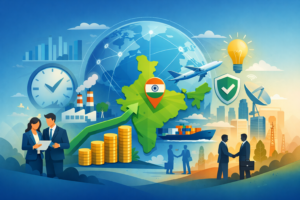
In today’s rapidly shifting global landscape, businesses are rethinking how and where they expand. Market volatility, operational disruptions, and evolving economic conditions have pushed companies to prioritize stability, compliance, and long-term sustainability over rapid but uncertain growth.
As organizations explore safer and more resilient markets, India has steadily emerged as a low-risk, high-potential destination for global hiring and business expansion. With a strong economic foundation, a skilled workforce, and improving regulatory transparency, India offers a balanced environment where businesses can grow with confidence.
This blog explores why India stands out as a strategic entry point and how companies can successfully establish their presence with minimal risk.
One of the primary reasons global companies are turning to India is its consistent economic resilience. Despite global slowdowns, India continues to maintain strong GDP growth, driven by domestic consumption, digital transformation, and infrastructure development.
Unlike many markets that are heavily dependent on external factors, India benefits from a diversified economic structure. Key sectors such as technology, manufacturing, pharmaceuticals, and services continue to perform steadily, offering businesses multiple avenues for expansion.
Additionally, government initiatives aimed at boosting investment, improving infrastructure, and supporting innovation have further strengthened India’s position as a reliable business destination.
India’s workforce is one of its strongest advantages. With a large pool of highly skilled professionals across industries, companies can scale operations efficiently without compromising on quality.
From IT and engineering to finance, healthcare, and customer support, India offers talent that is not only technically proficient but also adaptable to global work environments.
Another key factor is cost efficiency. Businesses can build high-performing teams in India at a significantly lower operational cost, making it an attractive option for both startups and established enterprises.
Moreover, India’s growing emphasis on digital skills and education ensures a continuous supply of talent ready to meet evolving business demands.
For many global companies, compliance is often seen as a challenge when entering new markets. However, India has made significant progress in simplifying and streamlining its regulatory framework.
The introduction of digital compliance systems, tax reforms, and standardized processes has improved transparency and reduced complexity. Businesses now have clearer guidelines for employment, payroll, taxation, and statutory requirements.
While compliance still requires careful planning, the availability of structured systems and professional support makes it manageable and predictable, reducing overall risk for investors.
India’s rapid digital transformation has played a crucial role in making it a business-friendly environment. With widespread internet penetration, digital payment systems, and cloud adoption, companies can operate efficiently from day one.
In addition, ongoing investments in infrastructure — including transportation, logistics, and smart cities — are enhancing connectivity and supporting business operations across regions.
This combination of digital readiness and physical infrastructure enables companies to set up, scale, and manage operations seamlessly, even in a distributed work environment.
India is increasingly becoming a central player in global business strategies. Many organizations are adopting diversification approaches to reduce dependency on a single market, and India naturally fits into this strategy.
Its geographical location, strong trade relationships, and growing influence in global supply chains make it an ideal base for regional and international operations.
Furthermore, India’s large domestic market provides an added advantage. Businesses not only gain access to talent but also tap into a vast and growing consumer base, creating opportunities for long-term growth.
One of the most important factors that make India a low-risk destination is the availability of flexible market entry options.
Companies no longer need to establish a full legal entity from the start. Alternative models allow businesses to hire employees, manage payroll, and ensure compliance without significant upfront investment.
This approach helps organizations:
Such flexibility is particularly valuable in uncertain times, where agility and cost control are critical.
India offers a unique balance between cost and quality. Businesses can significantly reduce expenses related to hiring, infrastructure, and operations while maintaining high standards of performance.
This cost advantage allows companies to:
At the same time, India’s competitive business environment ensures that quality, productivity, and professionalism remain strong.
India is not just a short-term solution — it is a future-ready investment destination. With a young population, increasing urbanization, and continuous policy improvements, the country is well-positioned for sustained growth.
Emerging sectors such as artificial intelligence, fintech, renewable energy, and e-commerce are further expanding opportunities for global businesses.
As companies look to build resilient and scalable operations, India offers an environment that supports both immediate needs and long-term ambitions.
In an era where global expansion decisions are driven by caution as much as opportunity, India stands out as a market that offers both stability and scalability.
Its strong economic foundation, skilled workforce, improving regulatory framework, and flexible entry options make it a low-risk gateway for global hiring and business expansion.
However, successful entry into India requires the right approach — one that ensures compliance, operational efficiency, and seamless workforce management from the beginning.
This is where experienced partners like Team Management Services (TMS) play a crucial role. By supporting businesses with hiring, payroll management, and compliance solutions, TMS helps organizations establish and scale their presence in India without unnecessary complexity.
With the right strategy and the right support, expanding into India can be not just a safe decision — but a transformative one for long-term business growth.
1003-04, 10th floor G-Square Business Park, Jawahar Road, Opposite Railway Station, above Kalyan Jewellers, Ghatkopar East, Mumbai – 400077
601 to 603 Aries Galleria, Vasana Road, Vadodara – 390015 Gujarat, India
Contact TMS:
+91-224-149-8942
+91-224-896-7640
For General Queries:
[email protected]
For Sales:
For Jobs:
[email protected]
Team Management Services. All Rights Reserved | Privacy Policy | Terms & Conditions
25+ years of expertise in Contract Staffing, EOR, Payroll & Compliance
Tell us about your staffing needs