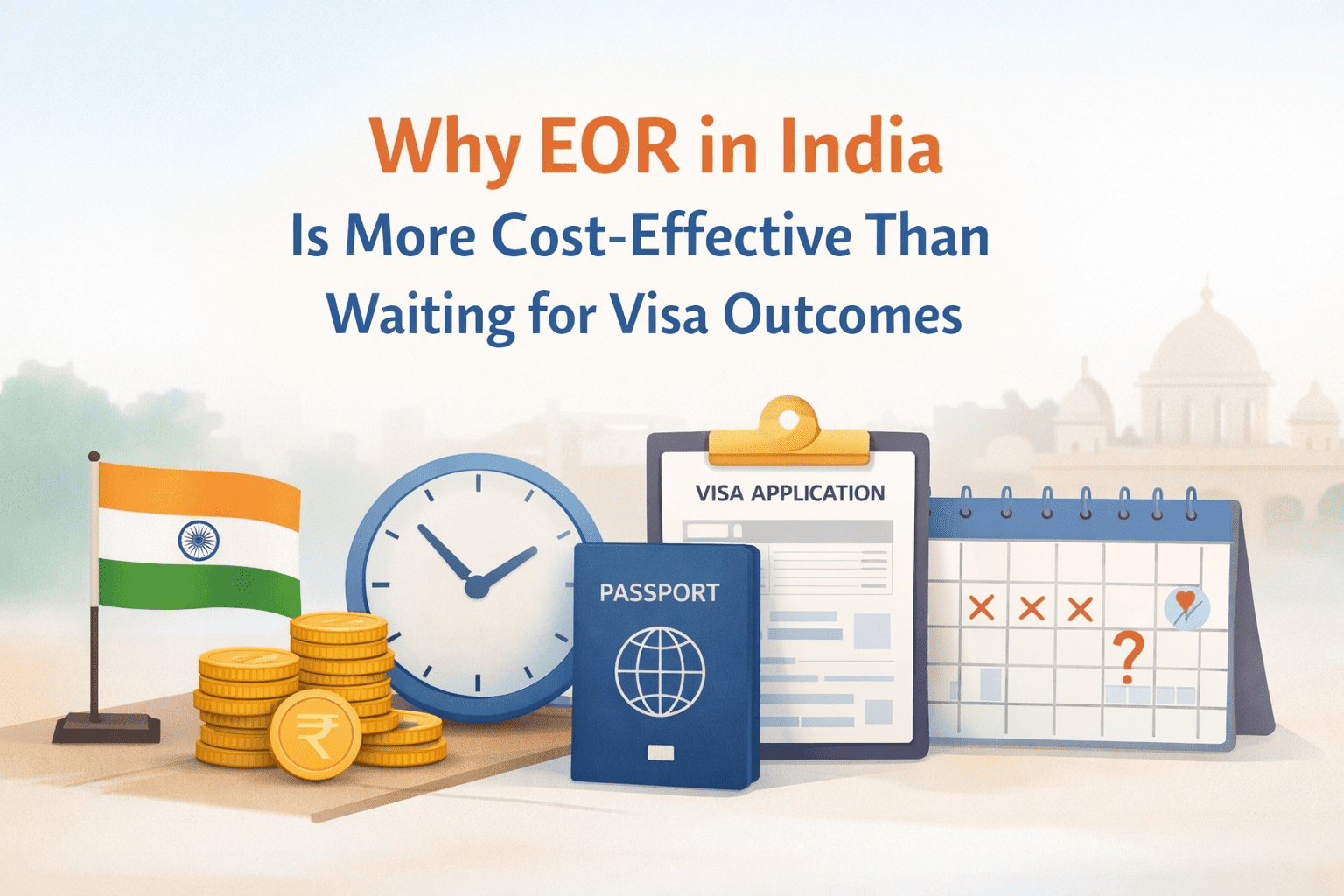
Visa delays have always been a challenge for U.S. employers, but with more global talent being sourced, especially from India, the impact of these delays is becoming more evident. As businesses rely on foreign talent to fill specialized roles, delays in visa approvals not only affect project timelines but also lead to unproductive bench time, employee dissatisfaction, and a decrease in workforce engagement. One key aspect that often goes unaddressed in visa delay scenarios is the impact on overall business operations. Beyond bench costs, issues like employee resignations, the challenges of remote work, especially in roles with data sensitivity, and the frustration employees face while waiting for visa outcomes can significantly disrupt a company’s growth.
The question is, how can U.S. employers avoid these cascading problems and maintain a steady workforce, even as visa approvals are delayed? The answer: EOR in India. In this blog, we’ll explore how EOR in India not only helps mitigate bench costs but also provides a comprehensive solution to issues like remote work constraints, employee engagement, and the risks of losing talent during the visa process.
Bench costs hurt immediately. Salaries continue without output. That alone strains budgets. But the real damage runs deeper.
As visa delays stretch on, employees may feel frustrated and disconnected from their role. The uncertainty of waiting for visa approvals can lead to feelings of exclusion, especially when they cannot contribute to projects. This is particularly problematic when employees are on long-term paid leave and feel like their professional growth is stagnating.
The longer employees remain in this state, the higher the risk that they’ll begin to seek other opportunities. Talented individuals might resign or accept offers from companies that provide more immediate employment and career progression.
While remote work is a common solution to keep employees engaged during visa delays, it’s not always feasible, especially in roles that involve data sensitivity. Companies in sectors such as finance, healthcare, and technology face strict data security regulations that may prevent employees from working remotely from locations outside the U.S. or specific regions.
In such cases, remote work becomes a logistical and compliance nightmare, as sensitive data cannot be easily accessed or managed securely. Waiting for a visa to enable employees to work in-person might seem like the only option, but it often leads to an extended period of unproductive downtime.
1. Shift Payroll to India Instead of Paying Bench Costs
EOR in India lets companies move payroll legally and efficiently. Employees remain employed under Indian labor laws.
They continue working while awaiting visa approval. No downtime. No bench loss.
Key advantages include:
Lower Costs: Indian salaries cost 50–70% less than U.S. equivalents.
Active Productivity: Employees contribute to projects or internal work.
Higher Retention: Engaged employees rarely resign out of frustration.
This approach turns dead time into productive time.
2. Compliance-Friendly Remote Work for Sensitive Roles
EOR in India supports compliance when remote work raises concerns.
A strong EOR partner helps companies:
Follow Indian labor laws correctly
Align work with data protection standards
Limit access to sensitive systems
Companies can also reassign employees to non-sensitive tasks. That keeps them productive without violating regulations.
Cost Comparison
Visa Delay with Paid Leave:
Annual Salary: $60,000
Three Months Paid Leave: $15,000
Zero output during that period
EOR in India:
Annual Cost: $18,000–$25,000
Continuous productivity
Full legal compliance
Instead of burning $15,000, companies pay less and get real work done.
That’s not a small improvement. That’s a structural advantage.
1. Rising Costs and Employee Disengagement
If U.S. companies don’t explore EOR in India, they continue to face rising bench costs while their employees remain disengaged. Employees stuck in visa limbo are more likely to seek opportunities elsewhere if their productive skills are not being utilized.
2. Delayed Business Growth
Waiting for employees to be able to work in the U.S. causes delays in business operations, reducing growth potential. By shifting payroll to India, businesses can continue to operate efficiently, meeting deadlines and supporting clients.
Waiting for visa approvals is costly, and the financial strain only increases over time. By shifting to EOR in India, U.S. employers can save on payroll expenses, keep employees engaged, and ensure continued productivity. With the added flexibility to manage global talent, EOR in India helps businesses grow without the delays and risks associated with waiting for visa outcomes.
At Team Management Services (TMS), we specialize in offering EOR in India solutions that allow U.S. employers to manage their workforce efficiently and cost-effectively during visa delays. With TMS EOR services, you can avoid bench costs, maintain employee engagement, and continue productive work even while waiting for visa approvals.
Our team takes care of all payroll, compliance, and legal considerations in India, enabling you to focus on what truly matters—growing your business.
Learn more about how we can help your company stay productive and compliant with India EOR payroll by visiting our blog on A Complete Guide to Hiring Employees in India Through EOR
Usually yes—visa delays, legal fees, and idle roles cost more than EOR fees.
Yes, if the EOR is compliant with Indian labor, tax, and payroll laws.
EOR hiring takes days; visas can take months or fail altogether.
Only when the role must be physically based in another country.

Content contributor at Team Management Services specializing in HR outsourcing, contract staffing, and employer of record (EOR) topics. Maitrayee writes extensively about workforce management, compliance, and recruitment strategies for businesses operating across India.
1003-04, 10th floor G-Square Business Park, Jawahar Road, Opposite Railway Station, above Kalyan Jewellers, Ghatkopar East, Mumbai – 400077
601 to 603 Aries Galleria, Vasana Road, Vadodara – 390015 Gujarat, India
Contact TMS:
+91-224-149-8942
+91-224-896-7640
For General Queries:
[email protected]
For Sales:
For Jobs:
[email protected]
Team Management Services. All Rights Reserved | Privacy Policy | Terms & Conditions