
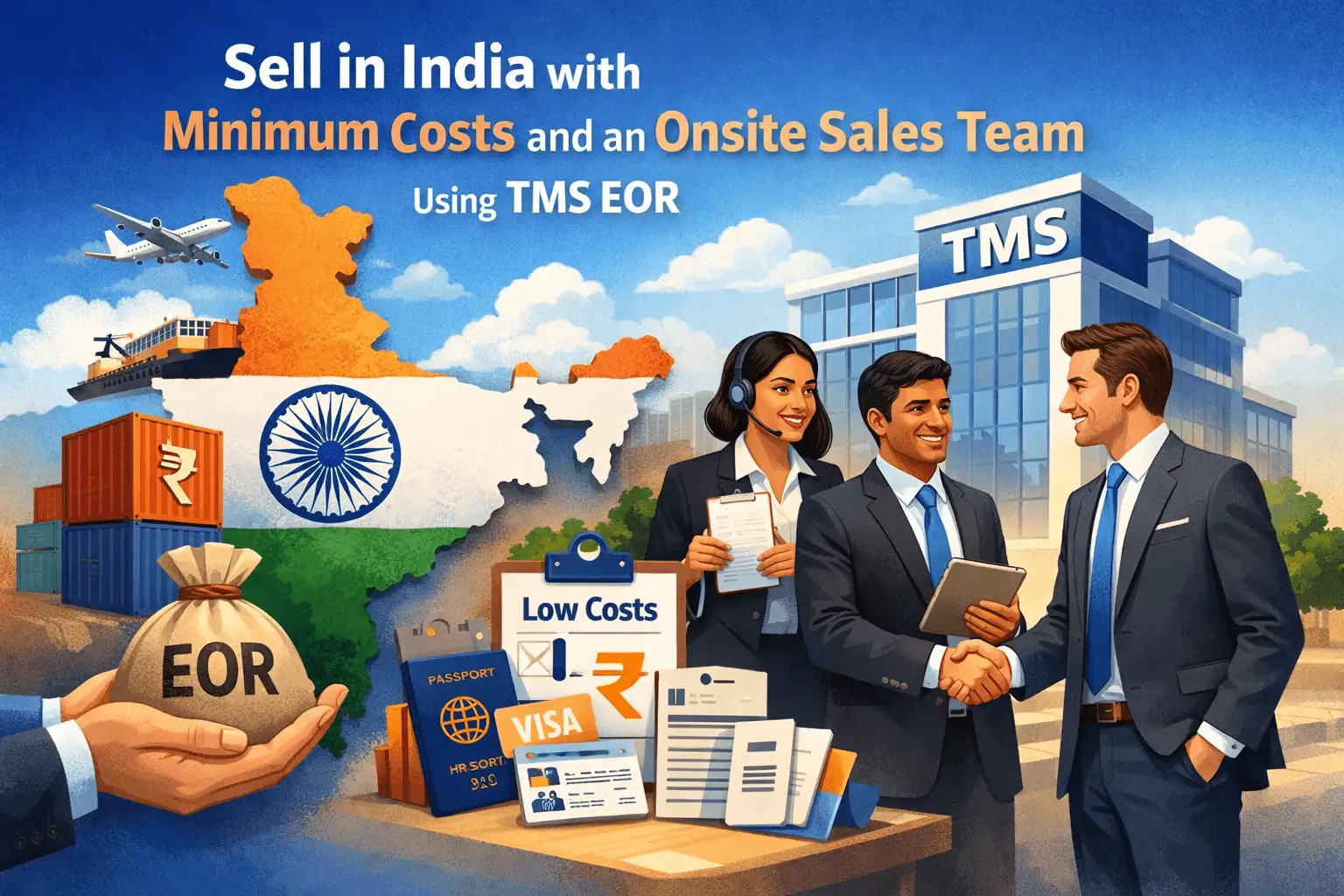
For many international companies, India is no longer a market of curiosity. It is a market of intent. Demand is visible, customers are receptive, and growth potential is clear. Yet despite this, companies often hesitate to take the first step, not because of lack of opportunity, but because the cost and complexity of entry feel disproportionate to the risk they are willing to take.
This hesitation usually stems from one assumption: that selling in India requires setting up a full local company before a single conversation with customers can begin. In reality, this assumption delays revenue, inflates costs, and limits flexibility at the very stage where agility matters most.
Today, more companies are choosing a different path, one that allows them to test demand, build local sales presence, and generate revenue before making structural commitments.
In early-stage market entry, revenue is more valuable than infrastructure. Before investing in offices, registrations, and long-term overheads, companies need answers to simpler but more critical questions. Is there demand for our product or service? How long is the sales cycle? What pricing works locally? Who are the real decision-makers?
These answers do not come from spreadsheets. They come from conversations on the ground.
That is why many global businesses now choose to sell in India without entity formation as their first step. This approach allows companies to validate the market while keeping costs tightly controlled.
Traditional entry models front-load costs. Legal fees, compliance setup, accounting structures, and administrative staffing are required long before revenue materializes. For sales-led expansion, this creates a mismatch between investment and return.
For leadership teams, the concern is not whether India will work in the long run, but whether it will work soon enough to justify early spend. When entry costs are high, even promising markets feel risky.
Lowering the cost of entry changes the equation entirely. It allows companies to focus spending where it matters most: customer acquisition.
India is a relationship-driven market. Buyers expect local presence, contextual understanding, and responsiveness that remote sales models struggle to deliver. While digital outreach plays a role, closing deals often requires people on the ground who understand local buying behavior and decision cycles.
An onsite sales team provides credibility, speed, and market intelligence that cannot be replicated from outside the country. The challenge has always been how to build such a team without committing to a full entity too early.
This is where modern employment models enable a more flexible approach.
It is entirely possible to hire and deploy a local sales team in India without establishing a legal entity, provided employment and compliance are handled correctly. Through an Employer of Record model, companies can legally employ sales professionals who operate locally while remaining fully aligned with the global organization.
This makes it possible to sell in India without entity registration, while still maintaining a strong, credible presence in the market. Sales teams can meet clients, attend industry events, and actively build pipelines, all without the company bearing the upfront burden of incorporation.
Team Management Services EOR enables companies to hire onsite sales professionals in India quickly and compliantly by operating through an established EOR in India framework. Employment contracts are structured under Indian labor laws, payroll and statutory obligations are managed locally, and employees work exclusively for the client company.
From a business perspective, this allows leadership teams to focus on sales strategy, customer engagement, and revenue generation, rather than administrative complexity. The sales team feels local to the market while remaining fully integrated into the company’s global operations. This structure supports rapid entry while preserving strategic optionality.
One of the biggest advantages of a sales-first entry model is flexibility. Companies are not locked into long-term commitments before understanding the market. Instead, they gain time and insight.
As sales activity progresses, patterns emerge. Deal sizes become clearer. Customer expectations reveal themselves. Leadership can then decide, based on evidence, whether deeper investment makes sense. For many companies, this staged approach proves more effective than traditional all-or-nothing entry strategies. It enables them to sell in India without entity setup initially, and move toward incorporation only when scale justifies it.
A common concern among international companies is whether such a model introduces compliance risk. In practice, the opposite is true.
Employment compliance in India is detailed, but well-defined. When managed through a local EOR partner, employment contracts, payroll processing, statutory contributions, and reporting obligations are handled accurately from the start. This removes uncertainty and allows companies to operate with confidence. For sales teams, this means stability and clarity. For leadership, it means governance is preserved even in early-stage expansion.
Sales-led expansion in a new market is inherently iterative, as messaging evolves, target segments are refined, and approaches are adjusted based on real customer response. Locking sales teams into rigid structures too early can restrict this learning process and increase financial risk before traction is proven. An EOR-led model allows companies to give onsite sales teams the freedom to iterate while keeping costs variable rather than fixed, which aligns well with the uncertainty that accompanies early-stage market entry.
As momentum builds and deals begin to close, the transition toward a deeper presence becomes far more straightforward because teams are already operational, customers are active, and internal processes have been tested. At that point, setting up a local entity becomes a deliberate scaling decision rather than a speculative investment, while the ability to sell in India without entity formation in the initial phase enables companies to move forward confidently without overcommitting.
Sales-led expansion in a new market is inherently iterative, as messaging evolves, target segments are refined, and approaches are adjusted based on real customer response. Locking sales teams into rigid structures too early can restrict this learning process and increase financial risk before traction is proven. An EOR-led model allows companies to give onsite sales teams the freedom to iterate while keeping costs variable rather than fixed, which aligns well with the uncertainty that accompanies early-stage market entry.
As momentum builds and deals begin to close, the transition toward a deeper presence becomes far more straightforward because teams are already operational, customers are active, and internal processes have been tested. At that point, setting up a local entity becomes a deliberate scaling decision rather than a speculative investment, while the ability to sell in India without entity formation in the initial phase enables companies to move forward confidently without overcommitting.
Yes, in many cases contracts can be structured through the parent company, depending on deal type and customer requirements. Legal structuring can be aligned accordingly.
It is particularly effective for B2B companies, but B2C businesses also use this model to test distribution partnerships and channel sales before deeper investment.
In most cases, hiring and onboarding can begin within weeks, allowing companies to start market engagement much faster than traditional entry routes.

Senior content writer at Team Management Services and the most prolific contributor to the TMS blog. K. Das covers HR topics including payroll management, statutory compliance, employee benefits, and workforce regulations across India.
1003-04, 10th floor G-Square Business Park, Jawahar Road, Opposite Railway Station, above Kalyan Jewellers, Ghatkopar East, Mumbai – 400077
601 to 603 Aries Galleria, Vasana Road, Vadodara – 390015 Gujarat, India
Contact TMS:
+91-224-149-8942
+91-224-896-7640
For General Queries:
[email protected]
For Sales:
For Jobs:
[email protected]
Team Management Services. All Rights Reserved | Privacy Policy | Terms & Conditions