
Your leadership team has decided: India needs to be more than just a sales market. You want access to deep talent, sharper costs and true 24×7 capability. Everyone talks about Global Capability Centres in India, but the big question remains: where do we start and what do we do first?
Without a clear plan, GCC initiatives can stall in endless internal debates, suffer from rushed decisions on location or structure, or run into compliance surprises. However, when you treat the centre as a long-term strategic asset and follow a structured roadmap, you reduce risk and significantly increase the probability of success.
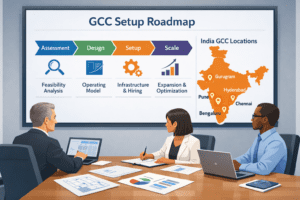
This Global Capability Centre setup guide walks through the journey from initial assessment to ongoing optimisation – focusing on what to do, in what order, and where companies commonly go wrong. Use it as a practical blueprint to frame your internal discussions and align leadership around a realistic, executable plan.
A Global Capability Centre is a captive unit owned and controlled by the parent company, typically set up in a location like India to run critical business, technology and support functions. Instead of buying services from a third-party vendor, you build your own team and infrastructure.
These centres often handle product development, shared services, analytics, operations, finance, HR, compliance and more. Because the GCC is part of your own organisation, it reflects your culture, ways of working and long-term strategy.
In contrast to traditional outsourcing or BPO, a GCC is not just about cost. It is about building enduring capability where you control priorities, talent, knowledge and intellectual property.
Initially, many overseas companies came to India for “back office” work: data entry, simple support, basic finance processes. Over time, the talent market, infrastructure and operating models matured. Consequently, GCCs progressed from transactional work to high-impact roles in product engineering, digital transformation and analytics-led decision-making.
Today, a well-designed Global Capability Centre setup in India can act as an innovation engine, not just a cost centre.
Many organisations underestimate the complexity of setting up a GCC. The decision is usually strategic, but the execution is deeply operational. Therefore, treating it like a simple “office opening” often leads to delays, rework and unnecessary cost.
A clear plan helps you align stakeholders, make better trade-offs and avoid getting stuck between ambition and reality.
Compliance and Regulatory Confidence
Firstly, you are creating a legal and operational footprint in a new jurisdiction. That means dealing with company incorporation, labour laws, tax registrations, data protection and local regulations.
If you improvise here, you risk non-compliance, delayed approvals or structures that are hard to unwind. A structured GCC setup playbook ensures that legal, tax and HR compliance decisions are made consciously and documented from day one.
Cost and Operational Efficiency
Your early choices – city, office model, hiring strategy, vendor ecosystem – have long-term cost implications. For example, focusing only on cheap rents while ignoring talent depth can slow hiring and push salaries up later.
In addition, decisions on org structure, process design and technology stack influence how lean or heavy your GCC will be over the next 3–5 years. Planning upfront helps you avoid expensive corrections.
Speed, Flexibility, and Scaling
You want to move fast, but you also want to scale sensibly. A structured approach balances both.
By sequencing decisions – first objectives, then design, then hiring and operations – you create a roadmap that allows for controlled speed. As a result, you can expand functions, add shifts or open satellite locations without repeatedly reworking the basics.
When you invest in good design, the payoff shows up for years.
If you want to see what “good” can look like, you can explore our Global Capability Centre services in India to understand how strategy, design and long-term HR operations come together.
The rest of this article focuses on execution: what to do, in what order, and what questions to ask at each stage. Think of it as a practical GCC setup playbook that you can map against your own context.
Firstly, align on why you are setting up a GCC at all. This may sound obvious, but different leaders often hold different pictures in their heads.
Start by clarifying:
Next, link these choices to your global business strategy. Are you trying to accelerate product development? Improve customer support? Build a new analytics capability? A sharp answer here drives every subsequent decision.
Meanwhile, assess internal readiness. Do you already have leaders who understand India or similar markets? Are your global processes mature enough to be replicated or adapted? Honest assessment at this stage prevents misaligned expectations later.
Once you know why and what, you can design how.
Decide on structural questions such as:
In addition, define your operating model and governance:
An initial org design should cover leadership roles, critical early hires and how teams will interface with existing global units. If you’re not ready for a full-fledged entity, you can also start lean with our Employer of Record services in India and later transition into a GCC model once the case is proven.
This is where plans move into action.
Firstly, address the legal and infrastructure layer:
Next, focus on people:
Meanwhile, start consciously building culture. Simple practices like regular leadership visits, joint town halls, cross-location project teams and clear communication go a long way in making the GCC feel like part of “one company”, not a distant satellite.
Once the centre is live, the real work of scaling and refining begins.
Firstly, track performance against the KPIs and SLAs defined earlier. Look at not just cost metrics, but also quality, speed, innovation and employee engagement.
In addition, standardise and improve processes. Identify repetitive tasks that can be automated, knowledge that should be documented and skills that can be cross-trained across teams. Over time, this helps your GCC evolve from a cost-saving unit to a strategic value centre.
Finally, keep your India Global Capability Centre strategy dynamic. You may add new functions, open additional locations or elevate the centre’s role in transformation initiatives. Periodic reviews with global leadership ensure that the GCC continues to align with changing business priorities.
Many GCCs run into trouble not because the model is wrong, but because the setup was rushed or incomplete. A few common pitfalls include:
To make this more concrete, here are a few simplified scenarios that reflect what we see in practice.
A high-growth SaaS company wants to accelerate product development and customer support. Initially, they considered only outsourcing. However, they realised they needed tighter integration, shared product context and long-term ownership of IP.
By following a structured setup approach – with clear scope, phased hiring and strong local leadership – they went live with their first engineering squads and a small support pod within months. Over time, the GCC expanded into DevOps and customer success, becoming a key driver of product velocity. A partner like TMS supported them with early hiring, HR operations and ongoing payroll and compliance.
This organisation already had scattered vendors handling finance and reporting. Data quality issues and inconsistent processes made group-level decision-making slow. They chose to consolidate finance operations and analytics into a single Global Capability Centre design and rollout.
Through structured assessment, they defined which processes to lift and shift, which to re-engineer and how to sequence migrations. As a result, the new centre delivered cleaner data, faster closes and better analytics insights, while also creating a pipeline of finance leaders familiar with group operations.
Operating in a heavily regulated industry, this company wanted a centre that could combine compliance, documentation and R&D support. They were rightly cautious about data security, regulatory expectations and reputation risk.
By front-loading compliance design, implementing robust security controls and hiring experienced local leadership, they built a centre that met global standards and passed audits with confidence. Over time, the GCC extended into clinical data analysis and digital health initiatives, with Team Management Services helping across HR, payroll and on-ground staffing needs.
Setting up a centre in India is no longer a question of “if” for many global organisations – it is a question of “how” and “when”. A clear Global Capability Centre setup guide and disciplined approach can dramatically reduce missteps, align stakeholders and accelerate value creation from your GCC.
Choosing between outsourcing, EOR and GCC is a strategic decision. However, once you decide that a GCC is the right path, execution quality becomes everything: the right scope, design, leadership, location and HR operations make the difference between a struggling unit and a high-performing global hub.
If you’re planning a GCC and want a structured, low-risk rollout, book a consultation with TMS and get a tailored roadmap for your India strategy – from early assessment and design through to hiring, HR, payroll and long-term optimisation.
India offers a deep talent pool, competitive costs and strong capabilities in technology, analytics, finance and operations. In addition, time-zone advantages and mature ecosystems in cities like Bengaluru, Hyderabad and Pune make India ideal for building scalable, high-impact capability centres.
The first step is to clarify why you need a GCC and what you want it to own in the first 12–24 months. Once you align leadership on scope, headcount, budget and success metrics, it becomes much easier to choose location, structure and the right execution partners.
Timelines vary, but a typical GCC can move from initial assessment to first teams going live in a few months. However, the overall duration depends on factors like legal setup, hiring complexity, technology integration and how quickly decisions are made across global stakeholders.
Most organisations start with a focused set of functions—such as engineering pods, finance operations, analytics or shared services—where processes are reasonably defined. Once the first wave stabilises and trust is built, you can gradually expand into more complex or strategic work.
Typical pitfalls include choosing a city only on cost, underestimating compliance requirements, delaying local leadership hiring, and copy-pasting HQ structures without adapting to India. As a result, hiring, retention and productivity can all suffer if design and governance are not planned upfront.
TMS helps across the lifecycle—clarifying strategy, advising on location and structure, supporting early setup, and providing on-ground HR, staffing, payroll and compliance support as you scale. Therefore, your team can focus on building high-value capabilities while TMS helps keep the India operations stable and compliant.
About the Author
HR content specialist at Team Management Services with expertise in contract staffing and workforce management.
1003-04, 10th floor G-Square Business Park, Jawahar Road, Opposite Railway Station, above Kalyan Jewellers, Ghatkopar East, Mumbai – 400077
601 to 603 Aries Galleria, Vasana Road, Vadodara – 390015 Gujarat, India
Contact TMS:
+91-224-149-8942
+91-224-896-7640
For General Queries:
[email protected]
For Sales:
For Jobs:
[email protected]
Team Management Services. All Rights Reserved | Privacy Policy | Terms & Conditions
20+ years of expertise in Contract Staffing, EOR, Payroll & Compliance
Tell us about your staffing needs