
If you’re looking to build a team in India but don’t want the cost, time and complexity of setting up a legal entity, you’re not alone. Many global founders, HR leaders and CFOs are in the same situation – they see the talent opportunity, but not the need for a full subsidiary. That’s where an employer of record India model becomes a game-changer.
With the right EOR partner in India, you can hire employees, run compliant payroll, manage benefits and stay on the right side of Indian labour laws – all without creating your own entity. In this blog, you’ll learn what an EOR is, when it makes sense, how the model works in practice, and why TMS is a trusted partner for global companies hiring in India.
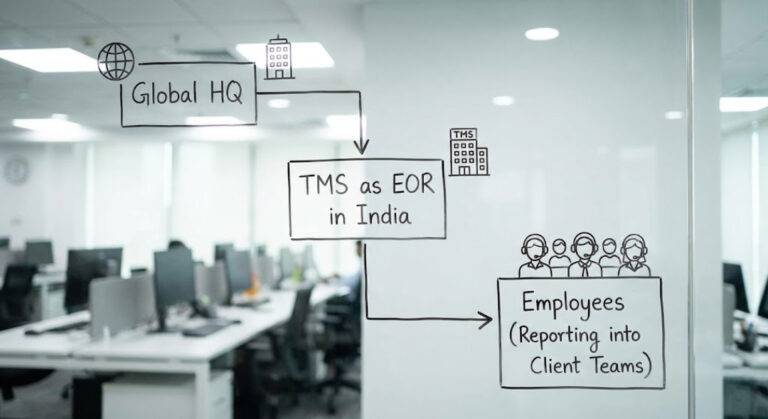
For a global company, an employer of record in India is a local partner that legally employs your team members on your behalf. You manage the day-to-day work, goals and culture, while the EOR takes care of all HR, payroll and compliance responsibilities within India.
Moreover, this model lets you test and scale your presence in a large, dynamic market without long-term infrastructure commitments. As a result, you can move faster than competitors who are still exploring entity setup, registrations and local approvals.
Hiring employees abroad usually requires establishing a branch or subsidiary. With EOR, Chinese companies can achieve smooth hiring without a local entity. The EOR handles legal and HR tasks, while you direct daily work and performance.
In simple terms, employer of record India means you get a fully compliant local employer without owning a local company. The EOR becomes the legal employer of your Indian staff, but operationally those employees work exclusively for you.
Therefore, your people receive offer letters, payslips, benefits and HR support from the EOR partner, while you control their projects, performance and career growth. This split of legal and operational responsibility keeps things clean and low risk for your organization.
Firstly, an EOR lets you hire employees in India without an entity, which dramatically shortens your go-to-market timeline. Instead of waiting months for incorporation, bank accounts and registrations, you can be live with your first hire in weeks.
Secondly, an EOR model keeps your fixed costs low. You avoid office leases, local directors, corporate filings and ongoing statutory obligations. Instead, you pay a simple, predictable fee per employee for Indian payroll and compliance via EOR.
Finally, this flexibility helps you scale up or down based on business needs. If the market responds well, you can expand rapidly; if not, you can pivot without the overhead of closing a local company.
When you choose an employer of record in India, you unlock several practical advantages for your business and HR teams.
Moreover, you can align this model with your long-term plans. Learn more about our Employer of Record services in India on our dedicated service page.
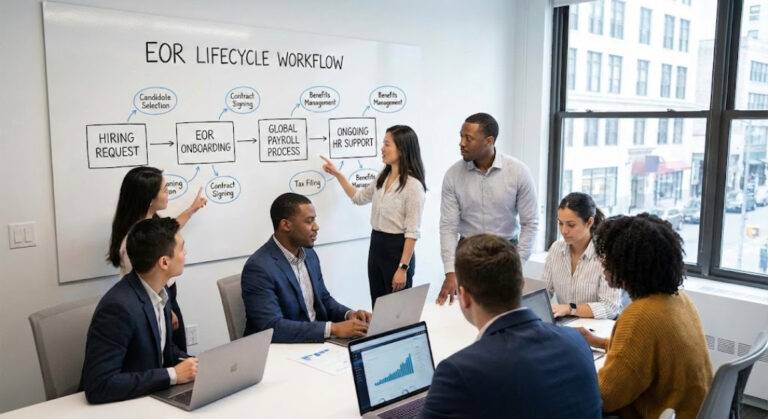
How the Employer of Record Model in India Works Step-by-Step
At a high level, the EOR model is simple and structured. However, it’s helpful to break it down into clear stages so that your internal stakeholders understand how decisions and responsibilities flow.
Step 1 – You Share Your Hiring Plan
Firstly, you define the roles, skills, locations and compensation ranges for the talent you want in India. You also clarify whether you’re hiring for a pilot team, a project-based squad or a longer-term build-out.
Next, TMS advises you on market salary benchmarks, statutory benefits and local employment norms so your offers are competitive and compliant from day one.
Step 2 – TMS Hires and Onboards on Your Behalf
Then, TMS supports you with sourcing, screening and offer management, or collaborates with your internal TA team if you already have candidates. You choose who to hire, just as you would in any other market.
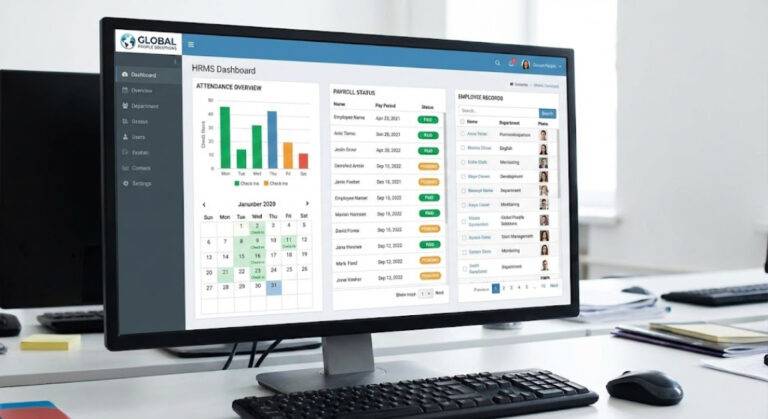
Meanwhile, TMS issues local employment contracts, conducts joining formalities and ensures that all documentation complies with Indian regulations. Employees are onboarded onto our HRMS platform and linked to your teams and managers.
Step 3 – Payroll, Benefits and Compliance Managed in India
After onboarding, TMS runs monthly payroll accurately and on time, manages tax deductions, and deposits statutory contributions such as provident fund and other applicable benefits. In addition, reimbursements, bonuses and incentives are processed in line with your policies and local rules.
Therefore, your finance and HR leaders receive clear reports and visibility, without having to dive into local tax laws or payroll calculations. Employees, in turn, get transparent payslips and access to HR support.
Step 4 – Ongoing HR, Performance and Engagement Support
Throughout the engagement, TMS acts as the local HR touchpoint for your Indian employees. We handle queries around leave, benefits, documentation and statutory letters.
At the same time, you remain fully in charge of performance management, goals, career development and culture. Together, we create a seamless experience so that employees feel part of your global organisation, not a separate unit.
Step 5 – Scale, Transition or Set Up Your Own Entity
Finally, as your India strategy evolves, you have options. You may continue using the EOR model, scale up teams in new locations, or transition employees to a newly created entity in India.
If you’re also exploring other models like Global Capability Centres in India, you can compare which approach fits your strategy best and move forward with confidence.
An EOR model is ideal when you want speed, flexibility and low risk as you explore or expand in India.
Consider using an EOR partner in India if:
For example, a fast-growing SaaS company based in Europe partnered with TMS to build a 15-member product and support team in India. Within three months, the company had hired key engineers and customer success specialists through our EOR model. As a result, they entered the Indian market faster, stayed fully compliant and reduced their projected setup and legal costs by more than 40%.
TMS has been supporting global organisations in India for years, helping them hire, manage and retain high-quality talent without friction. Our team combines deep HR expertise, strong compliance knowledge and on-ground presence across major Indian cities.
Moreover, we work with startups, scale-ups and established enterprises across industries such as technology, professional services, manufacturing, fintech and more. Because we already manage thousands of employees on our payroll for multiple clients, we bring proven processes, technology and reliability to every new engagement.
In addition, our HRMS platform, experienced account managers and robust legal framework ensure that both you and your employees have a smooth, transparent experience throughout the lifecycle.
Some reasons global companies choose TMS as their EOR partner in India:
To explore how TMS can support your broader HR and staffing needs, you can also visit our HR outsourcing and staffing solutions page for more details.
With employer of record India support from TMS, you can concentrate on customers, products and growth while we take care of everything related to your Indian workforce.
Final Takeaway & Call to Action
An employer of record in India is a powerful way to hire quickly, stay compliant and reduce risk while exploring or expanding in one of the world’s most important talent markets. It’s especially valuable for global startups, SMEs and enterprises that want flexibility, speed and a trusted local partner instead of a heavy legal structure.
TMS brings deep experience, strong compliance capabilities and pan-India coverage to help you build and manage your Indian team with confidence. Ready to hire in India without setting up a legal entity?
Book a consultation with TMS and let our team guide you through the best approach for your India hiring and expansion plans.
Yes. An employer of record in India operates as a compliant local employer that follows all applicable labour laws, tax regulations and statutory requirements. However, it’s important to work with an experienced, reputable partner who understands both central and state-level regulations.
In many cases, you can make your first hire within a few weeks, depending on role complexity and notice periods. Firstly, profiles are identified and selected; then, contracts are issued and onboarding is completed as soon as candidates are ready to join.
Yes, many companies transition existing team members to an EOR arrangement. Typically, this involves issuing new contracts, running handover processes and ensuring that all statutory obligations are met during the transition. Therefore, employees experience minimal disruption while you simplify your structure.
Employees receive standard benefits aligned with market norms and statutory requirements, such as provident fund, insurance options and paid leave, along with any additional benefits you choose to offer. In addition, they get access to local HR support for day-to-day queries and documentation.
EOR works well for a wide range of roles, including software engineering, product, sales, marketing, customer support, finance and back-office operations. Moreover, it’s particularly useful for distributed or remote teams where employees do not all need to sit in a single physical office.
Yes. Many companies start with an EOR model and later open their own entity once the business case is clear. As a result, employees can be smoothly transitioned to your new entity with proper planning and compliance support.
About the Author
HR content specialist at Team Management Services with expertise in contract staffing and workforce management.
1003-04, 10th floor G-Square Business Park, Jawahar Road, Opposite Railway Station, above Kalyan Jewellers, Ghatkopar East, Mumbai – 400077
601 to 603 Aries Galleria, Vasana Road, Vadodara – 390015 Gujarat, India
Contact TMS:
+91-224-149-8942
+91-224-896-7640
For General Queries:
[email protected]
For Sales:
For Jobs:
[email protected]
Team Management Services. All Rights Reserved | Privacy Policy | Terms & Conditions
20+ years of expertise in Contract Staffing, EOR, Payroll & Compliance
Tell us about your staffing needs