

years Experience

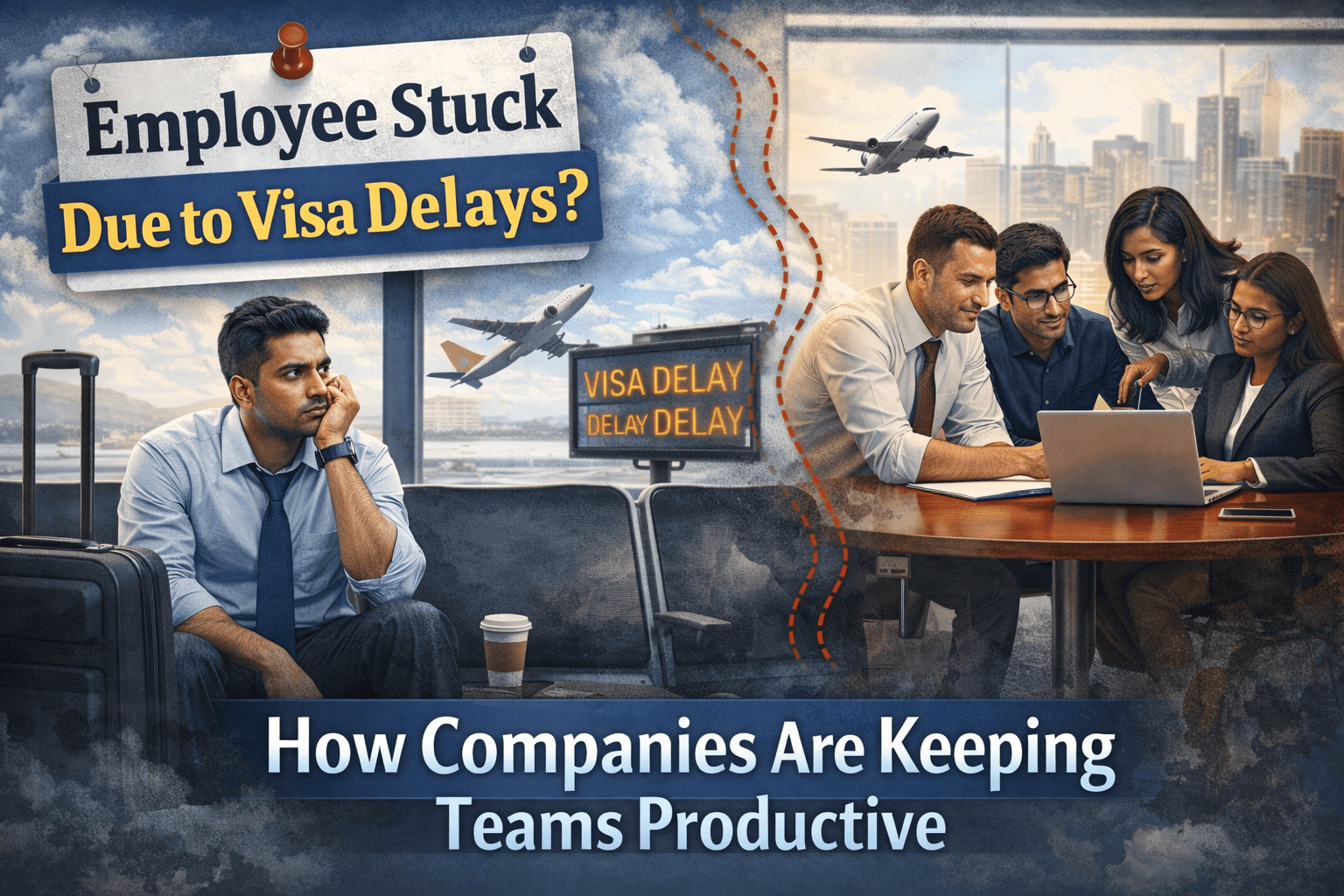
Employee Stuck Due to Visa Delays? How Companies Are Keeping Teams Productive

H1B Visa Delays Employee Management

Introduction:

Visa delays have quietly become one of the most disruptive challenges for global employers. While most conversations focus on immigration paperwork, the real disruption happens inside organizations—paused projects, rising bench costs, and growing uncertainty within teams.

For U.S. companies employing international talent on H-1B or H-4 visas, work authorization delays are no longer rare events. Instead, they have become recurring operational risks. As a result, employers are now asking a more practical question:


How do we keep teams productive when visa timelines stop moving?

Visa Delays Are No Longer a Temporary Problem

Earlier, visa delays were treated as short-term obstacles. Employees were placed on temporary leave, projects were redistributed, and leadership waited for approvals to arrive. However, over time, this approach has become unsustainable.


Processing delays now stretch across quarters. Consular backlogs, policy shifts, and administrative reviews have made outcomes unpredictable. Because of this, waiting is no longer a strategy—it is a cost.


Meanwhile, many employees are required to return to India due to visa expiration or travel constraints. When that happens, employers are forced to make fast decisions, often without clear guidance.

Why Remote Work Alone Is Not a Safe Solution

At first glance, allowing employees to continue working remotely from India while staying on U.S. payroll may seem convenient. After all, the employee is available, and the work continues. Yet, this approach introduces several hidden risks.


When employees work from India while remaining employed under U.S. payroll, companies may unintentionally trigger local employment laws, tax exposure, and compliance obligations. In addition, permanent establishment risks can arise, especially when roles are client-facing or revenue-linked.


Over time, what looks like a flexible workaround can turn into a compliance issue that is far more expensive to fix.

The Real Cost of Inaction During Visa Delays

Paid leave during visa delays continues payroll expenses without output. Projects slow down. Teams lose momentum. More importantly, critical knowledge remains idle.


Eventually, some companies choose to replace affected employees altogether. However, recruitment, onboarding, and ramp-up costs often exceed the cost of retention. In reality, losing trained talent is one of the most expensive outcomes of prolonged visa uncertainty.

This is why H1B visa delays employee management has become a board-level conversation for many global employers.

How Employers Are Rethinking Workforce Continuity

Rather than tying workforce planning entirely to visa timelines, forward-looking companies are separating employment structure from work delivery. This shift allows businesses to retain talent, maintain productivity, and remain compliant—even when physical relocation is not possible. One model that has gained traction is transitioning affected employees to India-based payroll through an Employer of Record (EOR).

Employer of Record Explained—Without the Legal Jargon

An Employer of Record (EOR) becomes the legal employer of the employee in a specific country. The employee continues working operationally for the U.S. company, while payroll, statutory compliance, and local labor obligations are handled by the EOR partner.

For employers, this means:

  • No need to set up an Indian entity
  • No exposure to Indian payroll or labor compliance risks
  • Full continuity of work and reporting structure

As a result, EOR has become a structured solution for H1B visa delays employee management, especially when delays extend beyond short timelines.

Keeping Teams Productive After Visa-Related Returns

When employees return to India due to visa constraints, transferring them to India payroll under an EOR allows work to continue without interruption.

Instead of pausing projects, companies can:

  • Keep employees actively engaged
  • Avoid bench costs and paid leave
  • Maintain delivery timelines

Because employment remains compliant, leadership teams gain peace of mind while teams stay focused on output—not uncertainty.

Cost Control Without Compromising Talent

Cost efficiency plays a major role in employer decision-making. Maintaining U.S. payroll during visa delays often results in high costs with limited productivity. On the other hand, India payroll under an EOR structure aligns employment cost with actual work output.

While cost savings should never be the only driver, they often become a deciding factor for finance leaders evaluating prolonged visa delays.

Retaining Talent Without Visa Dependency

Visa uncertainty places immense pressure on employees. Many fear that returning to India will automatically mean job loss.

Employers who offer structured alternatives send a different message—one of stability and long-term commitment.

By providing a compliant employment path during visa delays, companies preserve trust, retain institutional knowledge, and strengthen employee loyalty. When visas are eventually approved, mobility options remain open.

This approach reflects mature H1B visa delays employee management, rather than reactive decision-making.

Why This Model Is Becoming Standard Practice

Global hiring is no longer limited by geography. Companies now design workforce strategies around flexibility, compliance, and continuity.

Visa delays have simply accelerated this shift.

EOR is increasingly viewed not as a temporary fix, but as part of broader global workforce planning—especially for companies working across borders.

When Should Employers Consider an EOR Transition?

EOR becomes particularly effective when:

  • Visa delays exceed predictable timelines
  • Employees are required to return to India
  • No local entity exists in India
  • Projects cannot afford disruption

In such situations, structured employment models provide clarity where uncertainty dominates.

A Practical Path Forward

Visa systems may remain unpredictable. However, workforce continuity does not have to be. Employers who adopt flexible, compliant employment models protect productivity, control costs, and retain talent—even during prolonged immigration challenges.

Instead of putting growth on hold, companies that adapt their employment strategy stay competitive.

Final Thoughts

Visa delays test more than patience—they test leadership decisions. Employers who respond with structure, rather than uncertainty, are better positioned for long-term success. Solutions like Team Management Services (TMS) as an EOR for workforce stability allow businesses to remain compliant while keeping operations moving.


By leveraging TMS, companies can manage employee relocation due to visa issues, maintain productivity, and ensure workforce continuity during visa delays—all without legal risk or operational disruption.

FAQs

No. Payroll restructuring through EOR does not impact an employee’s future visa eligibility, as immigration and employment compliance remain separate processes.

Yes. Employees can continue working on the same projects, provided data security, contracts, and compliance frameworks are properly managed.

Not necessarily. Some companies use EOR proactively when visa timelines become uncertain, rather than waiting for delays to escalate.

In most cases, transitions can be completed within a few weeks, depending on documentation and role complexity.

HEAD OFFICE


1003-04, 10th floor G-Square Business Park, Jawahar Road, Opposite Railway Station, above Kalyan Jewellers, Ghatkopar East, Mumbai – 400077

BRANCH OFFICE

601 to 603 Aries Galleria, Vasana Road, Vadodara – 390015 Gujarat, India

Team Management Services. All Rights Reserved | Privacy Policy | Terms & Conditions