Employer of Record (EOR) services have changed significantly over the last few years. What once served as a temporary workaround for international hiring has evolved into a strategic operating model for global workforce management.
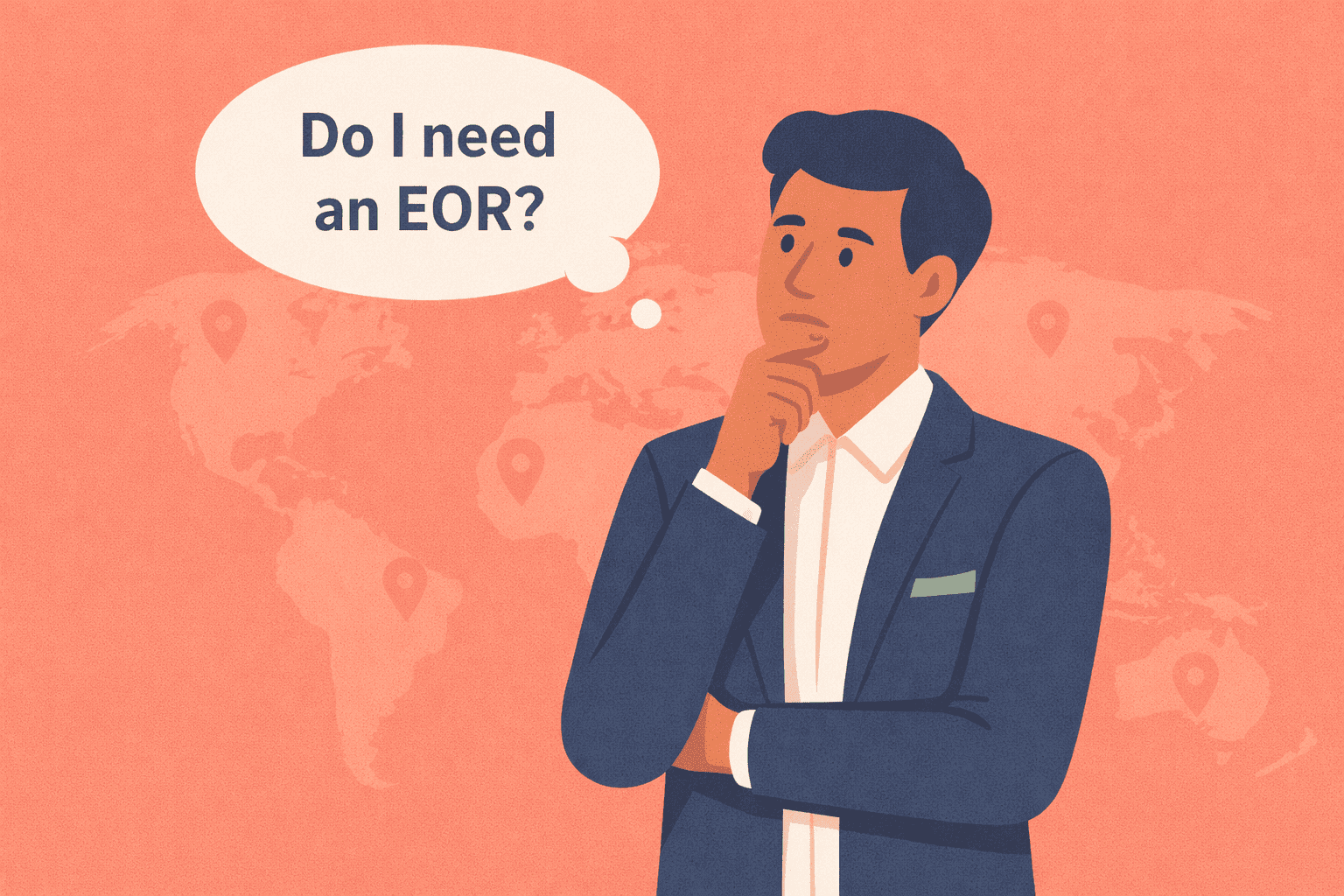
Today, companies use EORs to manage compliance risk, control payroll complexity, respond faster to market opportunities, and maintain operational flexibility across borders. The question most global employers now face is not what an EOR is, but when it actually makes sense.
This blog explores how the EOR model is evolving in the market and offers a practical way to assess whether your business truly needs one.
Earlier, EORs were often positioned as a way to hire quickly in countries where setting up an entity felt slow or expensive. That narrative no longer captures the full picture.
Modern EOR usage is driven by risk management and governance, not speed alone. Companies now rely on EORs to manage employment risk in environments where regulations change frequently, enforcement varies, and penalties are costly.
In many regions, compliance uncertainty—not hiring difficulty—is the primary reason employers adopt EOR models.
This shift has redefined staffing priorities. GCCs are no longer hiring just to fill roles; they are building capability-led teams that can operate independently while aligning with global standards.
As a result, workforce planning has become a strategic exercise rather than a transactional one.
Several market shifts have accelerated EOR adoption worldwide.
Businesses are expanding faster than regulatory clarity allows. Labour laws are becoming more detailed, enforcement is tightening, and cross-border payroll compliance has grown more complex. At the same time, leadership teams want flexibility without creating permanent overhead.
EORs sit at the intersection of these needs. They provide a compliant employment structure while allowing companies to operate without committing to long-term legal infrastructure prematurely.
Instead of asking whether you can use an EOR, ask whether your business environment benefits from one.
Are regulatory requirements changing faster than your internal processes?
If labour laws, tax rules, or social security requirements are evolving and your team struggles to stay current, an EOR helps absorb that volatility.
Are employment risks outweighing operational benefits in new markets?
When penalties, audits, or misclassification risks feel disproportionate to headcount size, EORs provide a controlled entry point.
Is payroll becoming harder to manage across countries or states?
Multi-country payroll often creates fragmentation. Different cycles, filings, and benefit structures increase error risk. EORs centralise execution while keeping local compliance intact.
Are you scaling cautiously rather than committing fully?
Many companies enter markets incrementally. An EOR supports this approach by keeping employment flexible while business strategy matures.
If these challenges resonate, the EOR model likely fits your current stage.
The EOR market itself has matured.
Clients now expect more than contract issuance and salary processing. Modern EOR providers are expected to offer transparent payroll reporting, proactive compliance updates, strong employee experience, and seamless coordination with internal HR teams.
Another shift is longer engagement cycles. EORs are no longer short-term placeholders. Many organisations use them for years as part of a stable operating model, especially in regulated or fast-changing regions.
One of the biggest changes in how EORs are used lies in workforce design.
Instead of building employment structures first and adjusting later, companies now design their workforce around compliance realities from the beginning. EORs enable this by embedding compliance into everyday operations rather than treating it as an afterthought.
This approach reduces downstream restructuring and improves long-term stability.
EORs are powerful, but not universal.
If your organisation has an established entity, deep local HR expertise, and long-term scale certainty in a country, direct employment may offer more control.
The value of an EOR depends on uncertainty levels, not company size.
The most effective global employers treat EORs as a strategic option, not a temporary fix.
They use EORs to:
Enter new markets safely
Manage compliance exposure
Maintain workforce agility
Avoid premature structural commitments
This mindset shift reflects how global workforce management itself is evolving.
As the Employer of Record model continues to evolve, businesses need partners who understand more than basic employment mechanics.
Team Management Services (TMS) provides Employer of Record solutions designed around compliance accuracy, payroll governance, and operational flexibility. Beyond hiring, TMS supports organisations with structured employment management, statutory compliance, payroll administration, and workforce continuity across regions.
Whether you are managing regulatory uncertainty, expanding cautiously into new markets, or restructuring global workforce models, TMS helps businesses operate with confidence—without building unnecessary legal complexity.
In today’s global environment, the right EOR doesn’t just support employment—it strengthens how your business operates across borders.
An EOR helps companies manage payroll, compliance, taxes, and employment risk in countries where they don’t have a legal entity.
Yes, when used correctly. Many companies rely on EORs for extended periods to stay compliant while maintaining operational flexibility.
Compliance capability, payroll accuracy, local law expertise, transparency, and experience with cross-border employment.
No. Businesses retain full control over performance, tasks, and outcomes. The EOR manages legal employment responsibilities.

Content writer at Team Management Services covering payroll outsourcing, HR compliance, and statutory requirements for Indian businesses.
1003-04, 10th floor G-Square Business Park, Jawahar Road, Opposite Railway Station, above Kalyan Jewellers, Ghatkopar East, Mumbai – 400077
601 to 603 Aries Galleria, Vasana Road, Vadodara – 390015 Gujarat, India
Contact TMS:
+91-224-149-8942
+91-224-896-7640
For General Queries:
[email protected]
For Sales:
For Jobs:
[email protected]
Team Management Services. All Rights Reserved | Privacy Policy | Terms & Conditions