
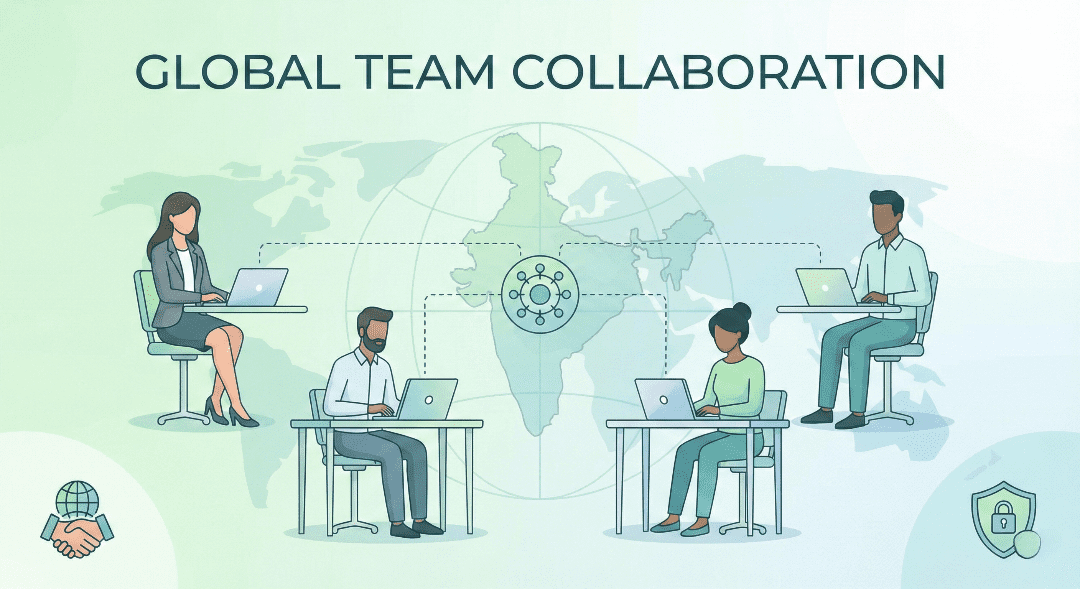
India has become one of the most strategic destinations for global companies expanding their distributed teams. With strong English proficiency, diverse skill sets, and a rapidly growing remote work culture, India offers businesses a unique blend of quality and cost efficiency. Every year, more companies choose India for roles across technology, finance, content, customer support, HR, operations, and analytics — and the momentum is only rising. Yet, the real challenge for foreign companies is not hiring Indian talent — it’s hiring legally, quickly, and confidently.
Setting up a local company, managing payroll, navigating compliance, and understanding labour laws can slow down expansion. This is exactly why an Employer of Record (EOR) model has become the smartest, fastest, and safest entry route. It helps you build a remote team in India without setting up a legal entity and without dealing with complex regulations.
In this detailed guide, we will break down how an EOR functions, why global companies are shifting to this model, and how it gives you a friction-free path to build teams in India at scale.
An Employer of Record acts as the legal employer for your Indian workforce while you retain full control over daily operations, performance, and work management. This division of responsibility ensures compliance without compromising productivity.
An EOR handles the following:
Drafting compliant employment contracts
Monthly payroll processing
Tax deductions (TDS) and filings
Provident Fund, ESIC, and Professional Tax
Statutory documentation
Employee onboarding and offboarding
Local labour law compliance
Record-keeping and audit support
You manage the work. The EOR manages the legal, HR, and compliance side. This model makes building a remote team in India extremely smooth, especially for companies expanding for the first time.
1. No Need for Entity Setup — Start Hiring in Days
Opening a legal entity in India can take several months due to paperwork, approvals, bank verifications, and compliance registrations. For fast-moving companies, this delay affects revenue, timelines, and market entry.
An EOR removes this barrier entirely.
You hire first. Paperwork happens instantly. Work starts immediately.
Within 7–15 days, you can have a fully functional remote team in India ready to contribute.
2. Eliminates Legal Confusion for Foreign Companies
Indian labour laws are detailed and vary across states. From maternity benefits to leave rules to notice periods — each detail matters.
An EOR ensures:
Correct worker classification
Accurate statutory deductions
Compliance with state-wise rules
Zero risk of penalties
Legally compliant employment contracts
This protection is one of the biggest reasons companies choose EOR over direct hiring.
3. Streamline Payroll, Benefits, and Documentation
Managing payroll for Indian employees requires precision.
It involves:
TDS calculation
PF and ESIC contributions
Reimbursements
Payslip generation
Monthly filings
Final settlements
One small error can lead to compliance issues.
An EOR provides an automated, error-free, and fully compliant payroll process that ensures employees are paid accurately and on time.
4. Locally Compliant and Legally Sound Employment Contracts
India has specific requirements for formal employment.
An EOR drafts contracts that match:
Local labour laws
Employer obligations
Statutory benefits
IP protection
Non-disclosure requirements
Termination guidelines
This ensures that your remote team operates under the proper legal framework right from day one.
5. Predictable and Transparent Hiring Costs
With an EOR, you pay:
A fixed monthly fee
The employee’s salary
No hidden costs
No legal surprises
No setup costs
This gives complete financial predictability, which is essential for budgeting and long-term hiring plans.
1. Protects Your Business from Compliance Mistakes
Hiring employees directly without an Indian entity can expose your company to legal complications.
An EOR becomes the official employer, absorbing compliance responsibilities and protecting you from risk.
2. Ensures Proper Worker Classification
Wrongly classifying contractors or employees can lead to penalties.
EOR ensures everyone is classified correctly based on Indian labour guidelines — not guesswork.
3. Strong Data Protection and IP Security Measures
Most reputable EORs maintain:
Robust IP protection clauses
GDPR-aligned security systems
Secure data transfer channels
Employee confidentiality agreements
This adds another layer of operational safety.
Step 1: You Choose the Candidate
You identify and interview the talent you want to hire.
Step 2: EOR Issues a Legally Compliant Employment Contract
They prepare the documentation based on Indian regulations.
Step 3: Employee Onboarding Begins
EOR collects KYC documents, manages joining formalities, and activates payroll.
Step 4: Monthly HR, Compliance, and Payroll Run Through the EOR
You focus on work; EOR manages legal responsibilities.
Step 5: You Manage Performance and Daily Workflows
The employee reports to your team, follows your processes, and meets your goals.
Step 6: EOR Handles Exit Process When Needed
Notice period, full-and-final settlement, and compliance are completely managed.
This model removes all operational and legal friction.
When you want to test India’s market without forming a company
When you’re entering India quickly and cannot wait months
When your hiring needs increase suddenly
When you want to minimise legal exposure
When hiring specialised or niche roles
When you need a cost-efficient expansion model
When exploring multiple cities simultaneously
EOR is especially useful for companies hiring their first remote team in India.
To maximise the success of your Indian team:
Create a clear onboarding plan
Document internal workflows
Clarify responsibilities between your HR and the EOR
Build communication guidelines
Set up regular performance review cycles
Maintain cultural alignment through virtual engagement
Schedule monthly compliance reviews with your EOR
These practices help you maintain a strong global workforce structure.
Before signing with any EOR, evaluate them on:
Transparent and predictable pricing
Strong India-specific compliance experience
A clean and accurate payroll system
Clear SLAs and support timelines
GDPR-aligned data security frameworks
A reliable HR support team
Strong reputation, reviews, and case studies
Fast onboarding capability
Quality customer support
Choosing the right EOR is equally important as choosing the right employee.
Here is the simplest view of your three-step process:
Identify the roles you want to hire.
Share candidate details with your EOR.
Start operations with your remote team in India within days.
It’s direct, fast, legally safe, and ideal for scaling.
Building a remote team in India doesn’t have to be complicated. Direct hiring often requires setting up a local entity, understanding legal rules, managing payroll, and staying compliant — all of which can slow you down.
An Employer of Record (EOR) removes these challenges instantly. It lets you hire talent without creating an entity, handling paperwork, or worrying about statutory compliance. This gives you the speed to scale, the protection to stay compliant, and the confidence to grow your global workforce without delays.
With the right EOR partner — such as Team Management Services (TMS), which offers fully compliant and quick onboarding in India — you not only hire faster but also reduce risk, ensure smooth operations, and tap into India’s rich talent market with ease. TMS simplifies your expansion so you can focus on running your business while your remote team is managed professionally and securely.
No. With an Employer of Record (EOR), you can legally hire employees in India without creating your own company. The EOR becomes the official employer on paper while you manage daily work. This saves months of legal setup and protects you from compliance issues that come with direct hiring.
Most companies complete their hiring and onboarding within 7–20 days. The EOR already has the legal framework, payroll systems, and compliance structure in place, so there’s no waiting for entity setup or government approvals. Your team can begin work almost immediately.
Yes. Even though the EOR handles payroll, compliance, and HR documentation, your employees work under your supervision daily. You assign tasks, set goals, manage performance, and integrate them into your workflows — the EOR simply handles the backend responsibilities.
Absolutely. One of the biggest benefits of an EOR is its nationwide compliance capability. Whether you want to hire in Bangalore, Mumbai, Delhi, Pune, or emerging cities like Indore or Kochi, an EOR enables expansion without separate registrations or state-specific filings. Scaling becomes fast, compliant, and fully centralised.
About the Author
Abhijit Divekar is the Managing Partner of Team Management Services (TMS), with 19+ years of experience in HR outsourcing, contract staffing, and statutory compliance across India. He has helped 450+ companies build compliant, scalable workforces.
1003-04, 10th floor G-Square Business Park, Jawahar Road, Opposite Railway Station, above Kalyan Jewellers, Ghatkopar East, Mumbai – 400077
601 to 603 Aries Galleria, Vasana Road, Vadodara – 390015 Gujarat, India
Contact TMS:
+91-224-149-8942
+91-224-896-7640
For General Queries:
[email protected]
For Sales:
For Jobs:
[email protected]
Team Management Services. All Rights Reserved | Privacy Policy | Terms & Conditions
20+ years of expertise in Contract Staffing, EOR, Payroll & Compliance
Tell us about your staffing needs